

How to Fix Uneven Liposuction: When to Wait, What Works
An uneven result after liposuction is upsetting, and it is often too early to judge. Here is how to tell swelling from a lasting irregularity, what causes dents and bulges, and how revision liposuction, fat grafting and other fixes work.
Last updated:
How do you fix uneven liposuction?
First, wait: Cleveland Clinic says swelling can take 3 to 6 months to clear, and a review in the Indian Journal of Plastic Surgery advises waiting at least 6 months before planning a revision. Dents and bulges that last are usually corrected with touch-up liposuction, fat grafting or, for loose skin, surgery that removes it.
How do you fix uneven liposuction?
Wait before you judge it, then have it assessed. Much of what looks uneven in the first months is swelling that settles unevenly, and a review by Dixit and Wagh in the Indian Journal of Plastic Surgery recommends waiting at least 6 months before planning a revision. Dents and bulges that last are usually corrected with a touch-up liposuction, fat grafting to fill hollows, releasing scar bands, or surgery that removes loose skin, depending on what caused them.
How common are uneven liposuction results?
Uneven results are the most common problem after liposuction, but they are still uncommon. A 2024 review of 39 studies and 29,368 patients found that an uneven contour was the most common complication of liposuction, in 2.35% of patients (Comerci and colleagues, Aesthetic Surgery Journal, 2024). The American Society of Plastic Surgeons lists "irregular contours or asymmetries" and the "need for revision surgery" among the risks you consent to.
If you're still deciding on liposuction, our overview of liposuction safety and complication rates puts these numbers in context.
Is it uneven, or is it still swelling?
In the first months, it's usually too early to tell. Swelling doesn't go down evenly: one side, or one spot, can stay puffier for weeks, and firm healing tissue can feel lumpy while it softens.
| Time since surgery | What you may notice | What it usually means |
|---|---|---|
| First 2–3 weeks | Puffiness, tightness, one side bigger | Swelling, which mostly goes down in this window (The Aesthetic Society) |
| Up to 4 months | A little puffiness, often after activity | Slight residual swelling (The Aesthetic Society) |
| Around 3 months | Firm or lumpy areas softening | Tissue returning to a normal, soft feel (Dixit and Wagh) |
| 3–6 months | Your shape settling | Swelling gone and the final result showing (Cleveland Clinic) |
| 6 months or more | Dents or bulges that haven't changed | Worth assessing for revision (Dixit and Wagh) |
The figures come from The Aesthetic Society, Dixit and Wagh's review, and Cleveland Clinic. A study by Danilla and colleagues, cited in a 2024 case series in Plastic and Reconstructive Surgery Global Open, found that most irregularities after high-definition liposuction improved partly or fully on their own within 3 months, which is one reason surgeons wait.
If you're a few weeks out, our week-by-week guide to swelling after liposuction covers what's normal now.
What causes uneven liposuction results?
Often more than one thing. Dixit and Wagh list four causes of surface irregularities: liposuction that was too superficial or removed too much, fibrosis with scar bands, a compression garment that didn't fit or was worn with poor posture, and loose skin. A 2021 review in Seminars in Plastic Surgery adds too much or too little fat removed, lines left by the cannula, and puckered scars at the incision site.
Changes after surgery count too. The Aesthetic Society says weight gain, aging and pregnancy following liposuction may negatively affect your results. Liposuction permanently removes fat cells, Cleveland Clinic says, and ASPS says results last as long as you keep a stable weight and general fitness. The fat cells that remain can still grow if you gain weight.
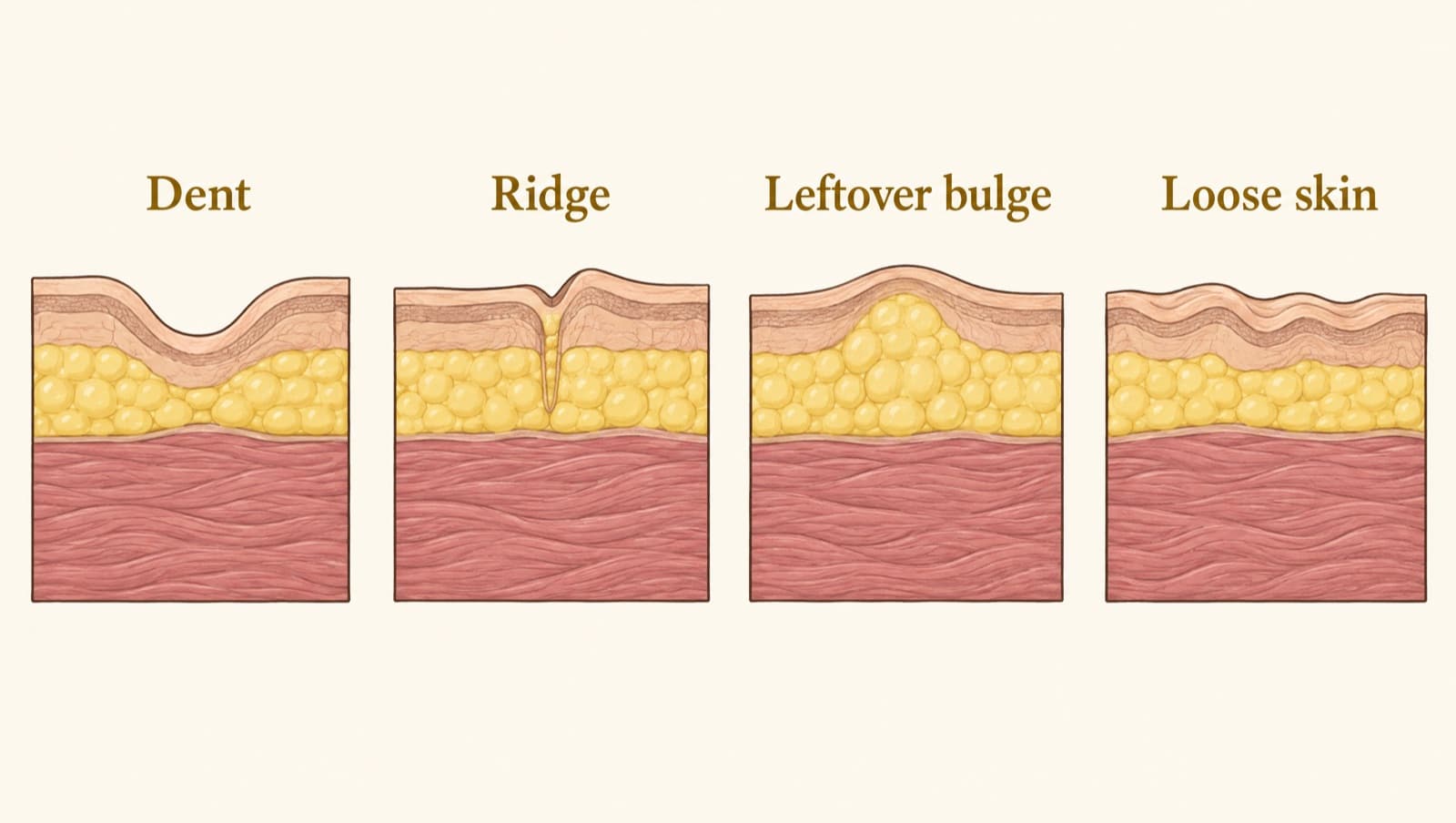
Types of irregularities after liposuction
Naming the problem helps, because each type has a different fix. A surgeon can tell them apart by examining you standing, lying down and with your muscles tensed.
| Type | What it looks like | Common cause |
|---|---|---|
| Dents and depressions | Hollows or dimples | Too much or too superficial fat removal; scar bands |
| Ridges and grooves | Lines or waves, sometimes along the cannula's path | Superficial liposuction; cannula lines |
| Lumps and bulges | Firm or soft raised areas | Fat left behind; fibrosis |
| Asymmetry | One side fuller than the other | Uneven removal, or a difference that was there before |
| Loose or rippled skin | Skin that folds or wrinkles | Skin that didn't shrink back after fat removal |
Dixit and Wagh give a useful clue about dents. Dents from overly superficial liposuction stay when you lie down. Dents from scar bands attached to the muscle look worse when you tighten it. Dents from loose skin may improve when you lie down.
How to fix liposuction irregularities
The fix follows the cause. These are the options the medical literature describes; which suit you depends on your exam.
- Touch-up liposuction. For fat left behind, Dixit and Wagh write that a touch-up liposuction is generally enough, done at least 6 months after the first surgery. This is what people usually mean by revision or corrective liposuction.
- Fat grafting. Your own fat, taken from another area and injected into the hollows. The Seminars in Plastic Surgery review recommends it for cannula lines, and for depressions at the incision site, that don't resolve on their own. Cleveland Clinic notes that not all transferred fat survives, so more than one session is sometimes needed.
- Releasing scar bands. Where scar tissue tethers the skin, surgeons can cut the bands under the skin and often add fat. A 2024 Aesthetic Surgery Journal study grades fibrosis from depressions to adhesions and matches a technique to each.
- Removing loose skin. Liposuction can't tighten skin. For a loose, uneven abdomen, Borille and colleagues combined liposuction, removal of scar tissue and a tummy tuck or mini tummy tuck in 23 patients; all looked better at 12 months, and 26% had a minor complication. See tummy tuck vs liposuction for how the two differ.
- Treating fibrosis first. If the problem is firm scar tissue, the non-surgical steps in our guide to fibrosis after lipo come before any operation.
Can uneven lipo be fixed without surgery?
Sometimes, while you're still healing. Dixit and Wagh say external ultrasound or lymphatic drainage massage may help swelling clear evenly and keep contours smooth. Once the tissue has settled, though, the evidence for non-surgical fixes is thin. In the Borille series, seven patients had already tried external ultrasound and enzyme injections without success. Energy devices don't add back fat that was removed, and they may cause their own irregularities: most of the patients in that series had had liposuction with an energy device, although the authors say they can't show the devices caused the problems. If you're weighing skin tightening, our guide to J-Plasma explains what it can and can't do.
Why a correction is harder than the first surgery
A revision works through scar tissue, and that changes things. Dixit and Wagh write that correcting contour irregularities in the presence of scarring and fibrosis "is often very difficult if not impossible". The Aesthetic Surgery Journal study notes that evidence on managing fibrosis after previous liposuction "remains limited". A correction can make things better, but perfectly smooth isn't a promise any surgeon can make. The more fat was removed the first time, the less there is to work with, which is where fat grafting comes in.
If you're thinking about going back for more on the same area, our guide to how many times you can get liposuction covers the limits.
How a revision is assessed, and what to bring
A good assessment looks at what was done, what changed and what is causing the problem now. Whichever surgeon you see, bring:
- Your operative report. It records the date, the areas treated, the technique and how much fat was removed. Ask the office that did your surgery for a copy.
- Photos from before your surgery, and any taken during recovery.
- Recent photos, taken in the same light, standing, front, sides and back.
- A list of treatments since surgery, such as massage, devices or injections, with dates.
- Your weight history, including any gain or loss since surgery, and any pregnancy.
- Your medical history and medications, including smoking or vaping.
Questions worth asking:
- What is causing each area? Fat, scar tissue, loose skin or a mix.
- Which option fits each area, and why?
- How much improvement is realistic?
- What are the risks of a revision in my case?
- Could it take more than one procedure?
The American Society of Plastic Surgeons says that in some situations one surgery can't achieve an optimal result and another may be needed, so it's a fair question to ask before any procedure.
Can pregnancy make liposuction results uneven?
It can change them. The Aesthetic Society says pregnancy following liposuction may negatively affect your results, as can weight gain and aging. Pregnancy stretches the skin and abdominal muscles and changes where you carry weight, and liposuction doesn't prevent that. If you're planning a pregnancy, it makes sense to wait until afterward, and until your weight has settled, before deciding whether a correction is needed. After pregnancy, loose skin or separated muscles may call for a tummy tuck or a mommy makeover rather than more liposuction.
Talking it through
If you're unhappy with your result, give it time to settle, then have it examined by a surgeon who explains what is causing each area before suggesting anything. If you're considering liposuction at Alluring, a liposuction consultation with Dr. Victoria Karlinsky, MD, FACS, is the place to ask who is a good candidate for liposuction, how she plans for an even result, and what happens if an area needs a touch-up later.
Frequently asked questions
Can botched liposuction be fixed?
Often it can be improved, though not always made perfect. For a dent from too much fat removal, Dixit and Wagh write that the patient should be reassured it can be corrected; where there is scarring and fibrosis, they call correction often very difficult if not impossible. The options depend on the cause: touch-up liposuction, fat grafting, releasing scar bands or removing loose skin. An honest assessment of what is realistic matters before you commit.
How long after liposuction can you have a revision?
Surgeons usually wait at least 6 months. Dixit and Wagh recommend at least 6 months before a revision is planned, and Borille and colleagues recommend at least six months after the last surgery. Where the problem is loose skin, Dixit and Wagh suggest waiting 6 months to a year so the skin has its full chance to shrink back.
I'm 6 weeks after liposuction and see no results. Is that normal?
It can be. At 6 weeks, much of the treated area can still be swollen, and The Aesthetic Society says slight swelling can last up to 4 months. Cleveland Clinic says the swelling can take 3 to 6 months to go away completely before you see results. Keep your follow-ups and compare photos over time rather than day to day.
Why is my stomach not flat after lipo?
It may still be swollen, or the cause may be something liposuction doesn't treat. Liposuction removes fat but doesn't tighten skin, The Aesthetic Society says, and it can't repair separated abdominal muscles, so a belly that was stretched by pregnancy or weight change can stay rounded. If it's still not flat after 6 months, an exam can tell whether the cause is fat, skin or muscle.
Is it normal for liposuction results to vary between people?
Yes. Results depend on your skin's elasticity, how much fat you started with, your weight since surgery and how you heal. ASPS describes the ideal candidate as someone with firm, elastic skin and good muscle tone, and Dixit and Wagh warn that poor skin elasticity raises the risk of irregularities and of skin not shrinking back well. Comparing your result with someone else's isn't a fair test.
Does lymphatic massage fix uneven lipo?
It can help swelling clear more evenly while you heal, according to Dixit and Wagh, but it doesn't remove leftover fat or fill a dent once the tissue has settled. There is no standard number of sessions; our lymphatic massage guide covers what the evidence says. Follow the schedule your surgeon gives you.
Sources
- Comerci AJ and colleagues. Aesthetic Surgery Journal: Risks and Complications Rate in Liposuction, a systematic review and meta-analysis (2024)
- Dixit VV, Wagh MS. Indian Journal of Plastic Surgery: Unfavourable outcomes of liposuction and their management (2013)
- Ferry AM and colleagues. Seminars in Plastic Surgery: Avoidance and Correction of Deformities in Body Contouring (2021)
- Borille GB and colleagues. Plastic and Reconstructive Surgery Global Open: Surgical Correction of Abdomen Irregularities after Liposuction (2024)
- Mera-Cruz G and colleagues. Aesthetic Surgery Journal: Fibrosis Management Algorithm in Secondary Liposculpture (2024)
- American Society of Plastic Surgeons: Liposuction safety
- American Society of Plastic Surgeons: Liposuction results
- American Society of Plastic Surgeons: Are you a good candidate for liposuction?
- The Aesthetic Society: Liposuction
- The Aesthetic Society: Liposuction aftercare and recovery
- Cleveland Clinic: Liposuction
- Cleveland Clinic: Fat Transfer
Not Sure Which Procedure Is Right for You?
Take our free 2-minute quiz to get personalized recommendations based on your goals, lifestyle, and budget.
Take the QuizStart Your Journey Today
Leave your name and phone number. We'll call you within 24 hours to discuss your goals.
Or call us directly
+1 (786) 305-8649Related Articles
Continue reading with these related posts

How to Get Rid of Fibrosis After Lipo, Including at Home
Hard, lumpy areas after liposuction are usually healing tissue that softens with time. Here is what you can safely do at home, how fibrosis differs from a seroma or hematoma, and what the research says about treatment.

Liposuction Swelling Timeline, Week by Week
Liposuction swelling peaks around 48 hours, is mostly down within 2 to 3 weeks and can take 3 to 6 months to clear completely. Here is the week-by-week timeline, how to reduce swelling, what fluid pockets and hard swelling mean, and when to call your surgeon.

What Is More Painful BBL or Tummy Tuck?
Considering a body contouring procedure but unsure how painful recovery might be? Many patients are surprised to learn that Tummy...

How to Fix Dents After BBL?
After undergoing a Brazilian Butt Lift BBL, some patients may notice dents or irregularities in the treatment area—an...

What Is J-Plasma Lipo? Renuvion, FDA Status and Cost
J-Plasma lipo is liposuction followed by Renuvion, a helium plasma device that heats the tissue under the skin so it contracts. Here is what the FDA has and hasn't cleared, who it suits, how it compares with a tummy tuck, and what it costs.
How to Regain Sensation After Breast Reduction?
Feeling concerned about sensation changes after your procedure is completely normal. We'll guide you through proven methods to restore sensation after Breast...
Related Procedures
Explore the procedures discussed in this article

Liposuction Miami
Liposuction in Miami, with Lipo 360 starting at $4,000. Every liposuction at Alluring is performed by Victoria Karlinsky, MD, FACS.

Tummy Tuck Miami
Tummy tuck in Miami, from a mini at $3,000 to a full tummy tuck at $4,500. Every tummy tuck at Alluring is performed by Victoria Karlinsky, MD, FACS.

Brazilian Butt Lift (BBL) Miami
BBL in Miami starting at $5,500. Every BBL at Alluring is performed by Victoria Karlinsky, MD, FACS, who places the fat under the skin with ultrasound guidance, as Florida law requires.
More Liposuction Articles

Liposuction After Ozempic: Are You a Candidate?
Liposuction can remove stubborn fat after GLP-1 weight loss once your weight is stable, but it doesn't tighten loose skin. Here's who is a candidate, when a tummy tuck fits better, and what current anesthesia guidance says about Ozempic, Wegovy and Zepbound.

Do BBLs Stink? What BBL Smell Is and How Long It Lasts
A healed BBL doesn't smell. Odor during recovery usually comes from incision drainage and a sweaty compression garment. Here's what's normal, how long it lasts, how to prevent it and when a smell means infection, checked against ASPS and Cleveland Clinic.

How to Reduce Itching After Lipo?
Itching after liposuction is common as skin and nerves heal. Here is what calms it, how to handle itching under your compression garment, what to ask before using creams or antihistamines, and when an itch or rash means call your surgeon.