Swelling and Asymmetry After Breast Augmentation: FAQ
One breast may look higher, firmer, or more swollen as your body heals after breast augmentation. Learn why uneven swelling happens, what to expect by week, and when changing symptoms warrant a call to your surgical team.
What Is Normal With Breast Augmentation Swelling Asymmetry?
Breast augmentation swelling asymmetry is one of the most common reasons patients call after surgery. In the first three months, it is normal for each breast to heal at a different pace—especially when one side was naturally fuller, lower, tighter, or more muscular before surgery.
Focus on your overall trajectory rather than day-to-day changes. Mild differences that gradually improve are usually part of recovery, while a breast that suddenly becomes much larger, harder, redder, or more painful needs prompt evaluation by your surgical team.
Why does one breast look higher, larger, or more swollen than the other?
One breast can look higher or more swollen because the two sides rarely experience identical swelling or muscle tightness after surgery. This is particularly common when implants are placed beneath the chest muscle.
Your body also did not start perfectly symmetrical. Most women have small differences in breast size, nipple level, chest-wall shape, or inframammary-fold position before surgery. Breast implants improve proportion, but they cannot make two naturally different sides anatomically identical.
In the first few weeks, one side may:
- Sit higher on the chest
- Look rounder or firmer
- Feel tighter
- Have more swelling near the upper breast
- Drop into position more slowly
- Bruise more noticeably
This does not automatically mean an implant has shifted. It often means that side has more inflammation or a tighter pectoral muscle.
The American Society of Plastic Surgeons’ breast augmentation recovery guidance notes that swelling and changes in breast sensation are expected during recovery. Your surgeon should assess any difference that is worsening rather than gradually settling.
Is uneven swelling normal after breast augmentation?
Yes. Uneven swelling is usually normal early in recovery, including during the first 4 to 8 weeks, and swelling can also fluctuate through the day.
Many patients notice their breasts look more even in the morning, then fuller or tighter by evening. More activity, warmer weather, a salty meal, poor sleep, and returning to work can all make swelling more noticeable temporarily.
Avoid judging your result based on one mirror check. Instead, take photos once a week in the same lighting, bra, posture, and time of day. This gives you a much more useful view of whether swelling is actually improving.
In our practice, we typically encourage patients to focus on comfort, incision healing, and gradual progress—not day-to-day symmetry—during the early healing phase.
What should I expect at 5 weeks post-op after breast augmentation?
At 5 weeks post-op breast augmentation, most patients are moving more comfortably and have less obvious swelling than they did in the first two weeks. However, the breasts may still sit high, feel firm, and look different from one another.
At this checkpoint, it can still be normal to notice:
- Residual upper-pole fullness
- One implant settling faster than the other
- Mild swelling after a busy day
- A tight or stretched feeling across the chest
- Sensitivity around the nipple or incision
- Temporary numbness in patches of breast skin
- A subtle difference in breast height or shape
Many patients can return to most normal daily routines by this stage, but exercise, upper-body training, lifting restrictions, and bra recommendations should come directly from their own surgeon. A patient who had a dual-plane procedure, muscle repair, a breast lift, or another operation at the same time may need a different schedule.
Five weeks is an important mark in your recovery, but your final results will still take time. Implants and surrounding tissues continue to settle over the next several months. Review your personalized plan with the team that performed your breast augmentation in Miami, especially before resuming chest workouts or high-impact activity.
When do breast implants “drop and fluff”?
“Drop and fluff” is informal language for the gradual process in which swelling decreases, the lower breast pole relaxes, and the implant settles into a more natural position. This settling process occurs over several months.
A higher, tighter breast generally needs more time to settle. If one side had a tighter chest muscle or smaller lower breast pole before surgery, that implant may appear higher for longer.
There is no universal timeline because implant placement, implant type, skin elasticity, breast anatomy, and postoperative activity all matter. Many patients see meaningful softening and settling between 6 weeks and 3 months, with continued refinement beyond that point.
Do not try to force an implant down with massage unless your surgeon specifically instructs you to do so. Massage is not appropriate for every implant type or surgical approach.
Why do my breasts look different at the bottom or near the cleavage?
Differences near the lower breast or cleavage may reflect normal swelling, your original anatomy, or the way the implants are settling. The lower folds beneath the breasts and the distance between the breasts are determined partly by your chest-wall structure and natural tissue attachments.
For example, one breast may have started with:
- A lower inframammary fold
- More loose skin
- A wider breast base
- A more prominent rib cage
- Mild pre-existing droop
- A different nipple position
These features can remain visible after augmentation. An implant adds volume, but it does not always correct droop or significantly raise the nipple. When breast position is a primary concern, a breast lift procedure may be the more appropriate treatment, either alone or combined with implants.
Call your surgeon if a breast suddenly appears much lower than before, the implant seems to have moved toward the armpit, or the lower breast shape changes quickly. Those changes deserve an examination.
Is rippling after breast augmentation normal?
Feeling or seeing slight implant rippling can occur, especially while swelling is resolving and the implants are still settling. Rippling refers to folds or wrinkles in an implant that can sometimes be felt through the skin or seen when leaning forward, raising the arms, or bending at the waist.
The FDA lists rippling or wrinkling as a known local complication of breast implants. It is more likely when there is less natural tissue covering the implant, after significant weight loss, or in certain implant and placement situations.
A small amount of rippling that appears only in certain positions may not require treatment. Still, let your surgeon know if rippling is new, clearly visible in everyday clothing, painful, or becoming more noticeable over time.
Do not assume visible rippling means an implant has ruptured. Silicone implant rupture is often “silent,” meaning it may not cause obvious symptoms. The FDA recommends routine imaging surveillance for silicone gel-filled implants beginning 5 to 6 years after placement, then every 2 to 3 years, using ultrasound or MRI. Your surgeon can explain what applies to your implant and health history.
Why is my breast numb, tingly, or extra sensitive?
Temporary numbness, tingling, burning, or heightened sensitivity is common after breast augmentation. During surgery, small sensory nerves in the breast skin and around the nipple can be stretched, irritated, or temporarily disrupted.
As nerves recover, patients may feel:
- Numb patches on the lower breast
- Tingling or “pins and needles”
- Brief burning sensations
- Oversensitivity to clothing or shower water
- Itching around the incision
- Sensitivity that differs from one side to the other
These symptoms often improve gradually over weeks to months. Sensory recovery is unpredictable, and some changes can persist. Johns Hopkins Medicine explains that changes in nipple and breast sensation may improve with time but can be permanent in some patients.
Avoid heating pads or very hot showers over numb skin, since reduced sensation can make it easier to burn yourself without realizing it. Also avoid applying numbing creams, scar products, or supplements unless your surgeon has cleared them.
Are shooting pains or “zingers” normal after breast implants?
Brief shooting pains, electric “zingers,” or quick pulling sensations are often part of nerve healing. They can happen randomly, with certain arm movements, or as swelling changes.
The discomfort should be intermittent and generally become less frequent or less intense over time. It should not steadily worsen every day.
Contact your surgeon promptly if pain is severe, new after a period of improvement, focused on one breast, or paired with swelling, redness, warmth, fever, drainage, or a major shape change. Pain alone is not enough to diagnose a complication, but it deserves attention when the pattern is changing.
When should I worry about breast augmentation swelling asymmetry?
You should contact your surgeon the same day for a new or worsening one-sided change. A fluid collection, bleeding, infection, implant malposition, or capsular contracture can cause asymmetry, and an in-person assessment may be needed.
Call your surgical team promptly if you have:
- One breast that suddenly enlarges or becomes much more swollen
- Rapidly increasing tightness, firmness, or pressure on one side
- Severe or escalating pain that does not respond to prescribed medication
- Redness, warmth, fever, chills, or foul-smelling drainage
- A new lump, persistent fluid-like movement, or significant bruising
- An incision that opens or drains
- A breast that appears to shift suddenly in position
If any of these apply to you, contact our Miami office right away so your recovery can be evaluated. Seek emergency medical care for chest pain, shortness of breath, fainting, or symptoms of a severe allergic reaction, since these symptoms are not typical breast augmentation recovery.
The Mayo Clinic’s overview of breast augmentation also advises patients to contact their care team with concerns such as signs of infection or unexpected changes during recovery.
Can I compare my results to before-and-after photos at 5 weeks?
You can look at photos for general context, but do not use them as a deadline for your own healing. Before-and-after galleries usually show patients after swelling has resolved and implants have had time to settle.
Your skin quality, implant size, muscle anatomy, starting asymmetry, and surgical plan all affect how quickly the breasts soften and settle. A patient who begins with more skin laxity may appear to “drop” sooner than someone with tight skin and a strong chest muscle.
If you want to understand what realistic results can look like after healing, review a breast augmentation before-and-after gallery with your surgeon. They can point out differences in starting anatomy and explain which features surgery can—and cannot—change.
What can I do to reduce swelling safely?
Follow your surgeon’s instructions first. Your postoperative plan is based on your procedure, implant placement, medications, and healing progress.
In general, patients may be advised to:
- Wear the recommended support bra or surgical garment.
- Sleep in the position approved by their surgeon, often on the back initially.
- Take prescribed and approved over-the-counter medications as directed.
- Avoid strenuous exercise and heavy lifting until cleared.
- Stay hydrated and maintain regular, protein-rich meals.
- Avoid nicotine in all forms, which can impair healing.
- Attend every scheduled follow-up appointment.
Do not add diuretics, anti-inflammatory supplements, lymphatic massage, or aggressive breast massage on your own. These approaches may be inappropriate at certain stages of healing or after particular surgical techniques.
Quick FAQ: Breast Augmentation Healing Concerns
Can one implant drop before the other?
Yes. One implant can settle faster because the chest muscles, skin envelope, swelling, and natural breast folds differ from side to side. This is often most noticeable in the first few months.
Will my breasts be perfectly symmetrical after augmentation?
No surgeon can promise perfect symmetry. The goal is improved balance and proportion, while respecting differences in your underlying anatomy. Mild asymmetry is common in natural breasts and can remain after surgery.
Is it normal for swelling to return after exercise?
Mild swelling or tightness can become more noticeable after activity, particularly if you have returned to activity too quickly. Scale back and contact your surgeon for guidance if it does not settle, becomes one-sided, or comes with pain.
How long should numbness last after breast augmentation?
Numbness often improves over weeks to months, but the timeline varies. Some patients have longer-lasting or permanent changes in nipple or breast sensation. Report persistent or bothersome symptoms at your follow-up visits.
Should I wait until my three-month visit to report asymmetry?
No. Do not wait if breast augmentation swelling asymmetry is sudden, worsening, painful, or associated with redness, warmth, fever, drainage, or one breast rapidly becoming larger or firmer. Your surgical team would rather evaluate a concern early than have you worry at home.
Not Sure Which Procedure Is Right for You?
Take our free 2-minute quiz to get personalized recommendations based on your goals, lifestyle, and budget.
Take the QuizStart Your Journey Today
Leave your name and phone number. We'll call you within 24 hours to discuss your goals.
Or call us directly
+1 (786) 305-8649Related Articles
Continue reading with these related posts
Tummy Tuck Drains: What They Are & How Long They Stay
Drains are often the part of tummy tuck recovery patients worry about most — but they're temporary and easier to manage than you'd expect. Learn what surgical drains do, why they help prevent seromas, and what to expect the day yours come out.

When Can You Work Out After Breast Augmentation?
Returning to the gym after breast augmentation requires a gradual, personalized approach. Explore a stage-by-stage timeline for walking, cardio, lower-body training, and safely resuming chest exercises.
Travel After BBL: Safe Flying Timeline & Tips
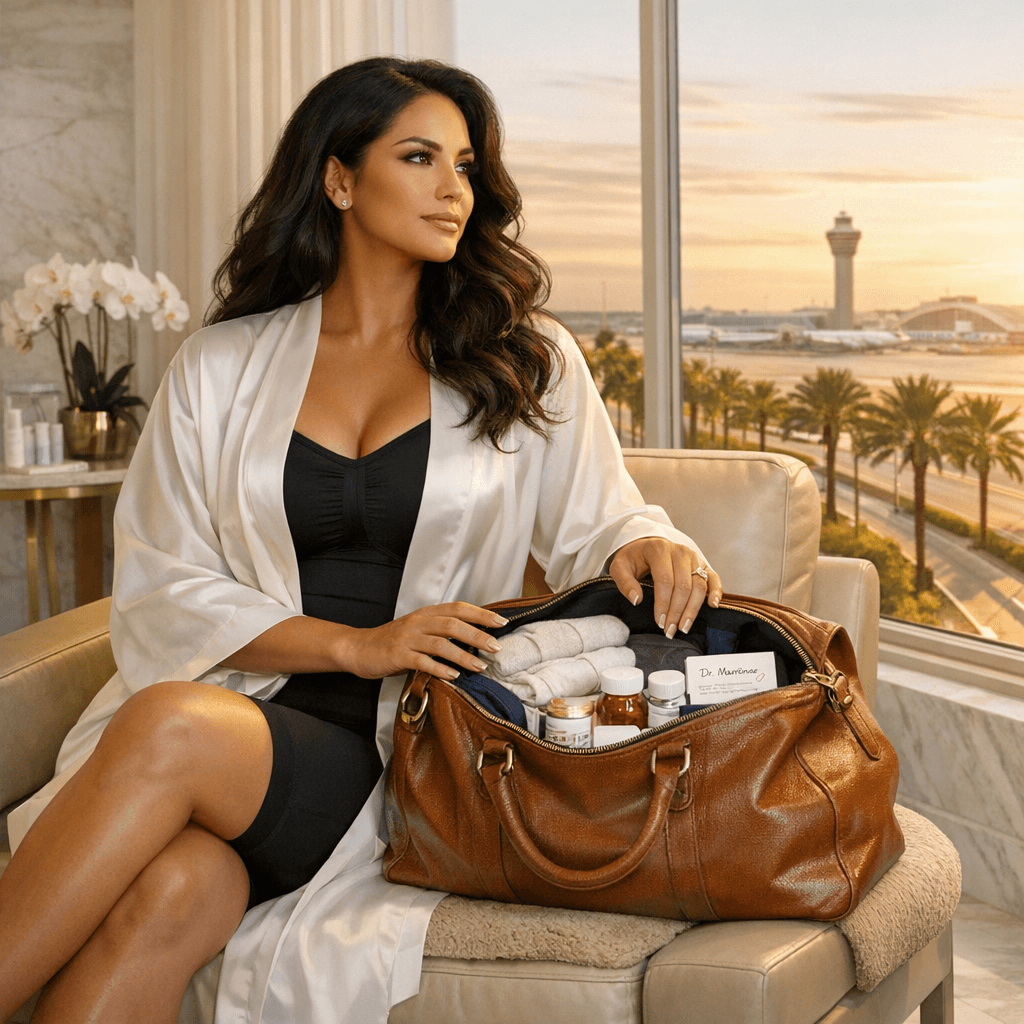
Planning travel after BBL? Discover safe flying timelines (week 3+), DVT risks, essential tips, packing lists and how long to stay in Miami before you fly home.

Exercises After Tummy Tuck Miami: Safe Timeline
Discover safe exercises after tummy tuck in Miami. Follow our week-by-week recovery timeline, humid climate tips for moms, and when to resume workouts. Consult today!
Exercises After Mommy Makeover: Safe Recovery Guide
Discover safe exercises after mommy makeover with our week-by-week recovery guide. From light walking and breathing exercises to core workouts and strength training. Miami tips, mistakes to avoid—consult your surgeon first!
Mommy Makeover Recovery Signs: Week-by-Week Guide
Learn mommy makeover recovery signs week-by-week: spot first improvements like reduced swelling, manage Miami humidity, and identify red flags for faster healing. Start your journey!