
Breast Augmentation13 min read
Capsular Contracture: Symptoms, Grades and Treatment
By Alluring Editorial TeamPublished
What is capsular contracture?
Capsular contracture is when scar tissue around a breast implant tightens and hardens. The FDA grades it I to IV; III and IV are considered severe and may need surgery. Within 10 years of a first augmentation, severe contracture was 12.1% in Mentor's study and 13% in Sientra's. The FDA says the cause is not known.
- 4.7 · 87 Google reviews

What is capsular contracture?
Capsular contracture is the tightening of the thin capsule your body forms around any implant, which can make the breast feel firm, look different or hurt. The capsule itself is normal; the tightening is the problem. The FDA says the hardening can happen around one implant or both, and that its cause is not known.
In the 10-year studies below, most women did not develop the severe form. An article on the ASPS website quotes a surgeon who says "the vast majority of women who have implants do not develop capsular contracture." This is what the evidence does and doesn't say.
What are the grades of capsular contracture?
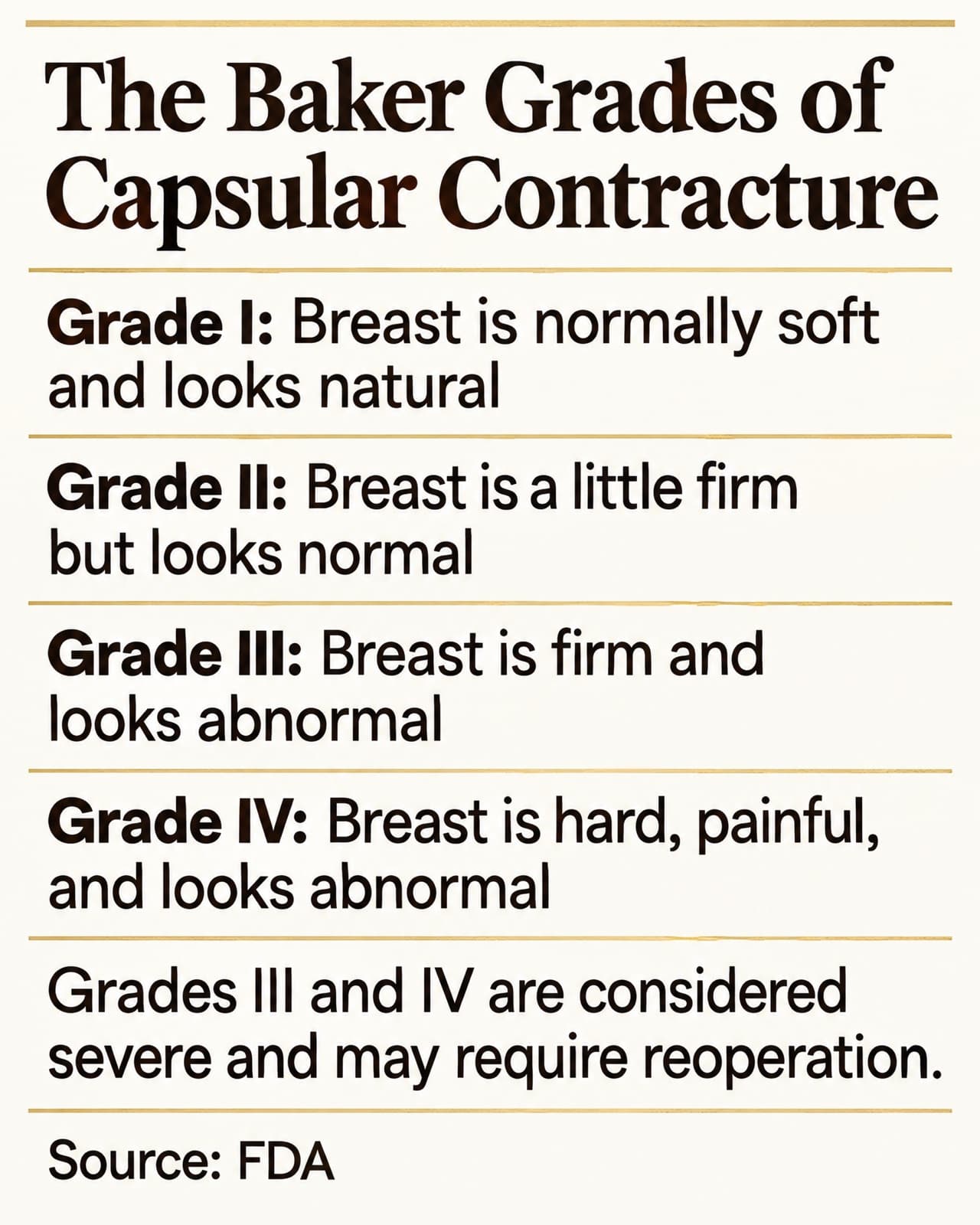
There are four, called Baker grades and sometimes stages. Grades III and IV are considered severe and may require another operation, the FDA says. The scale is a clinical judgment rather than a measurement: a 2015 review (Headon and colleagues) calls it subjective and says grades I and II are not clinically significant.
| Baker grade | How the FDA describes it | What it usually means |
|---|---|---|
| Grade I | Breast is normally soft and looks natural | Nothing to treat |
| Grade II | Breast is a little firm but looks normal | Usually nothing to treat; mention it at your next visit |
| Grade III | Breast is firm and looks abnormal | Considered severe; may require reoperation |
| Grade IV | Breast is hard, painful, and looks abnormal | Considered severe; may require reoperation |
What are the symptoms of capsular contracture?
The usual signs are a breast that feels firmer than it did, pain or tightness, and a change in shape. Allergan's labeling for Natrelle saline implants says symptoms range from mild firmness and mild discomfort to severe pain, a distorted implant shape and being able to feel the implant. It may affect one side only.
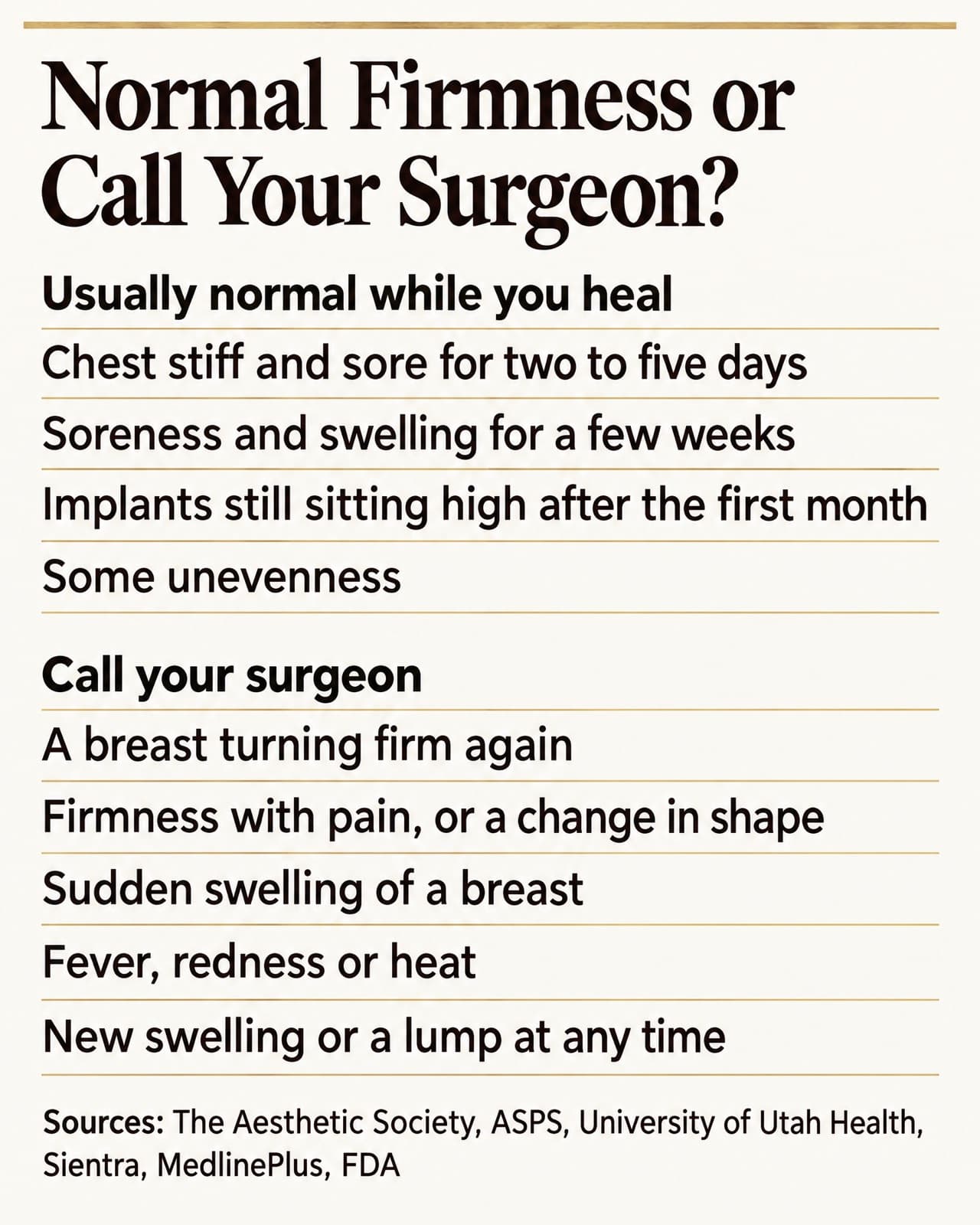
Early recovery also feels stiff and sore, so this table separates the two as far as the sources allow.
| Usually normal while you heal | Call your surgeon |
|---|---|
| Chest stiff and sore for two to five days (The Aesthetic Society) | A breast that softened and is turning firm again (practical advice) |
| Soreness and swelling for a few weeks (ASPS) | Firmness with pain, or a change in shape (Sientra's labeling) |
| Implants still sitting high after the first month (article on the ASPS website) | One breast that sits higher and doesn't settle (practical advice) |
| Some unevenness, because each breast can heal at a different rate (University of Utah Health) | Sudden swelling of a breast (MedlinePlus, on cosmetic breast surgery in general), which can mean bleeding or fluid around the implant (FDA) |
| Fever, redness or heat (Sientra's labeling) | |
| New swelling or a lump, even years later (FDA, on BIA-ALCL) |
Lines marked practical advice are not from a study. They apply the FDA's simple rule: for any abnormal change, see your surgeon or health care provider promptly. Our recovery timeline has more on what each week looks like.
When does capsular contracture happen?
It can appear in the years after surgery, and the chance rises with time. We did not find a reliable figure for how soon it can start or how often it starts in the first months. A 10-year analysis of Sientra's study (Calobrace and colleagues, 2018) separates early-onset events from later ones, but its abstract gives no share. Sientra's patient labeling shows the build-up in its own study of women having a first augmentation: severe contracture of 5.9% through 3 years, 9.7% through 6 years and 12.9% through 10 years, which the labeling also rounds to 13%.
New firmness years later is worth an exam for another reason. The FDA lists capsular contracture among the possible causes of rupture, and it was noted in 14% of the BIA-ALCL cases reported to the FDA through June 2024. The studies stop at 10 years, so they can't give a rate after that, and implants aren't lifetime devices, as our guide to how long breast implants last explains.
How common is capsular contracture?
There is no single number, because studies count different things. Here are the 10-year figures, each with what it measured.
| Source | Implants | Time frame | What it counted | Rate |
|---|---|---|---|---|
| Mentor's study (Caplin and colleagues, 2021) | MemoryGel silicone | 10 years, first augmentation | Baker III or IV | 12.1% |
| Sientra's study, in its patient labeling | Sientra silicone | 10 years, first augmentation | Baker III or IV | 13% |
| Allergan's study (Spear and Murphy, 2014) | Natrelle round silicone | 10 years, augmentation | Contracture, ungraded in the abstract | 18.9% |
| Allergan's labeling, from a 10-year survey | Natrelle saline | 10 years, first augmentation | Baker III or IV | 20.8% |
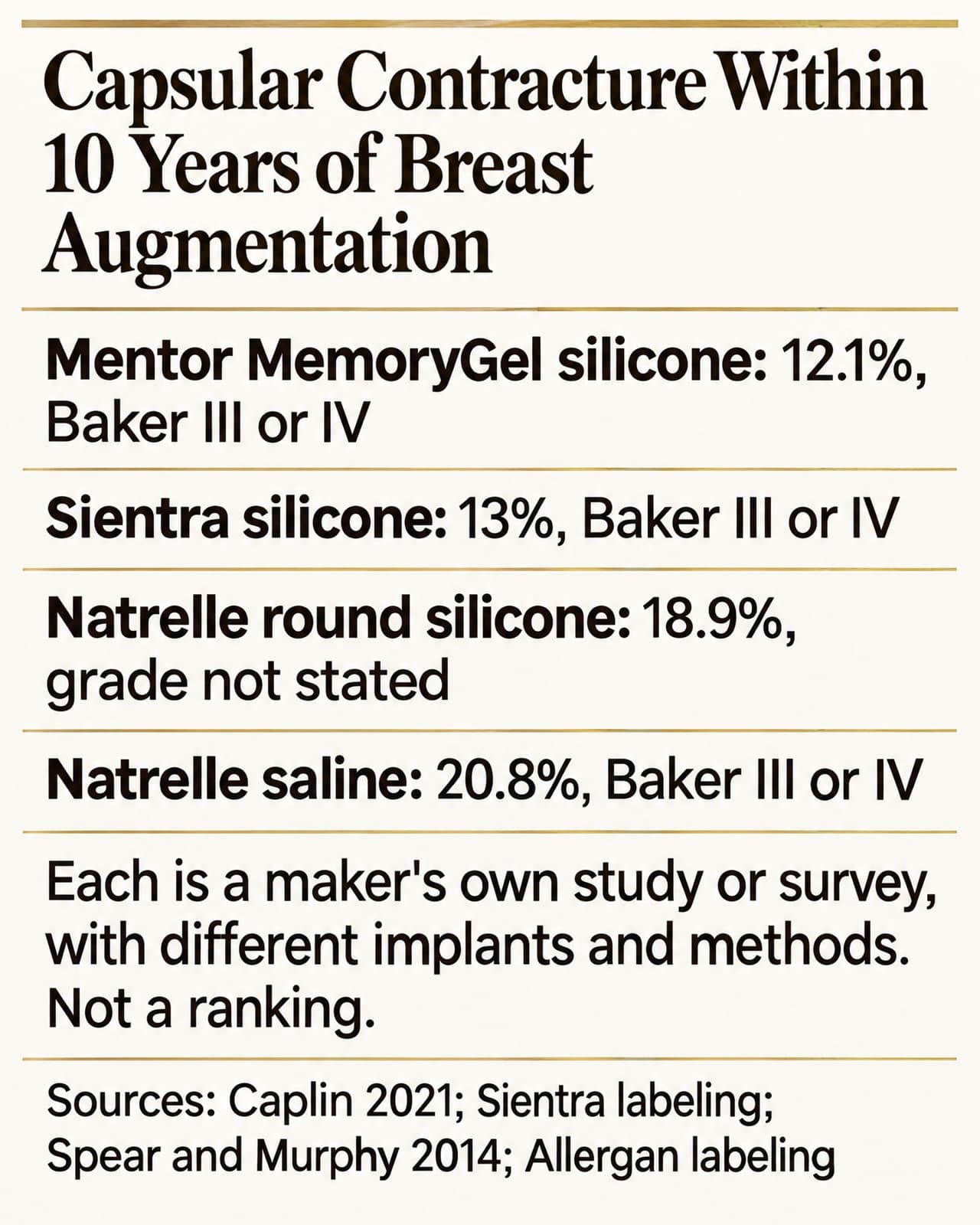
Each maker ran or paid for its own study, and implants and methods differ, so this isn't a ranking and none of it is any practice's rate. The 2015 review by Headon and colleagues gives an overall incidence of 10.6%. You may also see "one in six": two articles on the ASPS website use it for "some degree" of contracture, which is broader than the severe grades, and neither cites a study.
What causes capsular contracture?
The cause is not known, the FDA says, though it may be more common after infection, hematoma and seroma. A 2026 narrative review (Clark and colleagues) says chronic inflammation, bacterial biofilm and radiation after surgery were consistently implicated. The factors below are associations, not proof, and you can't predict who will get it.
| Factor | What the studies found |
|---|---|
| Time | Chances typically increase the longer you have implants (Sientra) |
| Repeat surgery | More likely than after a first augmentation (Sientra) |
| Radiation to the breast | A risk factor (Headon and colleagues, 2015) |
| Over the muscle | Higher than under it: 26.3% against 15.7% over 10 years, ungraded, in Allergan's study |
| Incision around the areola | Higher than at the breast fold, with odds about 1.9 times as high, but no significant difference from an armpit incision (Li and colleagues, 2018, 7 studies) |
| Smooth surface | Higher than textured, with odds about 2.8 times as high (Haas and colleagues, 2025, 24 studies) |
| Smaller implants | Linked to more contracture (Calobrace and colleagues, 2018) |
| Saline or silicone | The reviews disagree: Headon lists silicone as a risk factor, Haas found no significant difference |
The surface line needs a warning. Textured implants aren't the safer choice overall, because BIA-ALCL is reported far more often with them. Our post on breast implant illness and BIA-ALCL has those numbers.
Breast augmentation at Alluring
Get your breast augmentation price, in writing.
Many of our patients fly in from other states. We confirm your surgery and follow-up dates in writing, and tell you how many nights to stay in Miami.
Alluring patient care
Replies by text within 24 hoursHi! Let’s get your free consultation set up.
What are you thinking about doing?
Private. Only our patient coordinators see it, never a sales team.
How do you prevent capsular contracture?
No method is proven to prevent it, and the FDA has not cleared or approved any device to treat it or reduce how often it happens. What research offers is choices linked to lower rates, mostly made before and during surgery.
- Placement. Under the muscle is linked to less contracture. It has its own trade-offs, so see over or under the muscle and the placement section of our breast augmentation page.
- Incision. An incision at the breast fold is linked to less than one around the areola. An armpit incision showed no significant difference from one around the areola.
- Technique. The evidence is mixed. Clark and colleagues report that antimicrobial pocket irrigation and "no-touch" techniques were associated with less contracture in several reports. Headon and colleagues say antibiotic irrigation has failed to show any difference, and Calobrace and colleagues list it among factors linked to more contracture. Ask your surgeon what they do and why.
- Early problems. Report fever, swelling or redness early. Those need treatment anyway, and the FDA says contracture may be more common after infection and hematoma.
Does massage help capsular contracture?
No one has shown that it does. A 2017 literature review (Sood and colleagues) found 4 studies with 587 patients. The average contracture rate was 31% with massage and 40% without, which the authors called similar, with wide ranges in both groups. They concluded that "the available data do not support breast massage to prevent capsular contracture." Those studies used massage twice a day, starting between 2 days and 2 weeks after surgery. That describes what was tested, not a schedule to follow.
An article on the ASPS website by Dr. Kevin Tehrani says massage "has not been proven effective by any major studies" and warns against disturbing healing tissue without your surgeon's permission. You may read that daily massage for life prevents contracture. The evidence doesn't show that. If your surgeon prescribes massage, follow their schedule; our massage guide covers when and how.
How is capsular contracture treated?
It depends on the grade. Headon and colleagues say treatment is only indicated in grades III and IV, and that usually means surgery. Evidence for every option is limited: a 2016 systematic review (Wan and Rohrich) found no controlled trials that met its criteria.
| Option | What it is | What the evidence says |
|---|---|---|
| No treatment | For grades I and II | Treatment isn't indicated at these grades (Headon, 2015) |
| Capsulectomy | Surgery to remove all or part of the capsule | The standard for severe or recurrent cases (Clark, 2026), though the data are "less conclusive" (Wan, 2016) |
| New implant or new pocket | Replacing the implant or moving it to a new site | Linked to less recurrence (Wan, 2016) |
| Open capsulotomy | Surgery to open or release the capsule | Commonly used for mild to moderate cases (Clark, 2026), but it tends to recur (Headon, 2015) |
| Medicines | Leukotriene inhibitors, used off-label | Mixed: Pasca and colleagues, 2022, found benefit only for ongoing contracture; Headon said medical treatment seems ineffective |
| Closed capsulotomy | Squeezing the breast by hand to break the capsule | Not recommended: it can rupture the implant (FDA; Allergan's labeling) |
Contracture can come back: the FDA says so, and Headon and colleagues put recurrence approaching 25% in the first year after surgical treatment. Sientra's labeling says you could lose some breast tissue during surgery. Insurance may not cover removal or replacement, even with complications, the FDA says. For what surgery on implants costs, see the pricing section of our breast augmentation page.
What isn't known about capsular contracture?
Quite a lot, and a good conversation with a surgeon should include it.
- The cause. The FDA says it is not known.
- Who will get it. No one can predict it for an individual.
- Whether a mild grade will progress. We found no source that says how often grade I or II becomes grade III or IV.
- The right surgery. No controlled trials met the 2016 review's criteria.
- Prevention. The 2025 meta-analysis found no large randomized trials, and the 2026 review calls for prospective studies.
Who should you call, and what should you ask?
Start with the surgeon who placed your implants. If that isn't possible, because you moved or had surgery in another state, any surgeon who treats implant problems can examine you. Bring your device card, which lists your implant's style, size and serial or lot number. If you are having surgery away from home, ask before you leave who you call if a breast turns firm months later.
Questions worth asking, several from the FDA's own list:
- What grade do you think this is, and why?
- Could this be something else, such as a rupture? Do I need imaging?
- If surgery makes sense, would the capsule come out completely or in part? Would the implant be replaced or moved?
- What is the chance it comes back?
- What is your rate of complications, including contracture? What is your reoperation rate?
- What would insurance cover, and what would I pay?
If you are still deciding about implants, these are good questions for a free consultation, and the risks section of our breast augmentation page sets out the FDA's warnings in one place.
Frequently asked questions
Does capsular contracture hurt?
It can, but not always. The FDA says the hardening can be painful, and its Baker scale describes grade IV as hard, painful and abnormal looking. Grades I and II describe a breast that looks normal. Allergan's saline labeling describes a range from mild firmness and mild discomfort to severe pain. Pain that is new or getting worse is a reason to see your surgeon, whatever the cause turns out to be.
Can you get capsular contracture right after surgery?
We did not find a reliable figure for how early it can start, so we can't say it never happens early. Firmness in the first weeks is usually part of healing: The Aesthetic Society says your chest may feel stiff and sore for two to five days, and swelling takes longer to settle. A breast that swells suddenly soon after surgery is different, and needs a call right away.
Does capsular contracture get worse over time?
It can, but no one can say how often a mild grade progresses. Sientra's study shows severe contracture building from 5.9% through 3 years to 12.9% through 10 years across its patients, which describes a group rather than one woman's course. If you have been told you have grade I or II, ask how often you should be checked and what change should bring you back sooner.
How can I treat capsular contracture at home?
There is no proven home treatment. Massage isn't supported by the evidence, and no device is cleared by the FDA for it. Don't try to squeeze or break up a hard capsule yourself: Allergan's labeling warns that forcibly squeezing the capsule may break the implant, and Sientra's calls closed capsulotomy contraindicated. If your surgeon has prescribed massage, follow that plan.
What is a capsulectomy?
A capsulectomy is surgery to remove the scar tissue capsule around an implant, in part or completely. An open capsulotomy is different: it opens or releases the capsule without taking it out. Cleveland Clinic says that when the implant and capsule come out together as a unit, the term is en bloc. Ask your surgeon which one they recommend for your grade, and why.
Sources
- FDA: Risks and Complications of Breast Implants
- FDA: Things to Consider Before Getting Breast Implants
- FDA: Breast Implant Surgery
- FDA: What to Know About Breast Implants
- FDA: Questions and Answers about BIA-ALCL
- FDA: Medical Device Reports of BIA-ALCL
- ASPS: Breast augmentation recovery
- ASPS website, Daisy Brumby: What to know about capsular contracture
- ASPS website, Dr. Kevin Tehrani: What is capsular contracture?
- ASPS website, Dr. Cindy Wu: Augmentation and beach season
- The Aesthetic Society: Augmentation aftercare
- MedlinePlus: Cosmetic breast surgery, discharge
- University of Utah Health: Breast surgery recovery
- Cleveland Clinic: Breast Implant Illness
- Sientra: Patient brochure, silicone gel implants
- Allergan: Natrelle saline implants, patient labeling
- Plastic and Reconstructive Surgery: Caplin and colleagues, MemoryGel 10-year results (2021)
- Plastic and Reconstructive Surgery: Spear and Murphy, Natrelle 10-year results (2014)
- Archives of Plastic Surgery: Headon and colleagues, review (2015)
- Aesthetic Surgery Journal Open Forum: Haas and colleagues, meta-analysis (2025)
- PRS Global Open: Clark and colleagues, narrative review (2026)
- Plastic and Reconstructive Surgery: Calobrace and colleagues, Sientra risk factors (2018)
- Aesthetic Plastic Surgery: Li and colleagues, incision meta-analysis (2018)
- Eplasty: Sood and colleagues, massage review (2017)
- Plastic and Reconstructive Surgery: Wan and Rohrich, systematic review (2016)
- Aesthetic Surgery Journal: Pasca and colleagues, meta-analysis (2022)
What do real breast augmentation results look like?
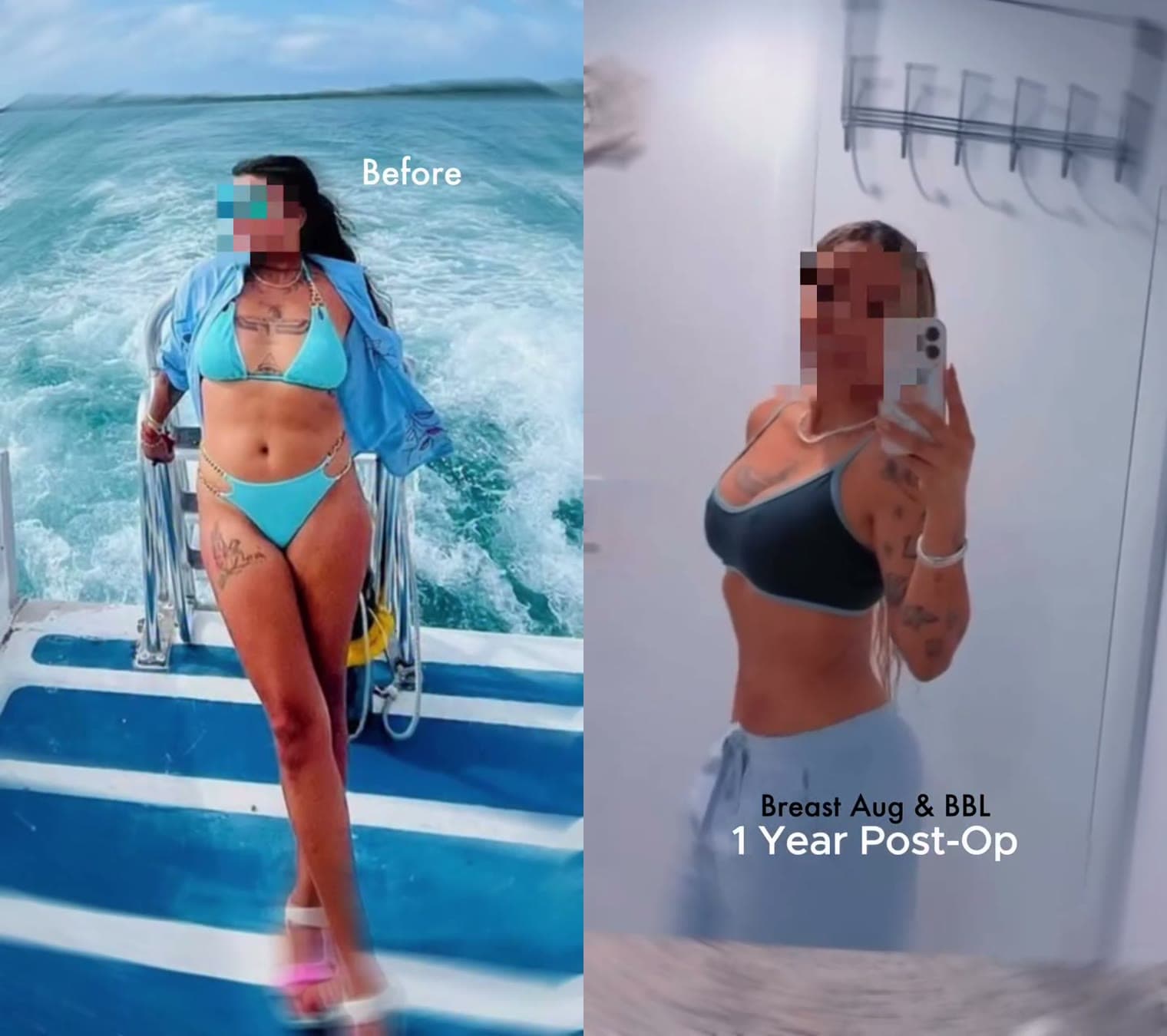
These are photos of real Alluring patients after breast augmentation, shared with their consent. Results differ from person to person, and your surgeon talks you through what is realistic for your body at your free consultation, before you decide anything.
Before and after breast augmentation 
Before and after breast augmentation 
Before and after breast augmentation 
Before and after breast augmentation 
Before and after breast augmentation 
Before and after breast augmentation
Photos in this section are real Alluring patients.
See every breast augmentation photo in the galleryMeet your surgeon

Check her credentials yourself
Each link opens her record on the issuing body's own site.
Licensed as a medical doctor by the Florida Department of Health.
Board certified in general surgery by the American Board of Surgery since 2008.
Fellow of the American College of Surgeons (FACS).
Certified in cosmetic surgery by the American Board of Cosmetic Surgery. The specialty recognition identified herein has been received from a private organization not affiliated with or recognized by the Florida Board of Medicine.
Start here
Personal care. Honest price.
Your price, surgery date and follow-up plan, in writing, before you book a flight.