Breast Augmentation12 min read
Over or Under the Muscle? Breast Implant Placement Compared
By Alluring Editorial TeamPublished
Are breast implants better over or under the muscle?
Neither suits everyone. Sientra's and Allergan's labeling say implants under the muscle are harder to see or feel and carry less capsular contracture, but surgery may be longer and more painful, and The Aesthetic Society says they may move when you flex. Over the muscle, recovery may be shorter, but implants show more.
- Typical recovery: Back to work in a few days to a week
- 4.7 · 87 Google reviews

Are breast implants better over or under the muscle?
Neither placement is better for every woman. ASPS says the choice depends on the type of implant, how much enlargement you want, your body type and your surgeon's recommendation.
What is the difference between over and under the muscle implants?
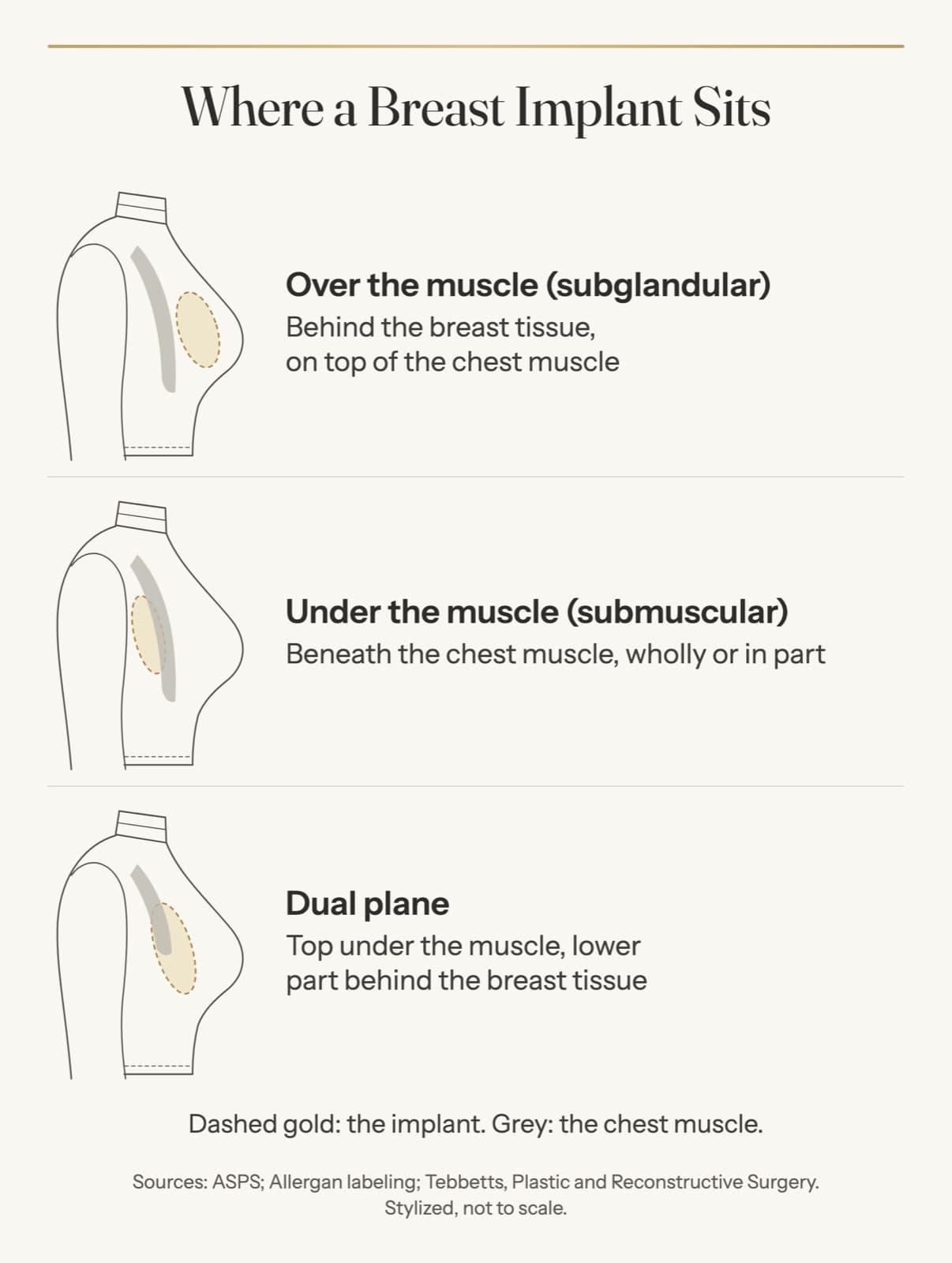
The difference is the layer the implant sits in. Under the muscle (submuscular) means beneath the pectoral muscle, and often only partly: Allergan's labeling for Natrelle saline implants defines it as "wholly or partially underneath the chest muscle." Over the muscle (subglandular) means directly behind the breast tissue, on top of the muscle.
Here is what each one trades.
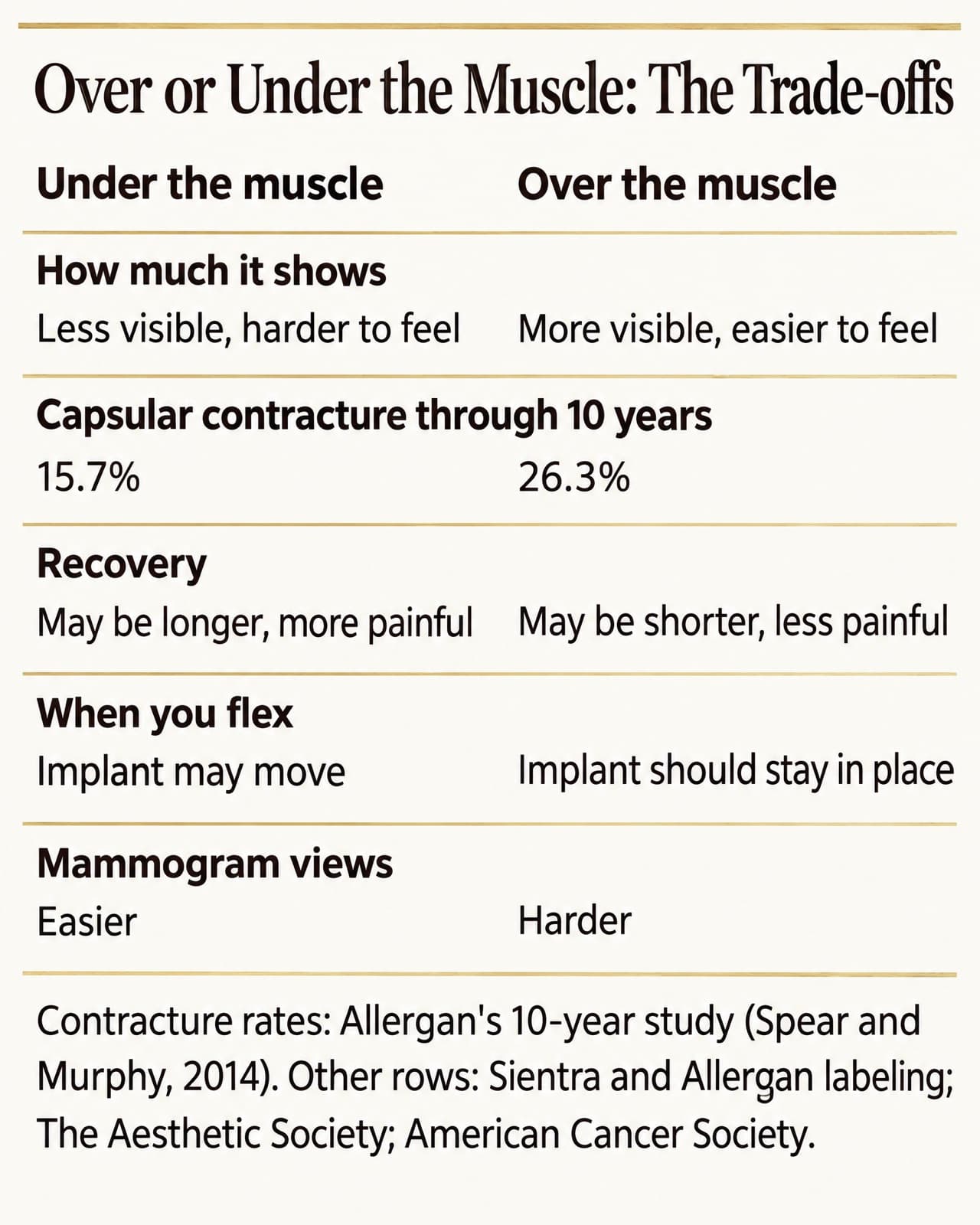
| What you care about | Under the muscle | Over the muscle |
|---|---|---|
| How much it shows | Less visible, harder to feel | More visible, easier to feel |
| Capsular contracture | Less likely | More likely |
| Surgery and recovery time | May be longer | May be shorter |
| Pain in the first days | May be more painful | May be less painful |
| When you flex your chest | Implant may move | Implant should stay in place |
| Mammogram pictures | Easier | Harder |
| Breastfeeding | May interfere less | May interfere |
| A future operation | May be more difficult | May be easier |
| Thin or weakened breast tissue | May work better | May not be recommended |
These rows come from Sientra's patient labeling and Allergan's labeling, which agree on the direction, plus The Aesthetic Society on flexing and breastfeeding. Notice how often the word "may" appears. These are tendencies across many women, and your own tissue can change the picture.
Which placement has less capsular contracture?
Under the muscle, in the studies we read. In Allergan's 10-year study (Spear and Murphy, 2014), capsular contracture after augmentation was 15.7% with the implant under the muscle and 26.3% over it. A 2025 meta-analysis (Haas and colleagues), pooling the 11 studies that compared placements, points the same way, with roughly a third of the odds of severe contracture (Baker grade III or IV) under the muscle (odds ratio 0.35, 95% confidence interval 0.25 to 0.50).
Three cautions. The Allergan figures describe one maker's implants in a study it funded, and the abstract doesn't grade how severe the contracture was. The meta-analysis authors say its studies varied substantially and that most weren't randomized. And "less likely" is not "prevented": contracture still happened under the muscle. What it feels like, how it is graded and how it is treated are in our guide to capsular contracture symptoms, grades and treatment.
Breast augmentation at Alluring
Get your breast augmentation price, in writing.
Many of our patients fly in from other states. We confirm your surgery and follow-up dates in writing, and tell you how many nights to stay in Miami.
Alluring patient care
Replies by text within 24 hoursHi! Let’s get your free consultation set up.
What are you thinking about doing?
Private. Only our patient coordinators see it, never a sales team.
Is under the muscle more painful, and is recovery longer?
Often yes at first. Both makers' labeling says under the muscle may be more painful, and an article on the ASPS website gives the reason: "the muscle has been stretched to accommodate the implant." ASPS says acute pain typically eases after 1 to 5 days, with soreness and swelling for a few weeks, but that figure isn't split by placement.
How much longer recovery takes is harder to pin down. The labeling says only that it may be longer, and the sources we read give no reliable comparison in days or weeks. You will find confident numbers online. The ones we could trace were single surgeons' opinions, not comparisons, so we leave them out. Cleveland Clinic puts full recovery at about 6 to 8 weeks on average, for breast augmentation in general.
Our guides to pain after breast augmentation and recovery, week by week cover what to expect and when to call your surgeon.
Will my implant move when I flex?
It may, if the implant is under the muscle. The Aesthetic Society says an implant under the muscle "may move when you flex your chest muscles", while one over the muscle "should stay in place". Surgeons call this animation, or animation deformity.
The evidence is thin, and it is worth knowing how thin. A 2019 systematic review of four studies (Dyrberg and colleagues) says how often it happens and why "have yet to be established", and that the degree of movement seems to track how much muscle is involved. In a 2009 study from one surgeon's patients (Spear and colleagues), all of whom had a variation of the dual-plane technique, photographs of 40 women showed no distortion in 22.5%, minimal in 62.5%, moderate in 10% and severe in 5%. In its survey, answered by 69 women, 82% described mild or no distortion, lifting weights was the activity most often affected (24%), and one woman said she would not recommend this placement. So in this small group, some movement was common and severe movement was uncommon. It may not hold for every version of under the muscle.
That study's authors suggest over the muscle may suit women "for whom exercise is central to their daily living." If you lift, do pull-ups or train your chest seriously, say so before you choose. Correcting animation often means another operation to move the implant. In a 2019 systematic review (Alnaif and colleagues), treatment worked in all 214 breasts studied, with complications in 11.6%, which the authors still call a "substantial complication rate." Most of those breasts, 151 of 214, had reconstruction after mastectomy, not a cosmetic augmentation.
What is dual plane, and is it the same as under the muscle?
Dual plane is a form of under the muscle. The 2001 paper that described the technique (Tebbetts) says it combines a partial pocket behind the muscle with a pocket behind the breast tissue in one patient. In plain words, the top of the implant sits behind the muscle and the lower part sits behind the breast tissue. "Half under the muscle" isn't a term from any source we read, but it may be the same idea, so ask what is meant.
The 2001 paper reports 468 patients from one surgeon's practice between 1992 and 1998, and its claim of fewer trade-offs is the author's own conclusion. It doesn't rule out animation either. In the 2019 review above, which included augmentation and reconstruction, some degree of movement ranged from 30% to 78% depending on the technique, with versions of dual plane near both ends. If a surgeon suggests dual plane, ask how much of your implant the muscle will cover, and why.
How does placement affect mammograms and breastfeeding?
Under the muscle may be easier on both. The American Cancer Society says women with implants should still have regular screening mammograms, with extra pictures called implant displacement views, and that those views "are easier if the implants were placed underneath (behind) the chest muscles."
Cleveland Clinic says implants below the muscle "usually affect milk production less" than implants above it, and the FDA says some women who have had a breast augmentation can breastfeed and some cannot. If either one matters to you, raise it early. Our guide to mammograms, pregnancy and breastfeeding with implants goes further.
How do I choose between over and under the muscle?
Start with what matters most to you, then let your exam settle it. Your tissue can overrule any of these.
| If this matters most to you | It leans | Why |
|---|---|---|
| You have thin or weakened breast tissue | Under | Both makers' labeling favors it here |
| You don't want implant edges seen or felt | Under | Less visible and harder to feel |
| Less capsular contracture | Under | Lower in the studies above |
| Easier mammogram pictures | Under | Displacement views are easier |
| You plan to breastfeed | Under | Usually affects milk production less |
| Heavy chest training | Over | Implant should stay in place when you flex |
| A shorter, easier recovery | Over | Labeling says it may be shorter and less painful |
| An easier future operation | Over | Both makers' labeling says so |
Placement is only one of three linked choices. The fill changes how an implant feels and ripples (saline vs silicone implants), and thin tissue cover can make rippling easier to see, as our guide to rippling and bottoming out explains. Size matters too: some practices offer bra sizers or 3D simulation, so ask whether yours does, and our breast implant size guide helps you prepare. The FDA's list of questions for your surgeon is a good place to start, and we would add these:
- Which placement do you recommend for my tissue, and why? Ask to see it drawn.
- How much of the implant would be under the muscle? "Under" can mean part or all of it.
- How would it change my first weeks? Ask about pain, work and lifting.
- I train my chest. What should I expect? Ask what animation looks like in your patients.
- What is your reoperation rate? This one is on the FDA's list.
Implants also need looking after for years, whichever layer they sit in. Our guide to how long breast implants last covers replacement and follow-up.
If you live in Florida or are flying in from another state
The conversation is the same wherever you live: your surgeon examines you, then recommends an implant and a placement. The placement section of our breast augmentation page shows both side by side. In South Florida, you can book a free consultation. From another state, you can start with a virtual consultation.
If you are flying in, raise placement when you talk about timing, because it can change how your first weeks feel. Dr. Victoria Karlinsky, MD, FACS, tells you, in writing, how many nights to stay in Miami before you fly home, and your surgery, pre-op and follow-up dates are confirmed in writing. The trip itself is yours to plan. None of the sources we read gives a number of days for flying after breast augmentation, so that answer comes from your surgeon. The risks and safety section of our breast augmentation page is worth reading before you decide.
Frequently asked questions
Do over the muscle implants sag more?
The sources we read don't compare sagging by placement. Sientra's patient labeling says implants too big for your tissue can speed up the effects of gravity, so ask about size as well as placement. The FDA's warning about major cosmetic deformity with large implants, especially on top of the chest muscle, is about implants that are removed and not replaced.
Do implants drop and fluff differently under the muscle?
You will read that they drop more slowly under the muscle, but none of the sources we read compares the two, so we can't give you a number. University of Utah Health says you begin to notice your final results around 3 months, with subtle changes through the first 12 months, and an article on the ASPS website says the whole process can take 3 to 6 months. See our drop and fluff timeline.
Can I lift weights with implants under the muscle?
Ask your surgeon before you count on it, because flexing can move an implant under the muscle. One surgeon on the ASPS website advises avoiding strenuous chest exercise such as push-ups with implants under the muscle, and another article there says to avoid strenuous upper-body activity for at least six weeks. Our guide to push-ups after breast augmentation covers the stages.
Can an implant be moved from over to under the muscle later?
Surgeons can reposition implants: the FDA lists "surgically opening the incision and moving the implant" among reoperations. No source we read covers a move from over to under the muscle specifically, so ask your surgeon whether a change of pocket would be an option for you. Both makers' labeling says a future operation may be more difficult when the implant is already under the muscle.
What do subglandular and submuscular mean?
They are the medical names for the two placements. ASPS describes submuscular as under the pectoral muscle, and subglandular or submammary as directly behind the breast tissue, over the muscle. Research papers often say subpectoral for under the muscle and prepectoral for over it, so you may see all of these words used for the same two choices.
What problems can implants under the muscle cause?
The ones tied to this placement are more pain early on, a possibly longer recovery, movement when you flex, and a harder operation if you ever need another one, according to the makers' labeling and The Aesthetic Society. The general risks of implants, such as capsular contracture, rupture and rippling, can still happen under the muscle.
Sources
- ASPS: What are the steps of a breast augmentation procedure?
- ASPS: What should I expect during my breast augmentation recovery?
- ASPS website, article by Ariel Frankeny: Back to active: Returning to exercise after breast augmentation recovery
- ASPS website, article by Dr. Catherine Huang-Begovic: Exercise after breast augmentation
- ASPS website, article by Dr. Eric Mariotti: What does "drop and fluff" mean after breast augmentation?
- The Aesthetic Society: Breast Augmentation, Detailed Procedure Information
- FDA: Risks and Complications of Breast Implants
- FDA: Breast Implant Surgery
- Sientra: Breast Augmentation with Sientra Silicone Gel Breast Implants, patient labeling
- Allergan: Natrelle Saline-Filled Breast Implants, patient labeling
- Plastic and Reconstructive Surgery: Natrelle round silicone breast implants, Core Study results at 10 years (Spear and Murphy, 2014)
- Aesthetic Surgery Journal Open Forum: Capsular Contracture After Breast Augmentation (Haas and colleagues, 2025)
- Aesthetic Surgery Journal Open Forum: Capsular Contracture After Breast Augmentation, full text (Haas and colleagues, 2025)
- Archives of Plastic Surgery: Breast animation deformity (Dyrberg and colleagues, 2019)
- Aesthetic Plastic Surgery: Outcome assessment of breast distortion following submuscular breast augmentation (Spear and colleagues, 2009)
- Journal of Plastic, Reconstructive & Aesthetic Surgery: Treatment of breast animation deformity (Alnaif and colleagues, 2019)
- Plastic and Reconstructive Surgery: Dual plane breast augmentation (Tebbetts, 2001)
- American Cancer Society: Mammograms with Breast Implants
- Cleveland Clinic: Breast Augmentation
- University of Utah Health: Recovering from Breast Reduction & Breast Augmentation
What do real breast augmentation results look like?
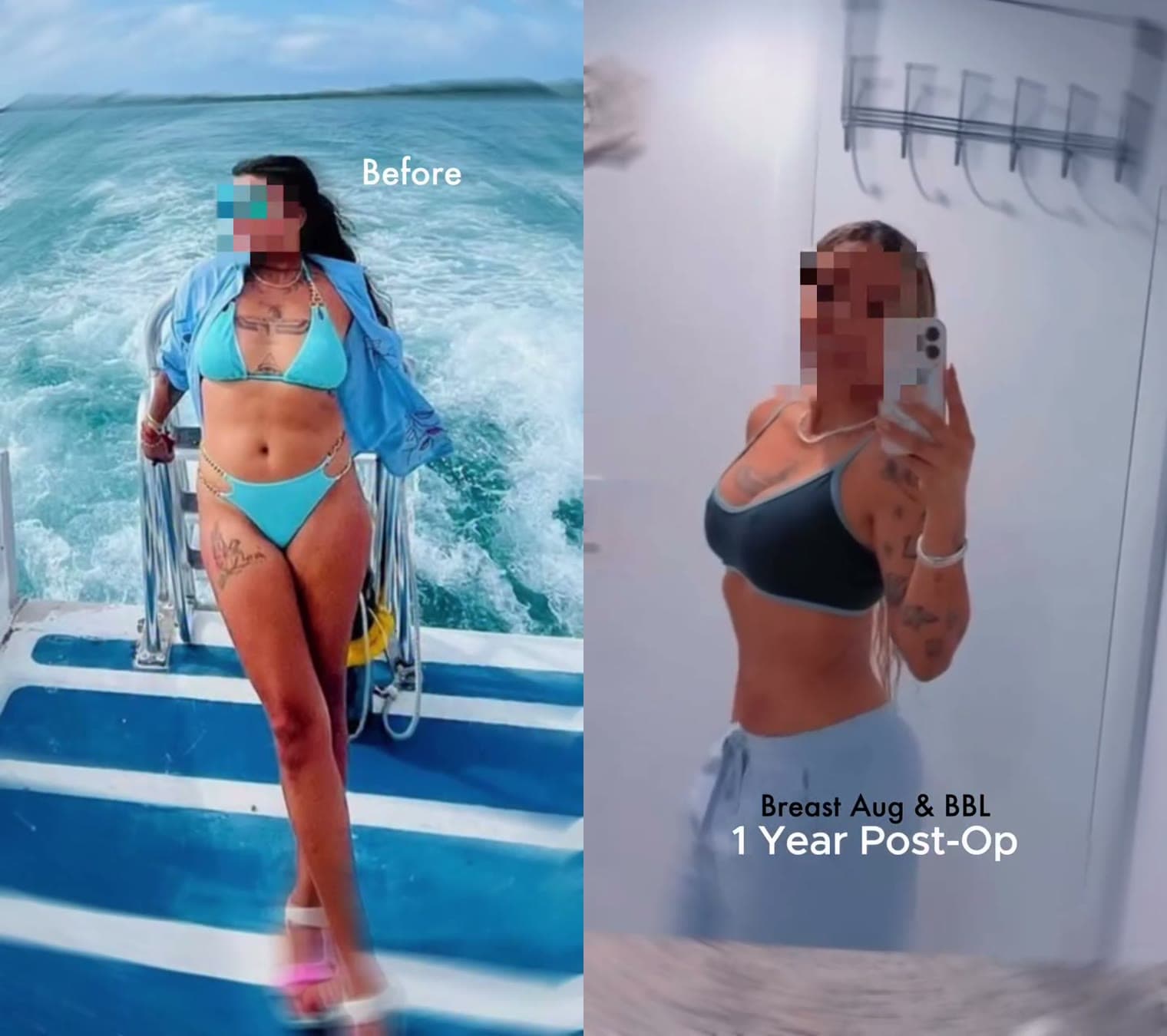
These are photos of real Alluring patients after breast augmentation, shared with their consent. Results differ from person to person, and your surgeon talks you through what is realistic for your body at your free consultation, before you decide anything.
Before and after breast augmentation 
Before and after breast augmentation 
Before and after breast augmentation 
Before and after breast augmentation 
Before and after breast augmentation 
Before and after breast augmentation
Photos in this section are real Alluring patients.
See every breast augmentation photo in the galleryMeet your surgeon

Check her credentials yourself
Each link opens her record on the issuing body's own site.
Licensed as a medical doctor by the Florida Department of Health.
Board certified in general surgery by the American Board of Surgery since 2008.
Fellow of the American College of Surgeons (FACS).
Certified in cosmetic surgery by the American Board of Cosmetic Surgery. The specialty recognition identified herein has been received from a private organization not affiliated with or recognized by the Florida Board of Medicine.
Start here
Personal care. Honest price.
Your price, surgery date and follow-up plan, in writing, before you book a flight.