Breast Augmentation11 min read
Saline vs Silicone Implants: How to Choose
By Alluring Editorial TeamPublished
Should I choose saline or silicone breast implants?
It comes down to feel, rupture and follow-up. ASPS says silicone gel feels a bit more like natural breast tissue; saline can go in through a smaller incision but may ripple more. The FDA approves saline from age 18 and silicone from 22, and recommends scans for silicone because its ruptures are usually silent.
- Typical recovery: Back to work in a few days to a week
- 4.7 · 87 Google reviews

Are saline or silicone implants better?
Neither is better for everyone. The Aesthetic Society says the choice "typically comes down to personal preference and your surgeon's opinion." What really separates them is how they feel, how they go in, what happens if one breaks, and how much monitoring you take on over the years. If you only read one thing here, read this table.
| If this matters most to you | It leans | Why |
|---|---|---|
| A feel closer to breast tissue | Silicone | ASPS says the gel feels a bit more like natural tissue |
| The smallest incision | Saline | It can go in empty and be filled during surgery |
| Knowing right away if it breaks | Saline | A rupture deflates the implant |
| No routine scans | Saline | The FDA has no screening recommendation for saline |
| Less visible rippling | Silicone | Rippling may be more likely with saline |
| You are 18 to 21 | Saline | The FDA approves silicone for augmentation from age 22 |
| Less capsular contracture | Neither | A 2025 meta-analysis found no significant difference |
Placement and size change the picture too, so read this next to over or under the muscle compared and our breast implant size guide.
What is the difference between saline and silicone implants?
The fill. The FDA says both have a silicone outer shell: saline is filled with sterile salt water and silicone with silicone gel. Saline implants are pre-filled or filled during the operation, and The Aesthetic Society says all silicone gel implants come pre-filled.
| Saline | Silicone gel | |
|---|---|---|
| Fill | Sterile salt water | Silicone gel |
| When it is filled | During surgery, or pre-filled | Always pre-filled |
| Incision | Typically smaller | Typically larger |
| FDA age, augmentation | 18 or older | 22 or older |
| Feel, according to ASPS | Uniform shape, firmness and feel | A bit more like natural breast tissue |
| Rippling | May be more likely | May be less likely |
| If it ruptures | Deflates, and the body absorbs the salt water | Usually silent, and the gel generally stays in the scar tissue |
| Routine scans | None recommended | First at 5 to 6 years, then every 2 to 3 years |
The incision and rippling rows come from Allergan's labeling for Natrelle saline implants, and the feel row from ASPS. ASPS also lists structured saline implants, which are filled with salt water and contain an inner structure that aims to make the implant feel more natural.

How old do you have to be for saline or silicone implants?
For breast augmentation, the FDA approved saline implants in women age 18 or older and silicone gel implants in women age 22 or older. For reconstruction, both are approved at any age. These are the FDA's approvals, not any one practice's policy, so ask at your consultation. Whichever you choose, the FDA requires your provider to review a patient decision checklist with you before surgery, and you get the chance to initial and sign it. Our candidate quiz covers the rest of who is a good fit.
Are saline implants safer than silicone?
None of the sources we read says one fill is safer overall. Both carry the risks in the FDA's boxed warning, including that implants are not lifetime devices. Here is what the evidence says on the questions women ask most:
- Capsular contracture: a 2025 meta-analysis (Haas and colleagues), in which three studies with 4,198 cases compared the fills, found no significant difference in severe contracture. The range around that result is very wide (odds ratio 0.39, 95% confidence interval 0.02 to 6.69), so the evidence can't really separate them.
- BIA-ALCL: the FDA calls it a cancer of the immune system and says an individual's risk is considered low, though the cancer is serious. It says the fill does not appear to be a risk factor, but that this has not been evaluated in a large, well-designed study. Surface texture matters more, as you will see below.
- Breast implant illness: Cleveland Clinic says people report symptoms with both saline and silicone. Our guide to breast implant illness symptoms covers what is known and what isn't.
- Other disease: the FDA says it has not detected any association between silicone gel implants and connective tissue disease, breast cancer or reproductive problems.
The clearest safety difference is practical: how you would find out about a rupture. The safety section of our breast augmentation page sets out the rest.
Breast augmentation at Alluring
Get your breast augmentation price, in writing.
Many of our patients fly in from other states. We confirm your surgery and follow-up dates in writing, and tell you how many nights to stay in Miami.
Alluring patient care
Replies by text within 24 hoursHi! Let’s get your free consultation set up.
What are you thinking about doing?
Private. Only our patient coordinators see it, never a sales team.
What happens if a saline or silicone implant ruptures?
A saline rupture shows, and a silicone rupture usually doesn't.
With saline, the FDA says the solution leaks "immediately or over several days" and the implant deflates, so you and your doctor can tell. ASPS says the body absorbs the salt water and naturally expels it. Allergan's labeling says deflated implants need another operation to remove them.
With silicone, the FDA says most ruptures have no symptoms, which is why they are called silent ruptures. The gel generally stays within the scar tissue around the implant. Occasionally you may notice a smaller breast, a change in shape, hard lumps, unevenness, pain, tingling, swelling, numbness or burning. ASPS says a leaking silicone implant will not collapse, so looking normal doesn't tell you it is intact.

Do silicone implants need MRIs or ultrasounds?
Yes, the FDA recommends scans for silicone because most ruptures are silent. Its guidance says that if you have no symptoms, your first ultrasound or MRI should be at 5 to 6 years after surgery, then every 2 to 3 years. If you have symptoms at any time, or an uncertain ultrasound result, it recommends an MRI. Saline implants have no screening recommendation, because a rupture is detectable without one.
Budget for this if you choose silicone. The FDA's example checklist warns that these scans may not detect every rupture, can be costly, and may not be covered by insurance. They are also separate from your mammograms, which you still need. Our guide to mammograms and breastfeeding with implants explains why.
What are gummy bear implants?
Gummy bear is the common name for form-stable implants, and they are silicone. ASPS says they get the name because they keep their shape even when the shell is broken. The gel is thicker than in traditional silicone implants, which makes them firmer, and ASPS says placing them takes a slightly longer incision.
This is a general explanation, not a list of what any practice offers. Ask your surgeon which types are available to you and why they would, or wouldn't, recommend one.
Teardrop vs round implants: what is the difference?
Round implants are the same shape all over, and shaped or teardrop implants have more projection at the bottom and taper toward the top. ASPS says that because round implants are uniform, there is less concern about them rotating, and that they tend to make breasts look fuller than form-stable implants. A shaped implant that rotates can look unusual and need a separate procedure to correct. Profile, meaning how far an implant projects, is covered in our size guide.

What is the difference between smooth and textured implants?
The surface. ASPS says smooth implants are the softest feeling and can move within the pocket, but may have palpable or visible rippling. Textured implants develop scar tissue that sticks to the surface, so they are less likely to shift.
Texture comes with a trade-off you should know about:
- Contracture: the 2025 meta-analysis linked smooth implants to more capsular contracture than textured (odds ratio 2.80, 95% confidence interval 1.92 to 4.08). Allergan's labeling is more cautious, saying some studies suggest texturing reduces severe contracture and others don't. Neither makes textured better overall.
- BIA-ALCL: the FDA says the risk is higher with textured surfaces. Reports to the FDA through June 2024 were 73% textured, 3% smooth and 24% not specified. Those are reports, not a rate. Of the smooth cases, only one is recorded as having no known textured implant, many histories are incomplete, and the FDA's example checklist notes that patients with smooth implants have also been diagnosed.
- What the FDA advises: in July 2019 it asked Allergan to recall certain textured implants, and it does not recommend removing implants of any type if you have no symptoms.
If you live in Florida or are flying in from another state
This choice outlasts surgery week, so think about where you will be in the years after it. Silicone means scans wherever you live, and a saline deflation means another operation wherever you are. Ask how follow-up would work once you are home, and keep the device card you get after surgery, which lists your implant's style, size and serial or lot number.
If you are flying in, Dr. Victoria Karlinsky, MD, FACS, tells you, in writing, how many nights to stay in Miami before you fly home, and your surgery, pre-op and follow-up dates are confirmed in writing. The trip itself is yours to plan. You can start with a virtual consultation from another state, or book a free consultation in South Florida. The implant section of our breast augmentation page compares your options, and saline and silicone prices are listed there too.
Frequently asked questions
How long do saline implants last compared with silicone?
No one can give you a number for either. The FDA says the life of an implant varies by person and cannot be predicted, and neither fill has a replacement date. The makers' figures measure different things, so they don't show that one lasts longer. Our guide to how long breast implants last goes through them.
How often do saline implants rupture?
Allergan's labeling reports implant deflation in 13.8% of women through 10 years in a patient survey of its Natrelle saline implants. Silicone figures come from scans: 8.5% in Sientra's MRI group and 24.2% suspected or confirmed in Mentor's. These were measured differently, by makers studying their own implants, so don't rank them.
Is a ruptured implant an emergency?
See your surgeon promptly for any abnormal change in your breasts or implants, as the FDA advises, and contact your surgeon immediately for fever, or for noticeable swelling or redness in the breast, as Allergan's labeling says. A silent silicone rupture found on a scan is a different situation: a surgeon in a video on the ASPS website says that is not an emergency, and that it is typically replaced within six months of being identified.
Do saline implants ripple more than silicone?
They may. Allergan's labeling says visible rippling may be more likely with saline. Its figure is 13.7% at 5 years, counting moderate or worse, while Sientra's silicone study reports 1.9% through 10 years. Those rates aren't directly comparable. Thin skin and tissue cover matters too, as our guide to rippling and bottoming out explains.
Can I switch from saline to silicone later?
In general, yes, through an implant exchange, which is its own surgery. Wanting a change isn't unusual: in Sientra's study, a different size or style was the most common reason for removal, at 49.1% of the implants removed through 10 years. The FDA says insurance may not cover it, so ask about cost up front.
Can I get silicone implants under age 22?
The FDA's approval of silicone gel for breast augmentation starts at age 22, while saline starts at 18, and both are approved at any age for reconstruction. If you are under 22, ask your surgeon what that means for you at your consultation, and whether waiting or choosing saline makes more sense for your goals.
Do silicone implants cause breast implant illness?
The cause of these symptoms isn't known. The FDA says symptoms such as fatigue, memory loss, rash, brain fog and joint pain may be associated with breast implants and are poorly understood. Cleveland Clinic says people report them with saline as well as silicone, so choosing saline doesn't rule them out. Talk to a doctor about any symptoms you have.
Sources
- FDA: Types of Breast Implants
- FDA: Risks and Complications of Breast Implants
- FDA: Things to Consider Before Getting Breast Implants
- FDA: What to Know About Breast Implants
- FDA: Breast Implants, Certain Labeling Recommendations to Improve Patient Communication
- FDA: Medical Device Reports of Breast Implant-Associated Anaplastic Large Cell Lymphoma
- FDA: Questions and Answers about BIA-ALCL
- ASPS: What types of breast implants are available?
- ASPS video gallery: What to Do When Your Breast Implant Ruptures
- The Aesthetic Society: Breast Augmentation, Detailed Procedure Information
- Cleveland Clinic: Breast Implant Illness
- Allergan: Natrelle Saline-Filled Breast Implants, patient labeling
- Sientra: Breast Augmentation with Sientra Silicone Gel Breast Implants, patient labeling
- Plastic and Reconstructive Surgery: MemoryGel Breast Implants, Final Results after 10 Years (Caplin and colleagues, 2021)
- Aesthetic Surgery Journal Open Forum: Capsular Contracture After Breast Augmentation (Haas and colleagues, 2025)
- Aesthetic Surgery Journal Open Forum: Capsular Contracture After Breast Augmentation, full text (Haas and colleagues, 2025)
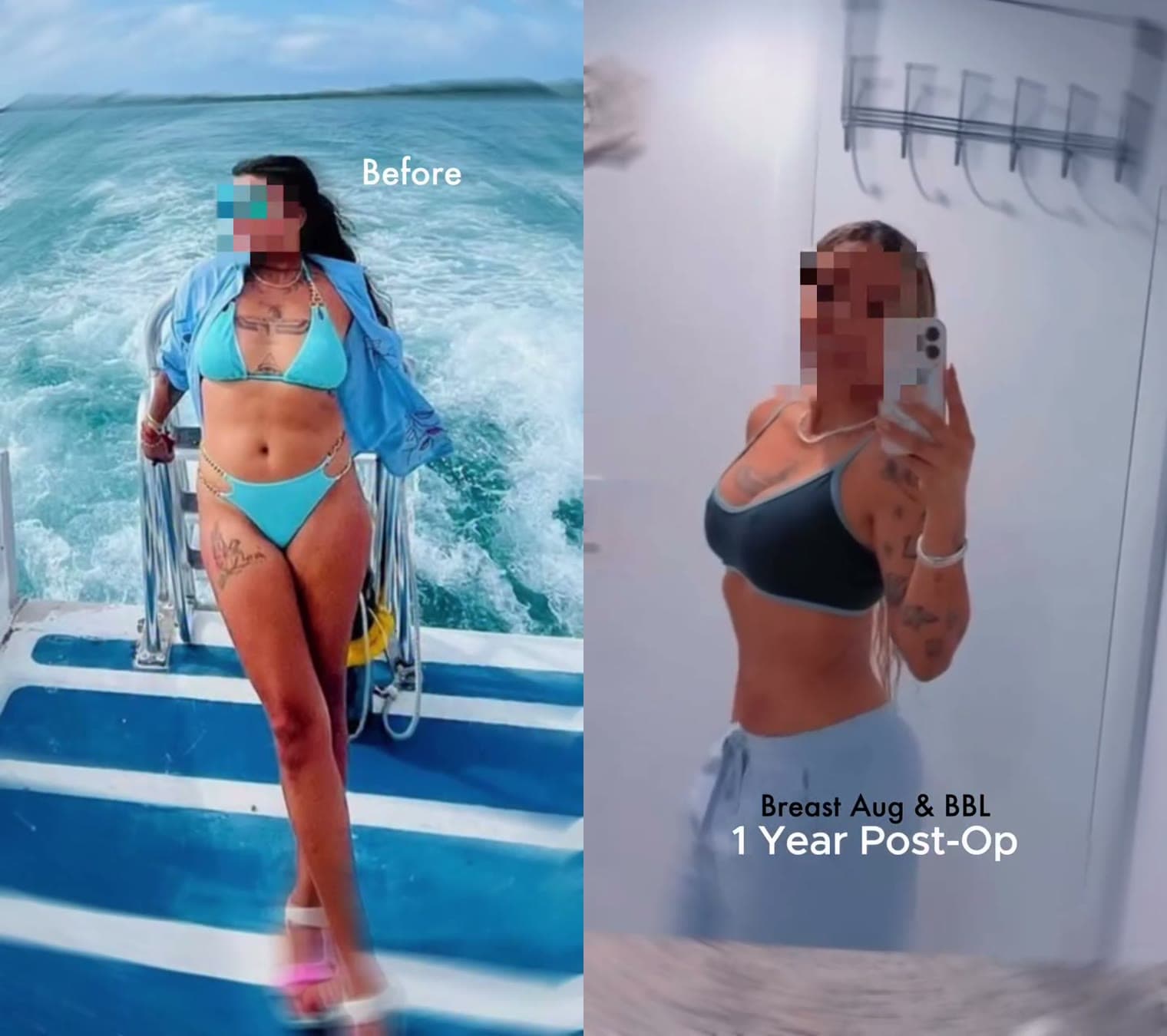
What do real breast augmentation results look like?
These are photos of real Alluring patients after breast augmentation, shared with their consent. Results differ from person to person, and your surgeon talks you through what is realistic for your body at your free consultation, before you decide anything.
Before and after breast augmentation 
Before and after breast augmentation 
Before and after breast augmentation 
Before and after breast augmentation 
Before and after breast augmentation 
Before and after breast augmentation
Photos in this section are real Alluring patients.
See every breast augmentation photo in the galleryMeet your surgeon

Check her credentials yourself
Each link opens her record on the issuing body's own site.
Licensed as a medical doctor by the Florida Department of Health.
Board certified in general surgery by the American Board of Surgery since 2008.
Fellow of the American College of Surgeons (FACS).
Certified in cosmetic surgery by the American Board of Cosmetic Surgery. The specialty recognition identified herein has been received from a private organization not affiliated with or recognized by the Florida Board of Medicine.
Start here
Personal care. Honest price.
Your price, surgery date and follow-up plan, in writing, before you book a flight.