Breast Augmentation11 min read
How Long Do Breast Implants Last? When to Replace Them
By Alluring Editorial TeamPublished
How long do breast implants last?
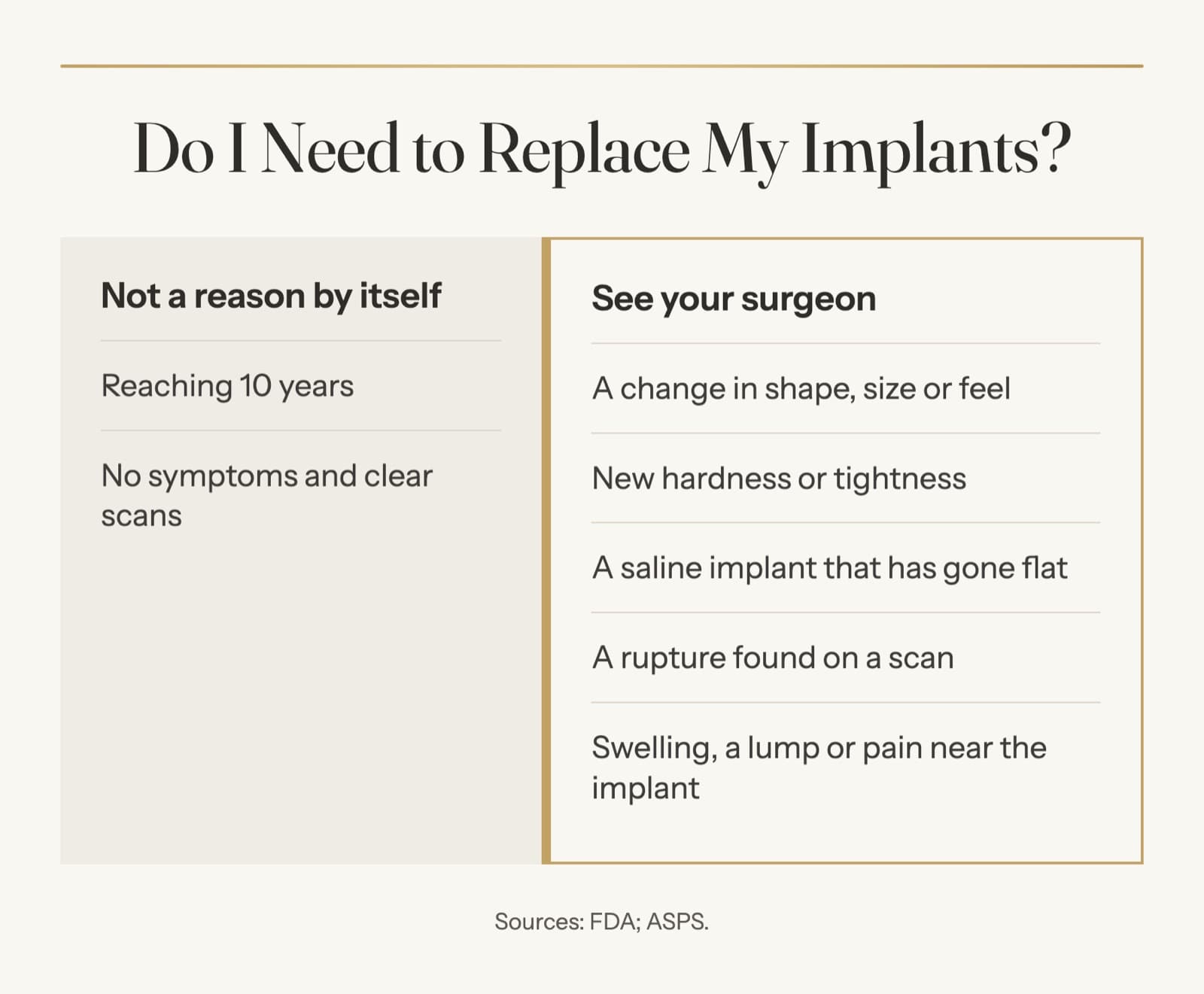
No one can give a number. The FDA says implants are not lifetime devices and that their life varies by person and cannot be predicted. It sets no replacement date, so 10 years alone is not a reason to replace them. In the makers' studies, 24% to 36.5% of women had another operation within 10 years of a first augmentation.
- 4.7 · 87 Google reviews

How long do breast implants last?
There is no set number of years, and many women keep theirs for years: in Allergan's 10-year study (Spear and Murphy, 2014), 81.8% of women who had a breast augmentation still had an original implant at the end. The FDA gives no expiry or replacement date. What it does say is that the longer you have them, the more likely you are to have them removed or replaced.
Do breast implants need to be replaced every 10 years?
No. "Replace them every 10 years" is a common belief, but it isn't FDA advice and we found it in no society guidance we read. Here is who actually says what:
- The FDA gives no replacement interval. In its words, "breast implants are not lifetime devices", and you should assume you will need additional surgery at some point. No one can predict when.
- ASPS says implants may need to be replaced, and that you can see your surgeon once a year to check your breast health and implant integrity. It sets no date either.
- Dr. Anureet Bajaj, a surgeon quoted in an article on the ASPS website, says "You don't need to replace an implant unless there's a problem with it." That is one surgeon's view, not an FDA rule.
- A surgeon in a video on the ASPS website says it is common for women to start thinking about their implants around the 10- or 15-year mark. That is when women start thinking about it, not when implants fail.
- Dr. Jonathan Kaplan, in a 2017 article on the ASPS website, answers this exact question "probably not", and says that with proper monitoring "you don't need to automatically replace your implants every 10 years." He traces the number to a 2011 FDA report on silicone implants, whose data he says has been "slightly misrepresented." His views are his own, not ASPS's.
The makers' main studies also follow women for 10 years. That is where the follow-up stops, not where implants expire.
How many women need another operation within 10 years?
About a quarter to a bit over a third, in the makers' own studies of a first breast augmentation. Revision and reconstruction run higher.
| Maker's study | Another operation | Implant removed | Rupture or deflation |
|---|---|---|---|
| Sientra silicone | 24% | 16% | 8.5% in the MRI group |
| Mentor MemoryGel silicone | 25.5% | 11.6% | 24.2% suspected or confirmed, MRI group |
| Natrelle saline | 36.5% | 20.2% | 13.8% deflation |
Please don't use this table to rank the makers. Each study covers that maker's own implants and was run or sponsored by the maker, the methods differ (Natrelle's 10-year figures are patient surveys), and "another operation" covers many things, including a size change a woman simply wanted. None of these is a rate for any one surgeon or practice. Sientra's brochure also warns that its rupture figure may be an underestimate.
These rows are first augmentations only. In the same Mentor study, another operation was 43.6% after a revision augmentation and 49.0% after a first reconstruction, and Sientra reports 39% for revision augmentation.
You may also see a 20% figure. The FDA's example checklist says as many as 20% of women who get implants for augmentation have them removed within 8 to 10 years, and that yours may last a shorter or longer time. The FDA says those numbers are "for illustrative purposes only", so read it as an example, not a forecast.
Does the risk jump at 10 years?
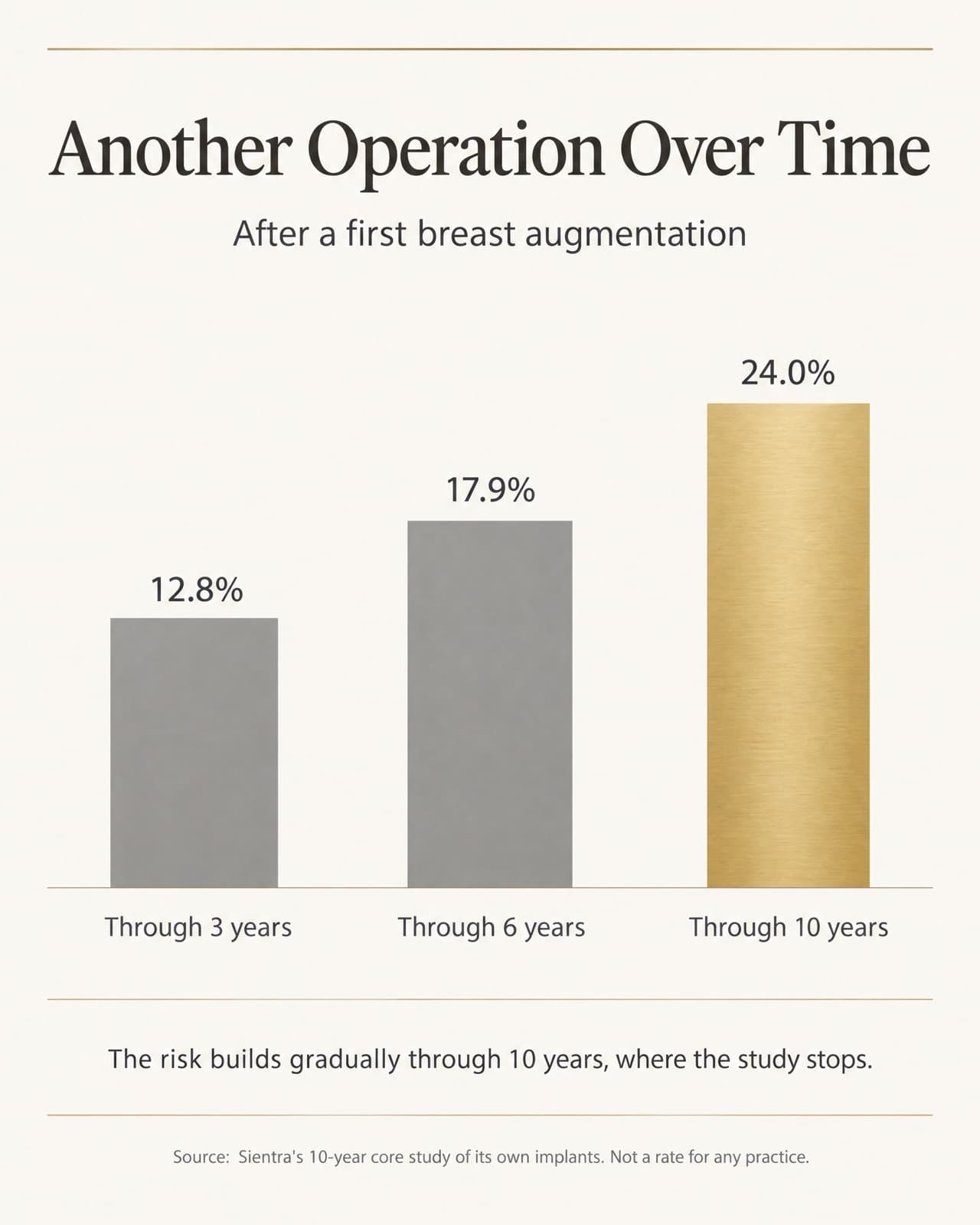
Not in the data through 10 years. Sientra reports it at 3, 6 and 10 years, and the risk builds gradually over that time. Here is its table for a first breast augmentation.
| Through | 3 years | 6 years | 10 years |
|---|---|---|---|
| Another operation | 12.8% | 17.9% | 24.0% |
| Removal with replacement | 4.4% | 7.9% | 12.2% |
| Removal without replacement | 1.3% | 2.7% | 4.7% |
| Rupture, MRI group | 0% | 4.2% | 8.5% |
Natrelle's saline labeling points the same way, with a caveat: its numbers come from two different studies, so they aren't a like-for-like trend. Another operation was 25.9% through 5 years in its clinical study and 36.5% through 10 years in a follow-up patient survey, and deflation was 6.8% and then 13.8%. What none of these studies can tell you is what happens after 10 years, because that is where they stop.
Breast augmentation at Alluring
Get your breast augmentation price, in writing.
Many of our patients fly in from other states. We confirm your surgery and follow-up dates in writing, and tell you how many nights to stay in Miami.
Alluring patient care
Replies by text within 24 hoursHi! Let’s get your free consultation set up.
What are you thinking about doing?
Private. Only our patient coordinators see it, never a sales team.
When do breast implants need to be replaced?
When there is a problem, or when you want a change. These are the usual reasons.
| Reason | What you might notice | What usually happens |
|---|---|---|
| Saline rupture | The implant goes flat, right away or over several days | Another operation to remove it, with or without a new one |
| Silicone rupture | Often nothing, or a change in size, shape or feel | Found on a scan; you make a plan with your surgeon |
| Capsular contracture | Firmness, tightness, sometimes pain | Grades III and IV may need another operation |
| Rippling or bottoming out | Visible wrinkles, or an implant sitting too low | Depends on the cause, and may mean surgery |
| You want a different size or style | Nothing is wrong | An implant exchange, if you choose it |
| Changes with age, weight or hormones | Your breasts look different over time | ASPS says some patients have a lift or an exchange |
Wanting a change is more common than many women expect. In Sientra's study, a different size or style was the most common reason for removal, at 49.1% of the implants removed through 10 years. In Natrelle's saline survey it was also the most common reason, at 41.3%. Choosing carefully the first time helps, which is what our breast implant size guide is for.
Age does play a part. The FDA lists normal aging of the implant among the possible causes of rupture, along with capsular contracture, injury and damage during other procedures. Dr. Bajaj puts it this way: the risk of rupture "is related to how old it is." That is a reason to keep up with follow-up, not a reason to replace an implant that has no problem.
How long do saline implants last compared with silicone?
No source gives a number for either, and the figures above don't show that saline lasts longer or that silicone ruptures less. The studies measured rupture in different ways: scans for silicone and patient surveys for saline. What does differ is how you find out. A saline rupture shows, and a silicone rupture usually doesn't. Our guide to saline vs silicone implants compares them in full, and placement has its own trade-offs in over or under the muscle compared.
How do I keep track of my implants over the years?
Mostly with a few habits, and the FDA's advice is the backbone of them:
- Keep your device card. You get one after surgery, with your implant's style, size and serial or lot number.
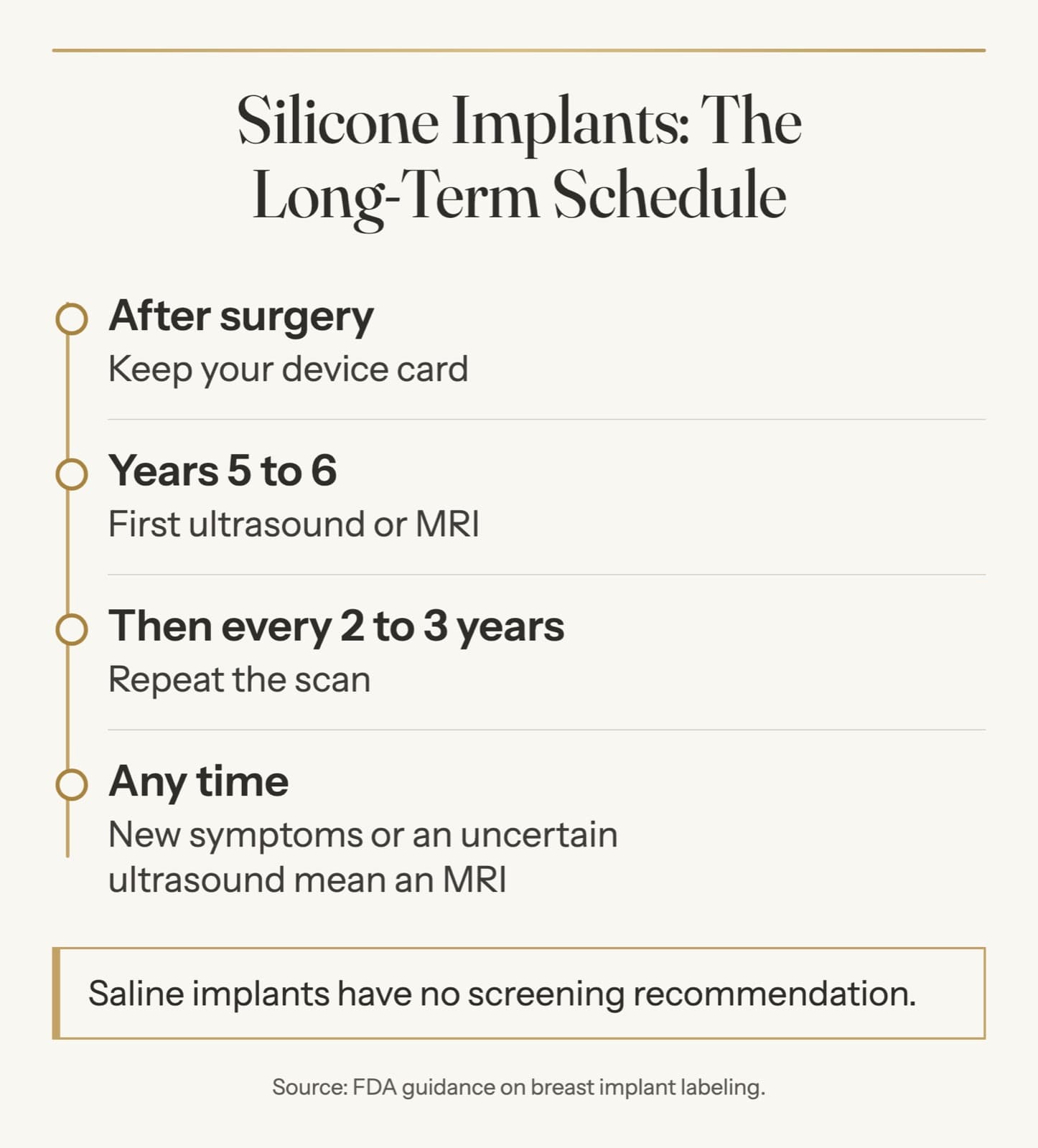
- Silicone: keep up with scans. The FDA recommends a first ultrasound or MRI at 5 to 6 years after surgery, then every 2 to 3 years, and an MRI if you have symptoms or an uncertain ultrasound result at any time. Saline has no screening recommendation.
- See your surgeon for an exam. ASPS says once a year is an option for checking your breast health and your implants.
- Keep having mammograms. Tell the facility about your implants when you book. Our guide to mammograms and breastfeeding with implants explains what changes.
- Report new changes promptly. The FDA says to see your surgeon or health care provider for any abnormal change in your breasts or implants. Persistent swelling, a lump or pain near an implant, even years later, needs checking. Our breast implant illness and BIA-ALCL guide explains why.
What happens if I take my implants out and don't replace them?
Your breasts may look different from how they did before implants. The FDA says some women who don't replace them may have dimpling, a concave chest wall, puckering or sagging. It adds that women with large implants, especially on top of the chest muscle, may have major cosmetic deformity. ASPS's 2025 statistics count 45,773 removals in augmentation patients that year, flat from 45,780 in 2024, so you would not be unusual in considering it.
Plan for the cost either way. The FDA says implant removal or replacement may not be covered by insurance, even if you have complications. An implant exchange is its own surgery, and the pricing section of our breast augmentation page lists what it costs here.
If you live in Florida or are flying in from another state
Implants outlast any trip, so plan for follow-up where you live. Before surgery, ask who you would see at home for a scan, an exam or a problem, and keep your device card somewhere you can find it years from now. Any surgeon who sees you later will want it.
If you are flying in, Dr. Victoria Karlinsky, MD, FACS, tells you, in writing, how many nights to stay in Miami before you fly home, and your surgery, pre-op and follow-up dates are confirmed in writing. The trip itself is yours to plan. From another state, you can start with a virtual consultation, and in South Florida you can book a free consultation. The FDA suggests asking "How long will my breast implants last?" at that visit, and an honest answer is that no one knows. The safety section of our breast augmentation page covers the long-term risks to weigh.
Frequently asked questions
Can breast implants last a lifetime?
Some women may keep the same implants for many years, but you shouldn't count on it. The FDA says implants are not lifetime devices and that you should assume you will need more surgery at some point. The studies we read stop at 10 years, so there is no good figure for how many implants last for life.
What happens if I keep my implants for 20 or 30 years?
No source we read sets an upper limit, and older implants are simply less studied, because the main studies stop at 10 years. The FDA says the longer you have implants, the more likely you are to have them removed or replaced. So keep up with scans if yours are silicone, and report any change to your surgeon.
Do newer implants last longer?
The sources we read don't answer this. The makers' studies cover the specific implants they tested, and Allergan's included textured implants that have since been withdrawn. The FDA says the life of breast implants can't be predicted, so be careful with anyone who promises you a number for a newer model.
Can breasts look good after implant removal?
No source we read gives a figure for how often women are happy with the result. The FDA warns about dimpling, puckering and sagging in some women, and more so after large implants. ASPS says some patients have a breast lift or an implant exchange to restore a more youthful contour, so ask your surgeon what your own skin and tissue would need.
Does insurance pay to replace breast implants?
Often not. The FDA says the cost of removal or replacement may not be covered by insurance, even if you have complications. ASPS says most health insurance plans won't cover cosmetic breast augmentation, related complications or another surgery to revise the appearance of your breasts. Check your own plan before you count on it.
What are the risks of replacing breast implants?
It is another operation, with its own risks, and the look you hoped for isn't assured. In the Natrelle saline labeling, Baker grade III or IV capsular contracture affected 13.2% of 126 replaced implants within 5 years. The sources we read give no recovery timeline specific to an exchange, so ask your surgeon what yours would involve, based on what is being done.
How will I know if my implant has ruptured?
With saline, the implant goes flat, usually so you can see it. With silicone, you probably won't know without a scan, because most ruptures are silent, though you may notice a change in size or shape, hard lumps, pain, tingling or swelling. Our saline vs silicone guide explains what happens next.
Sources
- FDA: What to Know About Breast Implants
- FDA: Things to Consider Before Getting Breast Implants
- FDA: Risks and Complications of Breast Implants
- FDA: Breast Implant Surgery
- FDA: Breast Implants, Certain Labeling Recommendations to Improve Patient Communication
- ASPS: What results should I expect after breast augmentation surgery?
- ASPS: How much does breast augmentation cost?
- ASPS: 2025 Procedural Statistics Release
- ASPS website, article by Gabby Shacknai: What to expect after your breast augmentation surgery
- ASPS website, article by Dr. Jonathan Kaplan: Do I need to change my breast implants every 10 years?
- ASPS video gallery: When Should You Replace Your Breast Implants?
- Sientra: Breast Augmentation with Sientra Silicone Gel Breast Implants, patient labeling
- Allergan: Natrelle Saline-Filled Breast Implants, patient labeling
- Plastic and Reconstructive Surgery: MemoryGel Breast Implants, Final Results after 10 Years (Caplin and colleagues, 2021)
- Plastic and Reconstructive Surgery: MemoryGel Breast Implants, full text (Caplin and colleagues, 2021)
- Plastic and Reconstructive Surgery: Natrelle round silicone breast implants, Core Study results at 10 years (Spear and Murphy, 2014)
What do real breast augmentation results look like?
These are photos of real Alluring patients after breast augmentation, shared with their consent. Results differ from person to person, and your surgeon talks you through what is realistic for your body at your free consultation, before you decide anything.
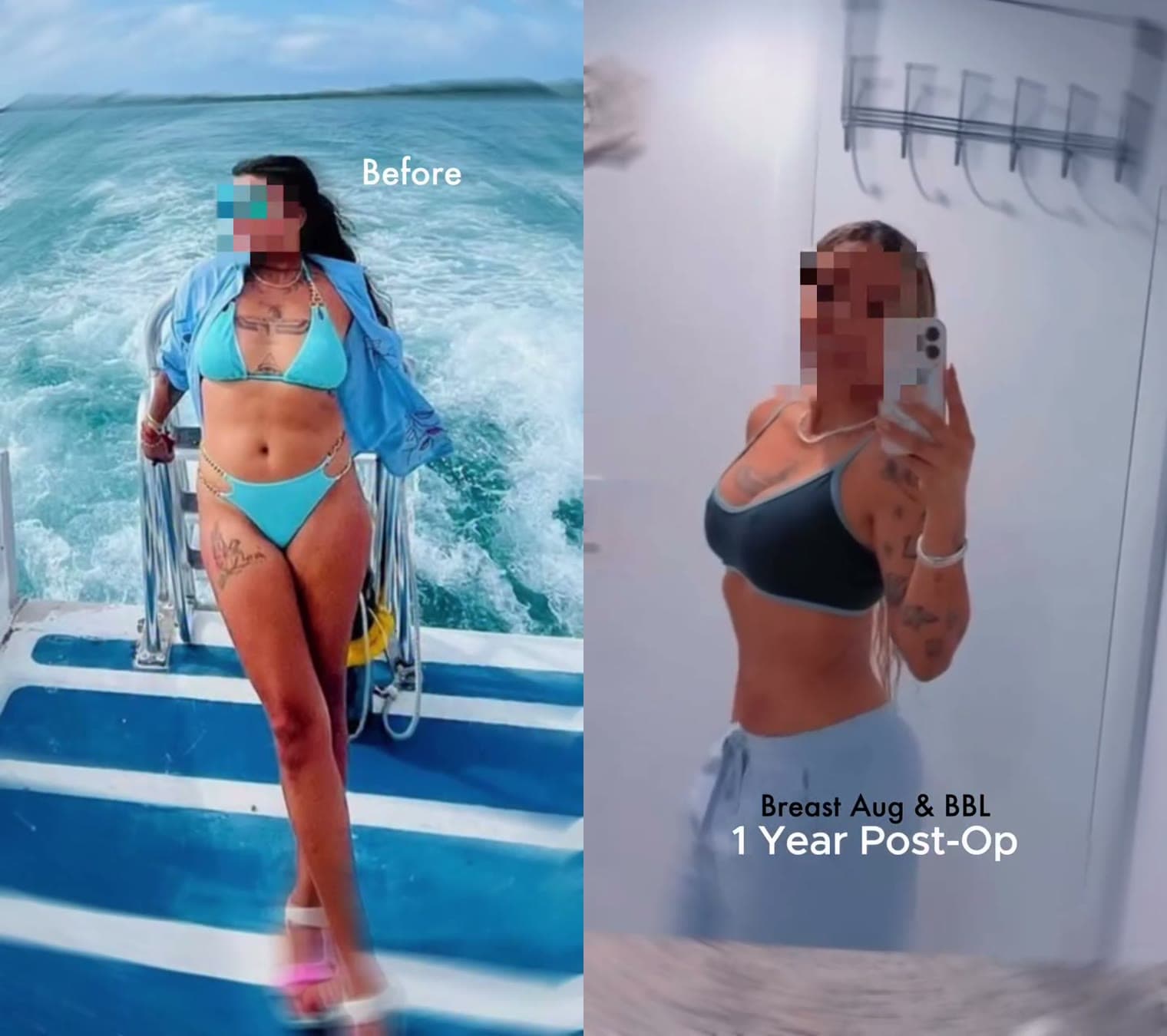
Before and after breast augmentation 
Before and after breast augmentation 
Before and after breast augmentation 
Before and after breast augmentation 
Before and after breast augmentation 
Before and after breast augmentation
Photos in this section are real Alluring patients.
See every breast augmentation photo in the galleryMeet your surgeon

Check her credentials yourself
Each link opens her record on the issuing body's own site.
Licensed as a medical doctor by the Florida Department of Health.
Board certified in general surgery by the American Board of Surgery since 2008.
Fellow of the American College of Surgeons (FACS).
Certified in cosmetic surgery by the American Board of Cosmetic Surgery. The specialty recognition identified herein has been received from a private organization not affiliated with or recognized by the Florida Board of Medicine.
Start here
Personal care. Honest price.
Your price, surgery date and follow-up plan, in writing, before you book a flight.