

Liposuction After Ozempic: Are You a Candidate?
Liposuction can remove stubborn fat after GLP-1 weight loss once your weight is stable, but it doesn't tighten loose skin. Here's who is a candidate, when a tummy tuck fits better, and what current anesthesia guidance says about Ozempic, Wegovy and Zepbound.
Last updated:
Can you get liposuction after Ozempic?
Often yes, once your weight is stable: The Aesthetic Society says to wait if you plan to lose a significant amount of weight, and liposuction doesn't tighten loose skin. Tell your surgeon you take a GLP-1 medication. 2024 guidance from the American Society of Anesthesiologists and partner societies says most patients can keep taking it.
Can you get liposuction after Ozempic?
Yes, many people can, once their weight has settled and if the problem is pockets of fat rather than loose skin. Liposuction reshapes specific areas; it isn't a way to keep losing weight, and it doesn't tighten skin. Whether you can keep taking your medication up to surgery is a separate question that your surgeon and anesthesia team answer together.
The rest of this guide walks through the three things that decide it: how stable your weight is, what your skin looks like, and how your GLP-1 medication fits with anesthesia.
Does liposuction work after Ozempic?
It works for the same thing it always does: removing stubborn fat from an area, such as the abdomen, flanks, back, arms or thighs, where it stays despite weight loss. How you lost the weight doesn't change what liposuction can do.
What weight loss often changes is the skin. The Aesthetic Society says liposuction removes fat but does not tighten skin, and Cleveland Clinic notes that saggy, loose skin, which liposuction alone can't improve, is common after significant weight loss. So after a large loss, the honest answer depends on how much your skin has bounced back.
Ozempic vs liposuction: what each one does
They aren't alternatives so much as tools for different jobs.
| GLP-1 medication (Ozempic, Wegovy, Zepbound) | Liposuction | |
|---|---|---|
| What it changes | Body weight overall | The shape of chosen areas |
| Used for | Diabetes, weight loss or heart problems (ASA) | Stubborn fat; ASPS says it isn't an obesity treatment |
| Loose skin | Common after significant weight loss (Cleveland Clinic) | Doesn't tighten it (The Aesthetic Society) |
| Who decides | Your prescribing doctor | Your surgeon, at an exam |
ASPS says liposuction is not a treatment for obesity or a substitute for proper diet and exercise. For many people the order is medication first, then liposuction for the areas that didn't respond, once the weight has held steady.
Is your weight stable enough for liposuction?
Weight comes first. The Aesthetic Society says your weight should be stable before liposuction, and if you are planning to lose a significant amount of weight, you should wait.
A surgeon quoted in an ASPS article on body contouring after GLP-1 weight loss puts it plainly: patients should be at or near the end of their weight loss before surgery, because if they keep losing significant weight afterward, they may look a little loose again.
None of the sources we reviewed gives a set number of months of stable weight before liposuction, so we won't invent one. Your surgeon will look at your weight history, where you are on your medication, and your goals.
Am I a candidate for lipo on Ozempic?
You may be if most of these describe you:
- Your weight has settled. You're at or near your goal and not still losing steadily, as The Aesthetic Society advises.
- You're close to a healthy weight. ASPS describes ideal candidates as adults within 30% of their ideal weight, with firm, elastic skin and good muscle tone. That is a description, not a cutoff; your surgeon decides at an exam.
- Your skin is fairly firm. Stubborn fat under skin that has mostly bounced back suits liposuction. Hanging or crepey skin usually needs a procedure that removes skin.
- You don't smoke or vape. ASPS lists this among its candidate criteria.
- You're not in the early dose-increase phase or having stomach side effects. That matters for anesthesia, as the next sections explain.
- You're eating enough. Healing needs protein and nutrients, which can be harder to get when a GLP-1 medication blunts your appetite.
The who is a good candidate for liposuction section of our liposuction page goes through the same checklist, including when another procedure suits you better.
Is lipo enough after Ozempic, or do you need a tummy tuck?
Liposuction is enough when the concern is fat. When the concern is loose skin, it usually isn't.
An ASPS page on tummy tucks quotes a surgeon explaining that your skin can only contract so much after liposuction, and if there's additional skin, it may need to be removed with a tummy tuck. ASPS describes a tummy tuck as removing excess fat and skin and, in most cases, restoring weakened or separated muscles. Arms, thighs and other areas have their own skin-removal procedures.
| Often suits liposuction | Often needs skin removal |
|---|---|
| Stubborn fat under firm skin | Skin that hangs or folds |
| A defined bulge in one or two areas | Loose skin across the lower abdomen |
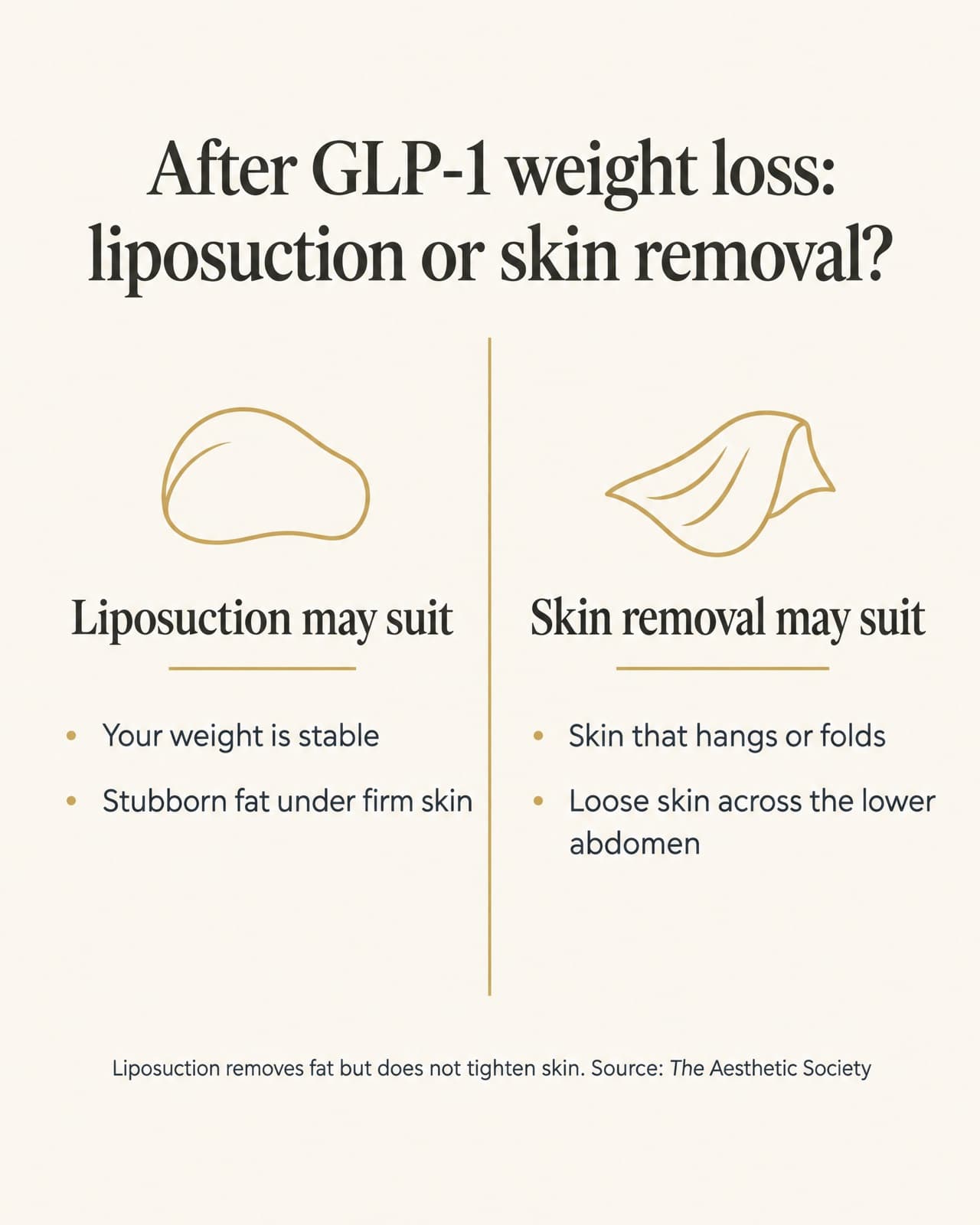
Only an exam can tell for sure. Many people fall in between, and some combine liposuction with a tummy tuck. That's a real option, but combining procedures adds to the surgery: a study in the Aesthetic Surgery Journal (Kaoutzanis and colleagues, 2017) found that combining liposuction with other procedures, especially in older patients or patients with obesity, can significantly increase complication rates. Our comparison of tummy tuck vs. liposuction and the tummy tuck in Miami page cover how to tell which you need.
Ozempic, Wegovy, Zepbound and anesthesia: do you have to stop?
Not always, and you shouldn't decide on your own. Tell your surgeon at the consultation that you take a GLP-1 medication, and follow the plan your surgeon and anesthesia team give you.
Here's why it matters. These medications slow how quickly food leaves your stomach. The American Society of Anesthesiologists explains that food still in the stomach during general anesthesia or deep sedation can flow back into the airway or lungs, a serious complication called aspiration. Its patient page lists semaglutide (Ozempic, Wegovy, Rybelsus), tirzepatide (Mounjaro, Zepbound) and others.
What the current multi-society guidance says
In October 2024, the American Society of Anesthesiologists and four partner societies in gastroenterology, bariatric surgery, obesity care and endoscopic surgery issued guidance that:
- Most patients can keep taking the medication before elective surgery.
- The decision is shared between you, your surgeon, your anesthesia team and the doctor who prescribes the medication.
- Higher-risk patients get extra steps. People in the dose-increase phase, which the guidance says typically lasts 4 to 8 weeks, should put off elective surgery until it has passed and stomach side effects have settled. People with nausea, vomiting, abdominal pain or constipation should wait until the symptoms are gone. People on higher doses should follow a liquid diet for 24 hours before the procedure.
- Other safeguards include adjusting the anesthesia plan and using an ultrasound before surgery to check whether the stomach is empty. In rare cases, surgery is delayed.
If your team does decide to pause the medication, the full guidance is candid that "the duration to hold therapy is unknown." For now, it suggests following the American Society of Anesthesiologists' original advice: hold a weekly injection for the week before surgery and a daily medication on the day of surgery.
Why you may hear different advice
Some ASPS articles, before and after the guidance, are more cautious. An ASPS article from June 2024 quoted a surgeon who said most anesthesia doctors require stopping weight-loss medications for at least 2 to 3 weeks before general anesthesia. The March 2025 ASPS article cited above, published after the guidance, says patients will need to stop their weight-loss medication before surgery, and quotes a surgeon who asks patients to stop one month ahead so they can work on their nutrition. Practices differ, and the right plan depends on your dose, your symptoms and the anesthesia you'll have. The instructions from your own surgeon and anesthesia team are the ones to follow.
Recovery after GLP-1 weight loss: what's different?
We found no source showing that liposuction recovery itself runs on a different schedule after GLP-1 weight loss. The standard timeline applies:
- Walk right away. MedlinePlus advises walking as soon as possible after surgery to help prevent blood clots.
- Swelling peaks, then settles. The Aesthetic Society says swelling peaks around 48 hours, mostly goes down within 2 to 3 weeks, and slight swelling can last up to 4 months.
- Garment and exercise. The Aesthetic Society says you wear a compression garment for 4 to 6 weeks and avoid strenuous exercise for 4 to 6 weeks.
- Work. The Aesthetic Society says most people return within a few days; ASPS puts it in weeks 2 to 3, depending on your job.
- Final result. Cleveland Clinic says it can take 3 to 6 months for swelling to go away completely.
Where GLP-1 history does matter is nutrition. The March 2025 ASPS article notes that without enough calories and food, these medications can deplete the vitamins, minerals and nutrients the body needs to heal, and a surgeon quoted there recommends plenty of protein and regular weightlifting after rapid weight loss to protect muscle. Our guide on what to eat after liposuction covers protein and fluids, and when you can work out after lipo covers getting back to the gym.
Ask your surgeon and your prescribing doctor when to restart your medication after surgery; it's part of the same plan.
What does liposuction after Ozempic cost?
At Alluring, Lipo 360 starts at $4,000, and your price is set after an exam. For a national comparison, ASPS puts the average cost of liposuction at $4,711, a surgeon's fee that does not include anesthesia, operating room facilities or other related expenses. The Lipo 360 cost section explains what affects your price.
Planning a consultation
Bring the name and dose of your medication, when you started it, when you last increased the dose, any stomach side effects, and your weight over the past year. That gives Dr. Victoria Karlinsky, MD, FACS, what she needs to tell you whether liposuction, a skin-removal procedure or waiting a little longer makes the most sense. You can start with a free consultation.
Frequently asked questions
How does being on Ozempic or Zepbound affect my candidacy for liposuction?
Being on the medication doesn't rule you out. What matters is whether your weight has stabilized, whether your skin is firm enough for liposuction alone, and whether you're past the dose-increase phase without stomach side effects. The 2024 multi-society guidance says most patients can continue these medications before elective surgery, with extra steps for higher-risk patients. Your surgeon and anesthesia team make the final call.
Can I get evaluated for liposuction while I'm still losing weight on medication?
Yes. A consultation while you're still losing weight can help you plan: your surgeon can look at your skin, talk about which areas are likely to need treatment and suggest when to come back. The surgery itself usually waits. The Aesthetic Society says that if you are planning to lose a significant amount of weight, you should wait to have liposuction.
Is liposuction after Ozempic different from liposuction after dieting?
The procedure is the same, and we found no source showing a different recovery timeline. The differences are around it: GLP-1 medications need a plan for anesthesia, a smaller appetite can make it harder to eat the protein and nutrients healing needs, and faster weight loss may leave more loose skin. Your surgeon weighs all three at your consultation.
Will liposuction tighten loose skin after Ozempic?
No. The Aesthetic Society says liposuction removes fat but does not tighten skin, and Cleveland Clinic says liposuction alone can't improve saggy, loose skin, which is common after significant weight loss. If loose skin is your main concern, a procedure that removes skin, such as a tummy tuck on the abdomen, is usually the better fit. Some people combine the two.
Will the fat come back if I stop Ozempic after liposuction?
The fat cells liposuction removes don't come back; Cleveland Clinic says the procedure removes them permanently. The fat cells that remain can still grow if you regain weight, and ASPS says liposuction results last as long as you keep a stable weight and general fitness. Whether and when to stop or restart your medication is a decision to make with your prescribing doctor.
Do I need to stop Ozempic before liposuction?
Not necessarily. Guidance from the American Society of Anesthesiologists and partner societies says most patients can keep taking GLP-1 medications before elective surgery, with a liquid diet for 24 hours or a delay for higher-risk patients. Some surgeons still ask patients to pause for longer. Don't stop or skip doses on your own; follow the plan your surgeon and anesthesia team give you.
Sources
- American Society of Anesthesiologists: New Multi-Society GLP-1 Clinical Practice Guidance Released
- American Society of Anesthesiologists: Drugs for Diabetes or Weight Loss: What To Know Before Surgery
- Kindel and colleagues: Multi-society clinical practice guidance for the safe use of glucagon-like peptide-1 receptor agonists in the perioperative period (PMC)
- American Society of Plastic Surgeons: Move over, mommy makeover: The "Ozempic makeover" may be the hottest new trend
- American Society of Plastic Surgeons: Understanding how medications interact with anesthesia and when to stop before plastic surgery
- American Society of Plastic Surgeons: Liposuction
- American Society of Plastic Surgeons: What results should I expect after liposuction?
- American Society of Plastic Surgeons: Are you a good candidate for liposuction?
- American Society of Plastic Surgeons: What should I expect during my liposuction recovery?
- American Society of Plastic Surgeons: How much does liposuction cost?
- American Society of Plastic Surgeons: Tummy tuck
- The Aesthetic Society: Liposuction
- The Aesthetic Society: Liposuction aftercare and recovery
- Cleveland Clinic: Liposuction
- MedlinePlus: Liposuction
- Aesthetic Surgery Journal: Kaoutzanis and colleagues, Cosmetic liposuction: preoperative risk factors, major complication rates, and safety of combined procedures
Not Sure Which Procedure Is Right for You?
Take our free 2-minute quiz to get personalized recommendations based on your goals, lifestyle, and budget.
Take the QuizStart Your Journey Today
Leave your name and phone number. We'll call you within 24 hours to discuss your goals.
Or call us directly
+1 (786) 305-8649Related Articles
Continue reading with these related posts

How to Fix Dents After BBL?
After undergoing a Brazilian Butt Lift BBL, some patients may notice dents or irregularities in the treatment area—an...

How to Sleep After Liposuction: Positions and Your Garment
Many people sleep most comfortably on their back, slightly raised, in their compression garment; after Lipo 360 your surgeon may prefer another position. Here is whether you can sleep without the garment, when side and stomach sleeping come back, and which night-time signs mean calling your surgeon.
How Long After Mommy Makeover Can I Drive?
Recovering from your Mommy Makeover requires patience, especially when it comes to resuming daily activities like driving. Most...

How to Sleep After BBL?
Recovering properly after your Brazilian Butt Lift requires careful attention to your sleeping position. How to sleep...
How to Reduce Itching After Lipo?
Itching after liposuction is common as skin and nerves heal. Here is what calms it, how to handle itching under your compression garment, what to ask before using creams or antihistamines, and when an itch or rash means call your surgeon.
Do BBLs Stink? What BBL Smell Is and How Long It Lasts
A healed BBL doesn't smell. Odor during recovery usually comes from incision drainage and a sweaty compression garment. Here's what's normal, how long it lasts, how to prevent it and when a smell means infection, checked against ASPS and Cleveland Clinic.
Related Procedures
Explore the procedures discussed in this article

Liposuction Miami
Liposuction in Miami, with Lipo 360 starting at $4,000. Every liposuction at Alluring is performed by Victoria Karlinsky, MD, FACS.

Mommy Makeover Miami
A comprehensive combination of personalized procedures to restore your pre-pregnancy body, with flexible financing options to fit your budget.

Brazilian Butt Lift (BBL) Miami
BBL in Miami starting at $5,500. Every BBL at Alluring is performed by Victoria Karlinsky, MD, FACS, who places the fat under the skin with ultrasound guidance, as Florida law requires.
More Liposuction Articles
Do BBLs Stink? What BBL Smell Is and How Long It Lasts
A healed BBL doesn't smell. Odor during recovery usually comes from incision drainage and a sweaty compression garment. Here's what's normal, how long it lasts, how to prevent it and when a smell means infection, checked against ASPS and Cleveland Clinic.
How to Reduce Itching After Lipo?
Itching after liposuction is common as skin and nerves heal. Here is what calms it, how to handle itching under your compression garment, what to ask before using creams or antihistamines, and when an itch or rash means call your surgeon.

Lipo Foam and Boards: What They Do, How Long to Wear Them
Lipo foam is a soft sheet worn on the skin under your compression garment after liposuction, and boards add a firm layer on top. Here is what each does, how to wear them, how to protect your skin and why your surgeon sets how long.