
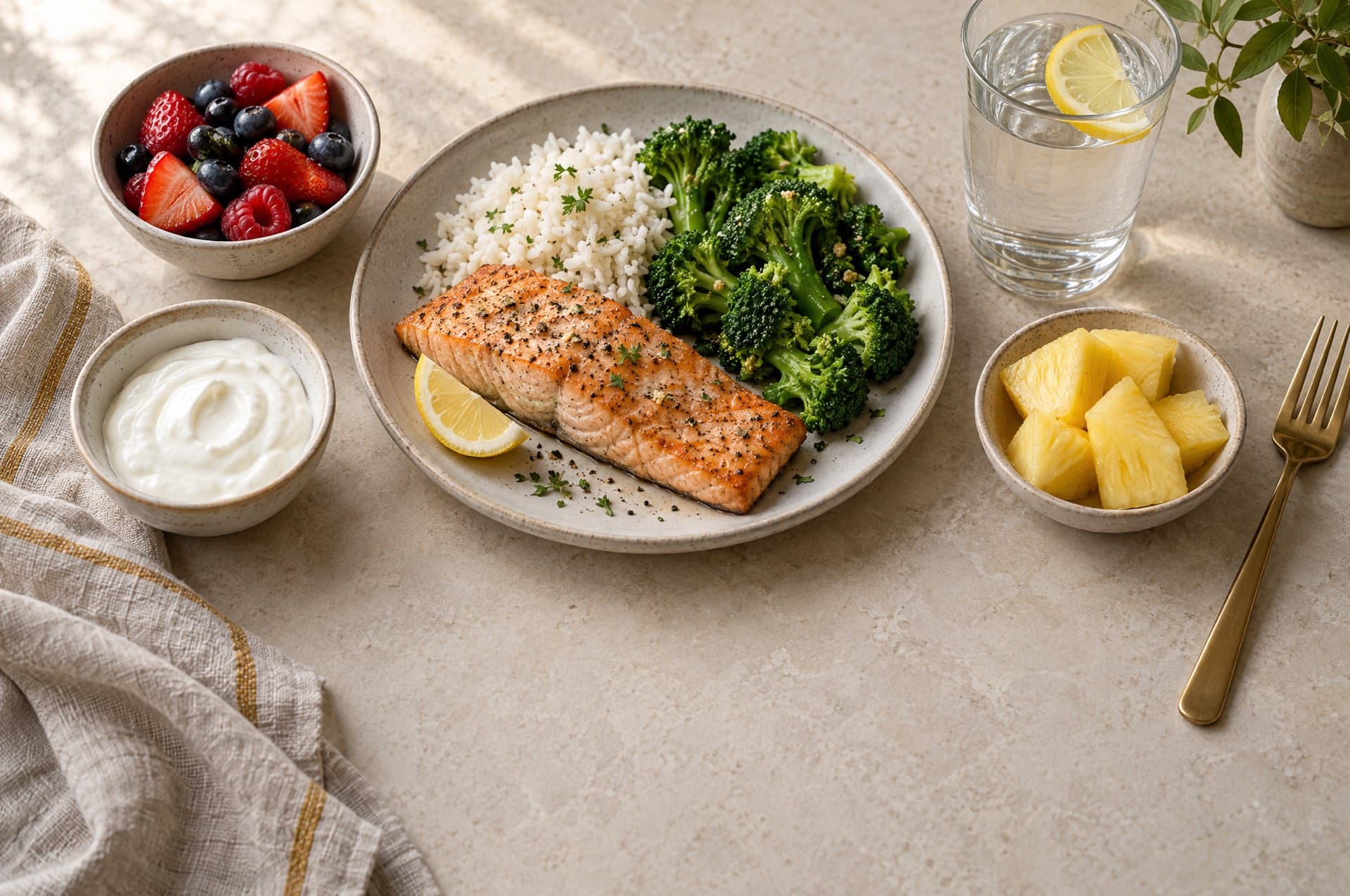
What to Eat and Avoid After Liposuction: Food List
Skip alcohol, salty processed food, sweets and unapproved supplements while you heal, and build meals around protein, fruit, vegetables and fluids. Here is what to eat in the first days, how to avoid constipation, and a sample day.
Last updated:
What should you eat and avoid after liposuction?
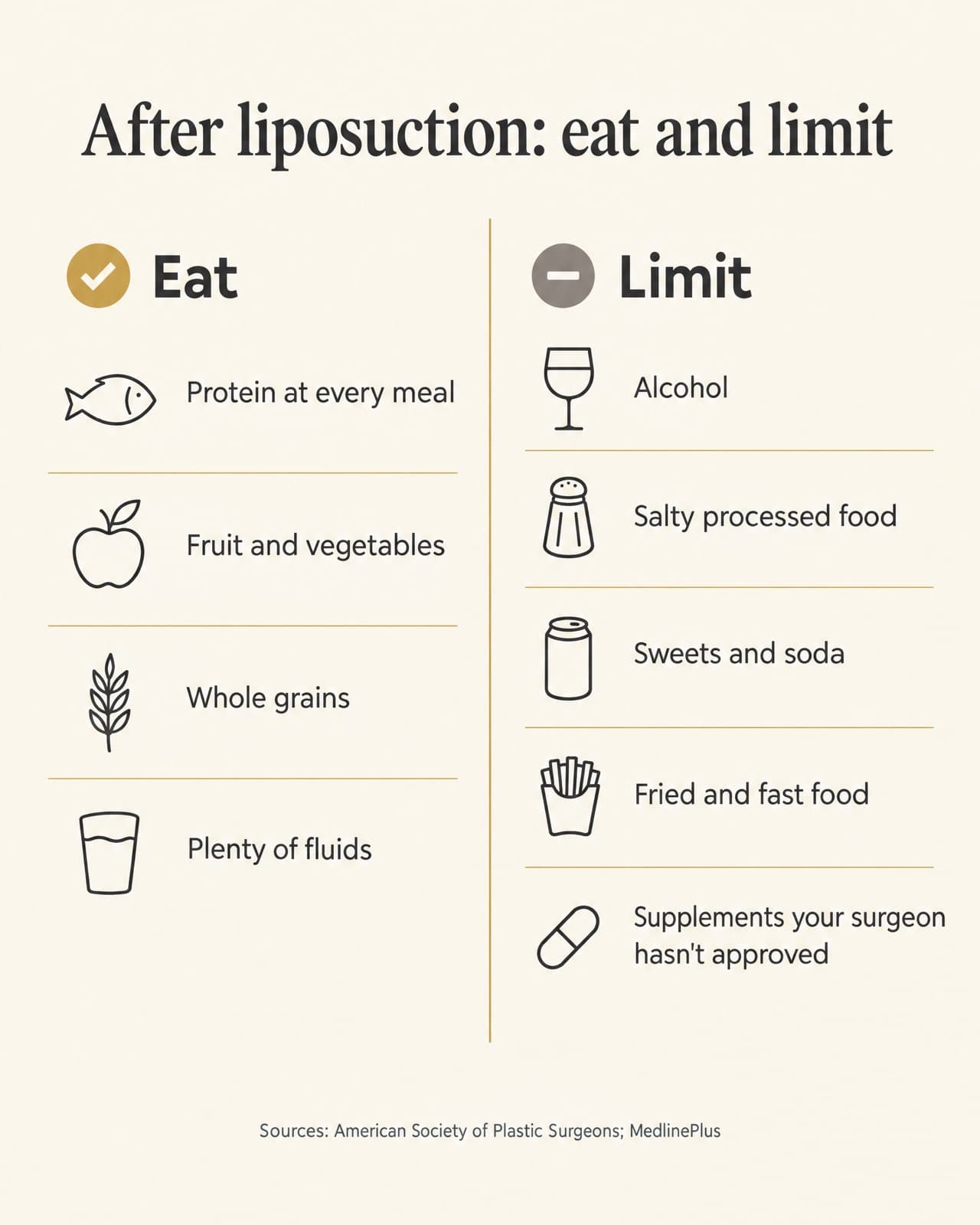
Build meals around protein, fruit, vegetables, whole grains and plenty of fluids. Avoid alcohol, high-sodium processed food and refined sugar, as a surgeon quoted in an American Society of Plastic Surgeons article advises. Check every supplement with your surgeon first; that surgeon says vitamin E, ginkgo, garlic, ginseng and fish oil can raise bleeding risk.
What should I eat after liposuction?
Eat simple, protein-rich meals with plenty of fruit, vegetables and fluids, and skip alcohol, salty convenience food and sugary snacks while you heal. There is no special liposuction diet. What your body needs is the raw material to repair tissue, enough fluid, and food that keeps your stomach settled and your bowels moving while you take pain medicine.
The same advice applies after Lipo 360, which treats a larger area in one surgery. If your surgeon has given you a specific diet, for example because of diabetes or a heart or kidney condition, follow theirs first.
Foods to avoid after liposuction
These are the foods and drinks to limit in the first weeks, and why:
- Alcohol. A surgeon quoted in an American Society of Plastic Surgeons (ASPS) article on nutrition after surgery calls it "a triple threat": it widens blood vessels, which raises the risk of bleeding and prolonged swelling, disrupts sleep and dehydrates you. MedlinePlus adds that you should not drink alcohol at all while taking narcotic pain medicine.
- Salty and high-sodium foods. The same surgeon, Dr. Josef Hadeed, says high-sodium foods should be avoided during recovery. MedlinePlus explains that the body uses sodium to control blood volume, and it says healthy adults should limit sodium to 2,300 mg a day. Common sources include processed meats like bacon, sausage and ham, canned soups and fast food. No study has measured salt and swelling after liposuction specifically, so treat this as sensible practice rather than proven fact.
- Refined sugar and sweets. Dr. Hadeed says refined sugars should be avoided too, and another surgeon quoted in the same ASPS article, Dr. Katerina Gallus, says very refined foods add little to healing and can push blood sugar up, which can impair healing.
- Greasy, fried and heavily processed food. In the first days these are harder on a queasy stomach. MedlinePlus advice for nausea and for constipation both list them as foods to avoid: white bread, pastries, doughnuts, sausage, fast-food burgers, chips and fries.
- Supplements your surgeon hasn't approved. Some raise bleeding risk. More on this below.
| Limit this | Why | Try instead |
|---|---|---|
| Alcohol | Bleeding, swelling, dehydration; unsafe with pain medicine | Water, milk, diluted juice |
| Salty processed food | High sodium | Home-cooked chicken, fish, eggs |
| Sweets and soda | Blood sugar, little nutrition | Fruit, yogurt |
| Fried and fast food | Hard on the stomach, low in fiber | Baked chicken or fish, rice, potatoes |
| Unapproved supplements | Some raise bleeding risk | Ask your surgeon first |
What to eat the first few days after liposuction
Anesthesia and pain medicine can leave you queasy, so start gently. MedlinePlus suggests eating 6 to 8 small meals through the day instead of 3 big ones when you feel nauseated, and choosing bland foods such as crackers, toast, baked chicken and fish, potatoes, noodles and rice. Clear soups and foods with a lot of water in them help too.
Sip fluids steadily rather than gulping. If your pain medicine upsets your stomach, MedlinePlus suggests taking it with food. Vomiting can dehydrate you, so if you can't keep fluids down, call your surgeon's office rather than waiting it out.
Your appetite may be small for a few days. That's common, and it's one reason to put protein first on your plate.
How to prevent constipation after liposuction
Narcotic pain medicine often causes constipation. MedlinePlus lists four things that help: drink more fluids, get more exercise, eat foods with extra fiber, and use stool softeners. Ask your surgeon which stool softener to use before you take one.
Walking counts as exercise here. MedlinePlus advises walking as soon as possible after liposuction to help prevent blood clots, and it helps your bowels too.
For fiber, MedlinePlus lists fruits such as berries, grapes, peaches, plums and prunes; vegetables such as broccoli, squash and potatoes with the skin on; beans, lentils and nuts; and whole-grain bread and pasta. Add fiber gradually, because a sudden increase can cause bloating and gas. MedlinePlus says to contact your provider if you haven't had a bowel movement in 3 days, or if you are bloated or have stomach pain.
How much protein do you need after liposuction?
Protein comes first because healing depends on it. A surgeon quoted in the ASPS article explains that wound healing needs a significant amount of amino acids to make collagen, and a registered dietitian quoted by Cleveland Clinic says that too little protein impairs collagen formation and slows healing.
None of the sources we reviewed sets a protein target for liposuction specifically, so we don't give one. If you have kidney disease or another condition that limits protein, ask your doctor. For most people, a practical approach is some protein at every meal and snack:
- Chicken, fish and lean beef. Dr. Gallus, in the ASPS article, calls them the most protein for your money.
- Eggs, Greek yogurt, milk and cheese. Easy to eat when your appetite is low.
- Beans, lentils, tofu and nuts. Protein plus fiber, which helps with constipation.
The Cleveland Clinic dietitian's tip for a small appetite: eat the protein part of your meal first, in case you fill up. Vitamin C and zinc matter too; Dr. Hadeed, in the ASPS article, notes that vitamin C is essential for making collagen and zinc supports immune function. Citrus, berries, peppers, meat, beans and nuts cover both.
How much water should you drink after liposuction?
Drink steadily through the day. A surgeon quoted in the ASPS article says women need about 11.5 cups of fluids a day, and more in a hot environment or with intense exercise. Water is the base; milk, broth and diluted juice count too.
If your surgeon has given you a fluid limit because of a medical condition, follow it.
Foods to reduce swelling after liposuction
No food makes swelling go away. Swelling follows its own timeline: The Aesthetic Society says it peaks around 48 hours, mostly goes down within 2 to 3 weeks, and slight swelling can last up to 4 months. The garment, walking and time do most of the work. For the full timeline, see our guide to reducing swelling after liposuction.
Food can support that process. Dr. Hadeed, a surgeon quoted in the ASPS article, says there is "some evidence" that omega-3 fatty acids, bromelain-rich foods such as pineapple, turmeric and ginger can reduce bruising, swelling and inflammation after surgery. That is a modest claim, and it means food sources, such as fatty fish, not fish-oil supplements: the same surgeon lists fish oil among supplements that can increase bleeding risk.
A sample day of eating after liposuction
This is an example, not a prescription. Adjust portions to your appetite and swap in foods you like.
| Time | Meal |
|---|---|
| Breakfast | Scrambled eggs, whole-grain toast, berries |
| Mid-morning | Greek yogurt with sliced peaches |
| Lunch | Baked chicken, rice, steamed broccoli |
| Afternoon | Pineapple chunks and a handful of almonds |
| Dinner | Baked salmon, potato with the skin on, green beans |
| Evening | A glass of milk or a small bowl of lentil soup |
Keep water nearby all day. If you feel queasy in the first days, go blander: toast, rice, noodles and plain chicken, in smaller amounts, more often.
Supplements after liposuction: ask your surgeon first
Don't start, stop or restart any vitamin or supplement around surgery without your surgeon's approval. Dr. Hadeed, a surgeon quoted in the ASPS article, lists vitamin E, ginkgo biloba, garlic, ginseng and fish oil as supplements that can increase the risk of bleeding, and the article itself says surgeons stress that every vitamin and over-the-counter product should be reviewed before surgery.
The same article quotes a surgeon who says arnica, bromelain and probiotics can help with bruising, swelling and gut health. Evidence for these is limited and products vary, so treat them as a question for your surgeon rather than a shopping list. For bruising specifically, see how to get rid of bruising after liposuction.
At your consultation at Alluring, bring a written list of every medicine, vitamin and supplement you take, with doses. It's one of the most useful things you can bring.
What to eat after Lipo 360
Eat the same way after Lipo 360 as after liposuction of a single area. Lipo 360 treats the abdomen, flanks and back together (see what Lipo 360 covers), so recovery can feel bigger, which makes protein, fluids and fiber all the more useful. There is no separate Lipo 360 diet.
If you had a BBL with Lipo 360
A Brazilian butt lift moves some of the removed fat to the buttocks, and eating to support the grafted fat raises questions of its own. Our guide on how to feed the fat after a BBL covers what to eat after a BBL combined with Lipo 360.
Will what you eat affect your liposuction results?
Yes, over the long run. Liposuction is not a treatment for obesity or a substitute for diet and exercise, ASPS says. Cleveland Clinic says liposuction permanently removes fat cells, but the fat cells that remain can still grow if you gain weight, and ASPS says results last as long as you keep a stable weight and general fitness.
That doesn't mean dieting hard while you heal. Recovery is the time to eat enough of the right foods, not to cut calories. Once you're healed, a steady, balanced way of eating is what protects your shape. The final result shows at 3 to 6 months, once swelling has gone, according to Cleveland Clinic; our page on liposuction recovery walks through each stage.
When to call your surgeon
| Usually normal | Call your surgeon |
|---|---|
| Small appetite for a few days | You can't keep fluids down |
| Mild queasiness after pain medicine | Vomiting that doesn't stop |
| Slower bowels while on pain medicine | No bowel movement in 3 days, bloating or stomach pain (MedlinePlus) |
| Swelling that slowly eases | Pain, redness or warmth in one leg (MedlinePlus lists these as signs of a clot) |
Call 911 for chest pain, difficulty breathing or coughing up blood, which MedlinePlus lists as emergency signs of a clot.
Planning your liposuction
If you're still deciding, a consultation is the place to talk through your health, your medicines and what recovery will look like for you. You can read about who is a good candidate for liposuction or book a free consultation with Dr. Victoria Karlinsky, MD, FACS.
Frequently asked questions
Can I eat rice after liposuction?
Yes. Rice is on MedlinePlus's list of bland foods to try when you feel nauseated, alongside crackers, toast, noodles and potatoes, so it's a good choice for the first days. Once your stomach settles, brown rice and other whole grains add fiber, which helps with the constipation pain medicine can cause. Pair rice with a protein such as chicken, fish or beans.
What can I eat for breakfast after lipo?
Aim for protein plus something gentle. Scrambled eggs with toast, Greek yogurt with fruit, or oatmeal made with milk and topped with berries all work. In the first days, when you may feel queasy, keep portions small and bland. Later, add whole-grain bread and fruit for fiber. Have a glass of water with it, and take pain medicine with food if it upsets your stomach.
When can I drink alcohol after liposuction?
None of the sources we reviewed gives a set number of days. A surgeon quoted in ASPS's nutrition article says alcohol before and after surgery can increase bleeding and bruising and should be avoided, and MedlinePlus says not to drink alcohol while taking narcotic pain medicine. The practical answer is to wait until you're off pain medicine and your surgeon says it's fine.
Is there a liposuction diet menu?
There is no official liposuction diet or menu. The pattern the sources support is simple: protein at every meal, fruit, vegetables and whole grains, plenty of fluids, and limits on alcohol, salty processed food and sweets. The sample day above shows one way to put that together. If you have a medical condition that affects your diet, your surgeon or doctor may adjust it.
Can overeating after liposuction bring the fat back?
The fat cells removed during liposuction don't come back, Cleveland Clinic says, but the fat cells that remain can grow if you gain weight, including in treated areas. That's why ASPS says results last as long as you keep a stable weight and general fitness. Eating well in recovery won't undo your result; a sustained weight gain over months can change it.
What vitamins should I take before liposuction?
Don't start any vitamin or supplement before surgery without asking your surgeon. A surgeon quoted in ASPS's nutrition article lists vitamin E, ginkgo biloba, garlic, ginseng and fish oil among supplements that can increase bleeding risk, and the article says every vitamin and over-the-counter product should be reviewed before surgery. Bring a full list to your consultation, and your surgeon will tell you what to stop and when.
Sources
- American Society of Plastic Surgeons: What to eat (and drink) while you heal: Nutrition's role in plastic surgery recovery
- American Society of Plastic Surgeons: Liposuction
- American Society of Plastic Surgeons: What results should I expect after liposuction?
- MedlinePlus: Pain medications - narcotics
- MedlinePlus: Sodium in diet
- MedlinePlus: When you have nausea and vomiting
- MedlinePlus: Constipation - self-care
- MedlinePlus: Liposuction
- MedlinePlus: Deep vein thrombosis
- Cleveland Clinic: What to eat when you're trying to heal
- Cleveland Clinic: Liposuction
- The Aesthetic Society: Liposuction aftercare and recovery
Not Sure Which Procedure Is Right for You?
Take our free 2-minute quiz to get personalized recommendations based on your goals, lifestyle, and budget.
Take the QuizStart Your Journey Today
Leave your name and phone number. We'll call you within 24 hours to discuss your goals.
Or call us directly
+1 (786) 305-8649Related Articles
Continue reading with these related posts

What Is J-Plasma Lipo? Renuvion, FDA Status and Cost
J-Plasma lipo is liposuction followed by Renuvion, a helium plasma device that heats the tissue under the skin so it contracts. Here is what the FDA has and hasn't cleared, who it suits, how it compares with a tummy tuck, and what it costs.

How to Get Rid of Fibrosis After Lipo, Including at Home
Hard, lumpy areas after liposuction are usually healing tissue that softens with time. Here is what you can safely do at home, how fibrosis differs from a seroma or hematoma, and what the research says about treatment.
What Is a Double BBL?
Many patients seeking enhanced results consider a double BBL as their path to achieving their desired aesthetic goals. A double BBL refers to a secondary Brazilian Butt...

Liposuction Swelling Timeline, Week by Week
Liposuction swelling peaks around 48 hours, is mostly down within 2 to 3 weeks and can take 3 to 6 months to clear completely. Here is the week-by-week timeline, how to reduce swelling, what fluid pockets and hard swelling mean, and when to call your surgeon.
How to Regain Sensation After Breast Reduction?
Feeling concerned about sensation changes after your procedure is completely normal. We'll guide you through proven methods to restore sensation after Breast...

How to Fix Uneven Liposuction: When to Wait, What Works
An uneven result after liposuction is upsetting, and it is often too early to judge. Here is how to tell swelling from a lasting irregularity, what causes dents and bulges, and how revision liposuction, fat grafting and other fixes work.
Related Procedures
Explore the procedures discussed in this article

Liposuction Miami
Liposuction in Miami, with Lipo 360 starting at $4,000. Every liposuction at Alluring is performed by Victoria Karlinsky, MD, FACS.

Brazilian Butt Lift (BBL) Miami
BBL in Miami starting at $5,500. Every BBL at Alluring is performed by Victoria Karlinsky, MD, FACS, who places the fat under the skin with ultrasound guidance, as Florida law requires.
Tummy Tuck Miami
Tummy tuck in Miami, from a mini at $3,000 to a full tummy tuck at $4,500. Every tummy tuck at Alluring is performed by Victoria Karlinsky, MD, FACS.
More Liposuction Articles

Liposuction After Ozempic: Are You a Candidate?
Liposuction can remove stubborn fat after GLP-1 weight loss once your weight is stable, but it doesn't tighten loose skin. Here's who is a candidate, when a tummy tuck fits better, and what current anesthesia guidance says about Ozempic, Wegovy and Zepbound.

Do BBLs Stink? What BBL Smell Is and How Long It Lasts
A healed BBL doesn't smell. Odor during recovery usually comes from incision drainage and a sweaty compression garment. Here's what's normal, how long it lasts, how to prevent it and when a smell means infection, checked against ASPS and Cleveland Clinic.

How to Reduce Itching After Lipo?
Itching after liposuction is common as skin and nerves heal. Here is what calms it, how to handle itching under your compression garment, what to ask before using creams or antihistamines, and when an itch or rash means call your surgeon.