

Lipo Foam and Boards: What They Do, How Long to Wear Them
Lipo foam is a soft sheet worn on the skin under your compression garment after liposuction, and boards add a firm layer on top. Here is what each does, how to wear them, how to protect your skin and why your surgeon sets how long.
Last updated:
What is lipo foam?
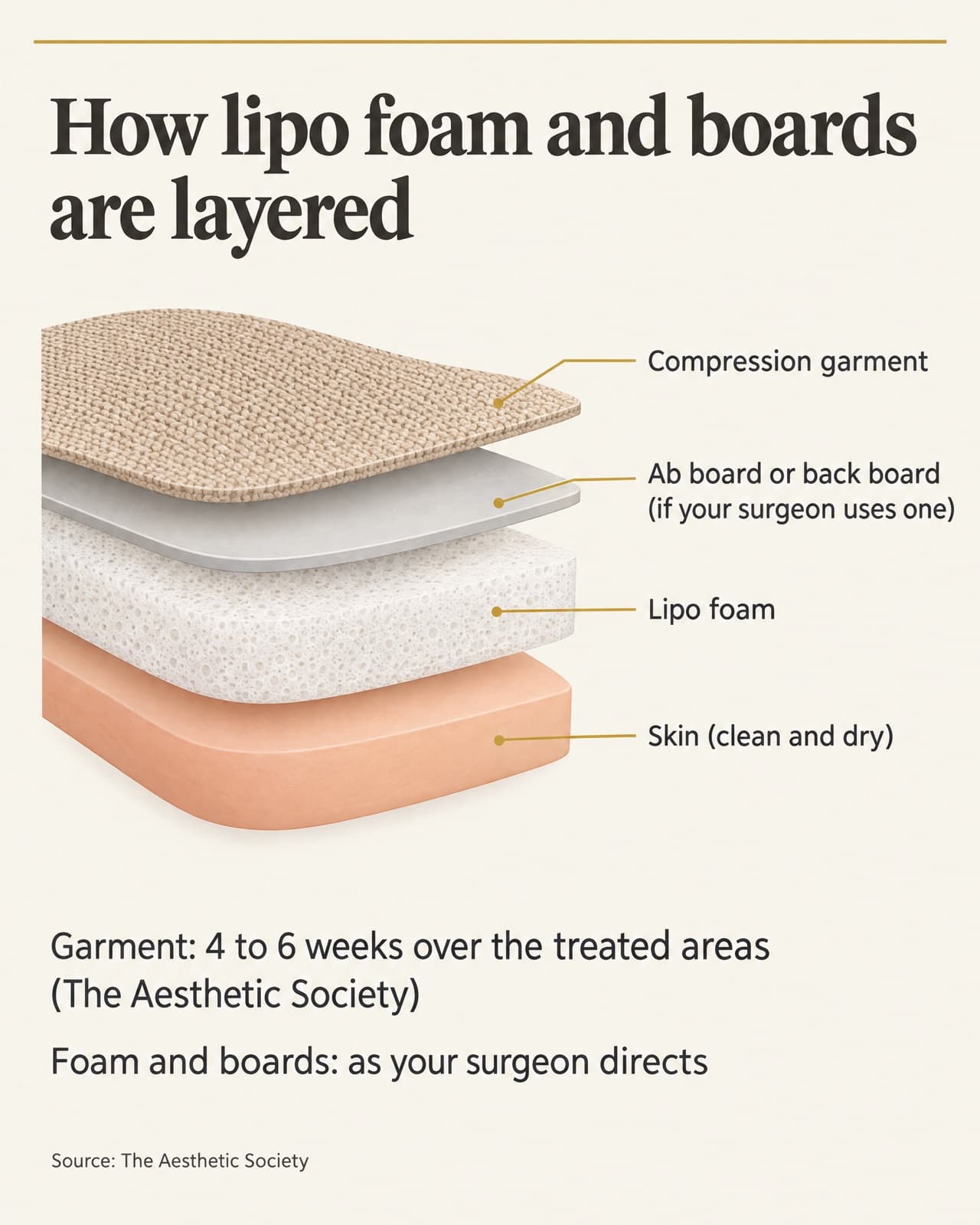
Lipo foam is a soft, flexible foam sheet worn directly on the skin under your compression garment after liposuction, to spread pressure evenly and cushion seams and creases. The Aesthetic Society says the garment itself is worn for 4 to 6 weeks; how long you wear foam and boards is your surgeon's call.
What is lipo foam?
Lipo foam, also written lipofoam, is a soft, flexible sheet of foam you wear directly on your skin, under your compression garment, after liposuction. It spreads the garment's pressure evenly over the treated areas and cushions seams, hooks and creases that could otherwise press into swollen skin. It comes as flat sheets or pre-cut pads, and your surgeon tells you where to place it and for how long.
Lipo foam is not a treatment in itself. It works only together with your garment, and the garment is the part the societies name: The Aesthetic Society says you wear a compression garment over the treated areas for 4 to 6 weeks.
What does lipo foam do?
Lipo foam turns the uneven squeeze of a garment into steady, even pressure. A garment presses hardest along its seams, zippers, hook-and-eye closures and wherever the fabric folds, and in the first days after surgery that can leave dents in swollen, numb skin. A layer of foam softens those pressure points.
What surgeons expect it to help with:
- Smoother skin. Even pressure while the skin settles onto the tissue underneath.
- Less bruising and bleeding. Firm, even compression over areas that were treated.
- Comfort. A soft layer between tender skin and a stiff garment.
- Fewer garment marks. Foam fills hollows and edges where the garment would otherwise dig in.
The research behind those expectations is old and small. A 1993 report in Aesthetic Plastic Surgery described foam under a pressure garment after liposuction as giving "less waviness in the skin surface, a more comfortable recovery, and less blood loss and ecchymoses" (ecchymoses are bruises). The report describes no controlled comparison with patients who went without foam.
Is lipo foam necessary?
Not always. Some surgeons use foam for every liposuction patient, some only for certain areas or techniques, and some don't use it at all. In an ASPS article on liposuction recovery, one surgeon describes giving supplemental foam to place under the garment to patients whose procedure included athletic sculpting.
The evidence can't settle it either way. A 2023 review in Plastic and Reconstructive Surgery Global Open found that "no RCTs or comparative studies have been conducted to evaluate the efficacy of compression" after body contouring, even though surgeons use it widely. We found no trial that tested lipo foam against no foam.
So: if your surgeon sends you home with foam, wear it as instructed. If your surgeon doesn't use it, don't add it on your own without asking, because foam changes how your garment fits.
What are lipo boards: ab board and back board?
Lipo boards are firmer, curved panels worn on top of the foam and under the garment. An ab board covers the abdomen; a back board covers the lower back and sometimes the flanks. They are thin, semi-rigid plastic or dense foam, shaped to follow the body.
Boards are meant to hold a flat, even surface over a large area and stop the garment from bunching at the waist when you sit or bend. You are most likely to be given one after Lipo 360 or a tummy tuck, where a large area of the trunk is treated. We found no published study of boards, so their use rests on surgeons' experience.
| Lipo foam | Lipo board (ab or back) | |
|---|---|---|
| What it is | Soft, flexible foam sheet or pad | Firm, curved panel |
| Where it goes | Directly on the skin | On top of the foam |
| What it does | Evens out and cushions pressure | Keeps a large area flat, stops bunching |
How to wear lipo foam and boards
Follow the placement your surgeon or nurse shows you before you go home, and ask them to show your helper too. The general order is skin, foam, board, garment.
- Start with clean, dry skin. Pat the areas dry after showering. Don't put lotion, oil or powder under foam unless your surgeon says you can.
- Lay the foam flat. Smooth it over the treated area with no folds, rolls or wrinkles. Cut it to fit curves if your surgeon allows, and keep cut edges from overlapping.
- Ask about your incisions. Some surgeons want foam over the small incisions and some want gauze or a gap there. Do what yours says.
- Add the board, if you have one. Center it over the foam so its edges rest on foam, not on bare skin.
- Close the garment evenly. Fasten it from the bottom up, then run your hands over it to find creases or bunched foam.
- Recheck after every bathroom trip and every time you get up from bed. Foam slides, and a folded edge left for hours can leave a deep mark.
How long do you wear your foams and boards after lipo?
There is no published standard, so it's your surgeon's call. The Aesthetic Society's figure is for the garment: 4 to 6 weeks over the treated areas. Foam and boards are often part of that time rather than all of it, and surgeons differ on whether they stay on day and night and for how many weeks.
The published examples are few. In a 2002 report in Dermatologic Surgery, a girdle with foam built into it was "kept on for two to three days" after liposuction. That was one surgeon's device, not a rule, but it shows how short some foam protocols are.
Ask your surgeon three things before you go home:
- How long do I wear the foam, and how long the board?
- Day and night, or only part of the day?
- What should I use once the foam comes off?
Write the answers down. Your surgeon may change the plan at your follow-up visits as your swelling goes down.
When can you stop wearing foams after lipo?
Stop when your surgeon tells you to, not when the foam starts to feel unnecessary. Swelling can look settled while the skin is still adjusting. The Aesthetic Society says swelling mostly goes down within 2 to 3 weeks, with slight swelling for up to 4 months, and Cleveland Clinic says the final result can take 3 to 6 months to show.
The one exception: if the foam or board is hurting your skin, take it off and call your surgeon the same day rather than waiting for your next appointment.
Skin care under lipo foam: blisters, pressure marks and rashes
Foam sits against your skin for long stretches, so check the skin every time you take the garment off. Foam can occasionally irritate skin: the 2002 report says Reston foam, a medical foam applied directly to the skin, "can occasionally cause allergic dermatitis, bullae formation or postinflammatory hyper-pigmentation." In plain words: a rash, blisters, or darker patches that linger after the skin heals. The 2023 review also notes that one surgeon observed, in 2006, that excessive or poorly distributed compression could cause skin folding and bulging.
| Usually normal | Call your surgeon |
|---|---|
| Faint lines or a grid pattern from the foam that fade once the garment is off | A deep dent or line that doesn't fade |
| Mild itching as skin heals | A spreading red rash, hives or intense itching |
| Numb patches over treated areas | Blisters, open or weeping skin |
| Some leakage from incisions in the first several days | Redness, heat, pus or fever |
| Tightness that eases when you adjust the garment | Pain that gets worse under the board or garment |
To protect your skin:
- Keep foam dry. Replace it when it is soaked with fluid or sweat.
- Smooth every edge. Most marks come from folds, not from the foam itself.
- Let skin breathe briefly when your surgeon allows garment breaks, and check the areas you can't see with a mirror or a helper.
- Don't cover a blister with more foam. Leave it for your surgeon to look at.
If itching is the main problem, our guide to itching after lipo explains what helps.
Can you wash lipo foam?
Check the manufacturer's instructions and ask your surgeon. Many foam sheets are sold for single use, and the foam loses its spring once it has been soaked and flattened. Because it sits over healing incisions, replace any sheet that is soiled with drainage rather than rinsing and reusing it. A board can usually be wiped down; ask your surgeon what to clean it with.
Lipo foam after a tummy tuck
Some surgeons also use foam and an ab board after a tummy tuck, especially with liposuction of the flanks. The rules change around the long incision and any drains, so placement and timing are entirely your surgeon's. Our tummy tuck recovery guide covers the rest of that recovery, and the recovery section of our tummy tuck page shows how long the compression garment usually stays on.
Foam and boards after a BBL with Lipo 360
After a BBL with Lipo 360, the foam and boards go over the areas that were suctioned, never pressing on the buttocks where fat was added. The garment timing can also differ from liposuction alone. For liposuction, The Aesthetic Society's figure is 4 to 6 weeks; its butt lift aftercare page, in its general advice for every type of butt lift, says you will likely need a compression garment for 6 to 8 weeks. Your surgeon sets the plan for the combined procedure, and our BBL compression garment timeline covers it in detail.
What to ask before your surgery
Foam and boards are easier when you know the plan ahead of time. Ask at your pre-op visit whether your surgeon uses them, whether they are provided or you buy them, and who will show you how to put them on. The liposuction recovery section of our procedure page shows where compression fits in the first months, and if you are considering liposuction in Miami, you can ask about aftercare before you book. For nights, our guide to how to sleep after liposuction covers sleeping in your garment.
Frequently asked questions
Does lipo foam help with swelling?
It may, as part of compression. Foam spreads the garment's pressure so the whole treated area is compressed evenly, and a 1993 report described less bruising and bleeding when foam was used under a pressure garment. No controlled study has measured swelling with and without foam. Walking, your garment and time do most of the work: The Aesthetic Society says swelling peaks around 48 hours after surgery.
Can lipo foam tighten loose skin?
No. Foam helps skin settle smoothly while it heals, but it doesn't remove or tighten skin. The Aesthetic Society notes that liposuction itself removes fat without tightening skin. If loose skin is your main concern, a procedure that removes skin, such as a tummy tuck, may suit you better, and a surgeon can tell you at an exam.
Is lipo foam the same as a faja?
No. Faja is the Spanish word many people use for the compression garment itself. Lipo foam is a separate soft layer that goes under the faja, directly on the skin, and a lipo board goes between the two. You can have a faja without foam, but foam only works with a garment over it to hold it in place.
Do you wear lipo foam at night?
Often, yes, if your surgeon wants foam on day and night in the early weeks. Some surgeons keep foam on only while you are up and moving. Whatever the plan, check for folds before you go to sleep, because a crease you lie on for hours is the most likely to leave a mark. Our sleep guide covers positions and garments at night.
Is foam used after chin liposuction?
After chin or neck liposuction, compression usually comes from a chin strap or small wrap rather than body foam, and whether a foam pad goes under it is up to your surgeon, as is how long you wear it. Our guide to chin lipo recovery explains the chin strap and what to expect.
Where can I get lipo foam?
Ask your surgeon first. Some practices provide foam and boards on surgery day, and others give you a list to buy ahead. If you buy your own, choose foam made for post-surgical use and boards sized for your body, and bring them to your pre-op visit so the team can check the fit before you need them.
Sources
- The Aesthetic Society: Liposuction aftercare and recovery
- Aesthetic Plastic Surgery: Use of Reston foam in liposuction (Schlesinger and Kaczynski, 1993)
- Dermatologic Surgery: A new foam girdle for the significant reduction of ecchymoses post-liposuction (Brandy, 2002)
- Plastic and Reconstructive Surgery Global Open: The Use of Postoperative Compression Garments in Plastic Surgery, Necessary or Not? (Ormseth and colleagues, 2023)
- American Society of Plastic Surgeons: Eight ways to make liposuction recovery a breeze
- Cleveland Clinic: Liposuction
- The Aesthetic Society: Liposuction
- The Aesthetic Society: Butt lift aftercare and recovery
Not Sure Which Procedure Is Right for You?
Take our free 2-minute quiz to get personalized recommendations based on your goals, lifestyle, and budget.
Take the QuizStart Your Journey Today
Leave your name and phone number. We'll call you within 24 hours to discuss your goals.
Or call us directly
+1 (786) 305-8649Related Articles
Continue reading with these related posts

What Is J-Plasma Lipo? Renuvion, FDA Status and Cost
J-Plasma lipo is liposuction followed by Renuvion, a helium plasma device that heats the tissue under the skin so it contracts. Here is what the FDA has and hasn't cleared, who it suits, how it compares with a tummy tuck, and what it costs.

How to Get Rid of Fibrosis After Lipo, Including at Home
Hard, lumpy areas after liposuction are usually healing tissue that softens with time. Here is what you can safely do at home, how fibrosis differs from a seroma or hematoma, and what the research says about treatment.

Liposuction Swelling Timeline, Week by Week
Liposuction swelling peaks around 48 hours, is mostly down within 2 to 3 weeks and can take 3 to 6 months to clear completely. Here is the week-by-week timeline, how to reduce swelling, what fluid pockets and hard swelling mean, and when to call your surgeon.

How to Fix Uneven Liposuction: When to Wait, What Works
An uneven result after liposuction is upsetting, and it is often too early to judge. Here is how to tell swelling from a lasting irregularity, what causes dents and bulges, and how revision liposuction, fat grafting and other fixes work.

What Is More Painful BBL or Tummy Tuck?
Considering a body contouring procedure but unsure how painful recovery might be? Many patients are surprised to learn that Tummy...
Chin Lipo Recovery Time: How Long Healing Takes
Chin lipo recovery, stage by stage: when swelling peaks and settles, what the chin strap does, how to sleep, numbness, and the signs that mean you should call your surgeon. Plus what chin liposuction costs as an add-on.
Related Procedures
Explore the procedures discussed in this article

Liposuction Miami
Liposuction in Miami, with Lipo 360 starting at $4,000. Every liposuction at Alluring is performed by Victoria Karlinsky, MD, FACS.

Brazilian Butt Lift (BBL) Miami
BBL in Miami starting at $5,500. Every BBL at Alluring is performed by Victoria Karlinsky, MD, FACS, who places the fat under the skin with ultrasound guidance, as Florida law requires.

Tummy Tuck Miami
Tummy tuck in Miami, from a mini at $3,000 to a full tummy tuck at $4,500. Every tummy tuck at Alluring is performed by Victoria Karlinsky, MD, FACS.
More Liposuction Articles

Liposuction After Ozempic: Are You a Candidate?
Liposuction can remove stubborn fat after GLP-1 weight loss once your weight is stable, but it doesn't tighten loose skin. Here's who is a candidate, when a tummy tuck fits better, and what current anesthesia guidance says about Ozempic, Wegovy and Zepbound.
Do BBLs Stink? What BBL Smell Is and How Long It Lasts
A healed BBL doesn't smell. Odor during recovery usually comes from incision drainage and a sweaty compression garment. Here's what's normal, how long it lasts, how to prevent it and when a smell means infection, checked against ASPS and Cleveland Clinic.
How to Reduce Itching After Lipo?
Itching after liposuction is common as skin and nerves heal. Here is what calms it, how to handle itching under your compression garment, what to ask before using creams or antihistamines, and when an itch or rash means call your surgeon.