Breast Augmentation12 min read
Breast Implant Rippling and Bottoming Out: Causes, Fixes
By Alluring Editorial TeamPublished
What causes breast implant rippling and bottoming out?
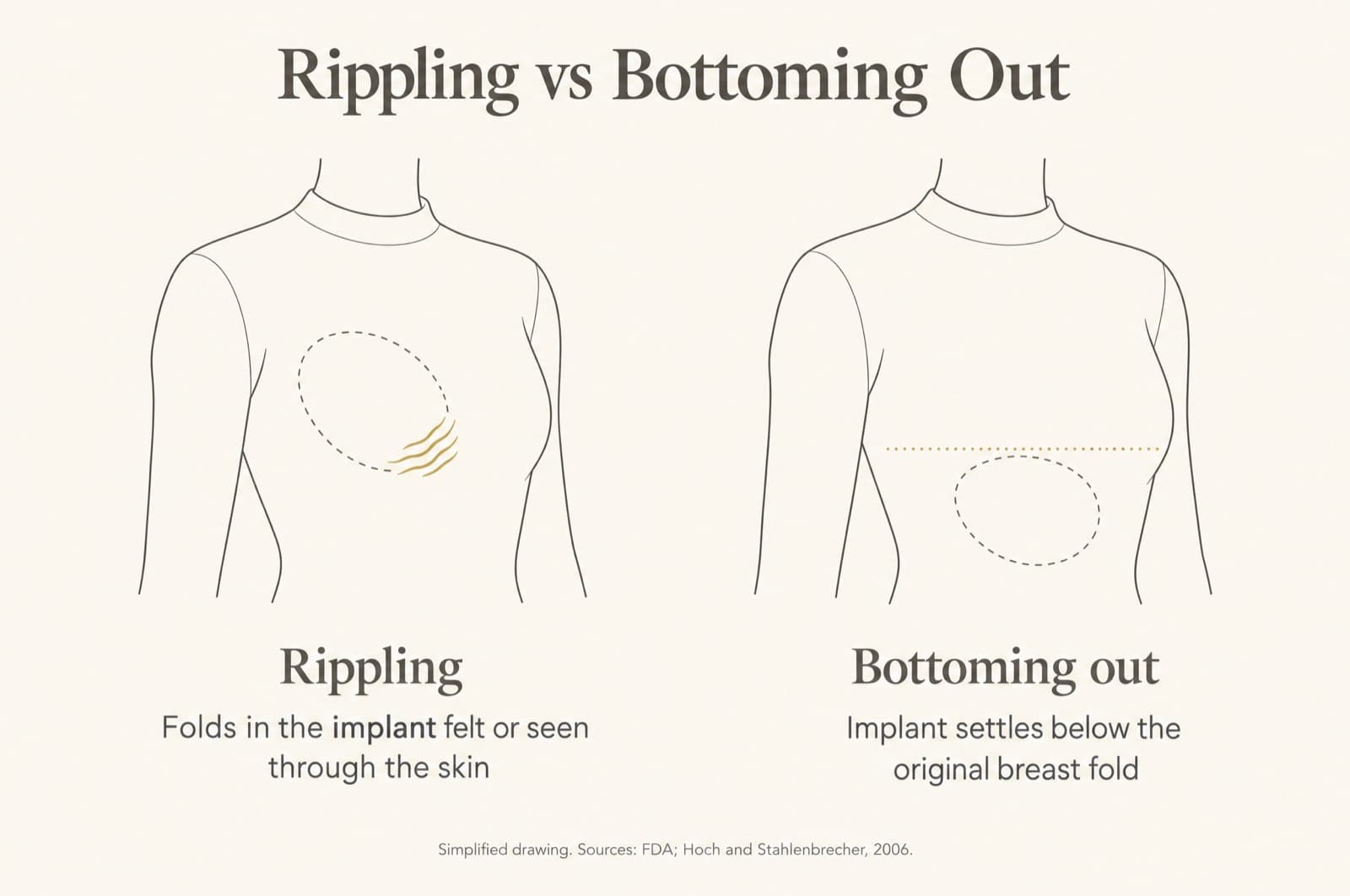
Rippling is wrinkling of the implant that shows or can be felt through the skin, the FDA says, and Allergan's labeling says it may be more likely with saline. Bottoming out means the implant settles too low. The FDA says implants can shift from gravity, trauma or capsular contracture. Correcting either usually means another operation.
- 4.7 · 87 Google reviews

What are breast implant rippling and bottoming out?
They are two different changes, and you can have one without the other. Rippling is wrinkling of the implant that can be felt or seen through the skin, in the FDA's words. Bottoming out is an implant that has settled too low. A 2006 surgical paper describes it as displacement beneath the original fold under the breast.
Sientra's patient labeling gives rippling's possible effects as discomfort, an unwanted look, another operation or implant removal. The evidence on both problems is thin, so this guide says where it runs out.
Why are my implants rippling?
Rippling shows when folds in the implant aren't hidden by enough tissue on top of them. No single cause has been proven, but the sources we read keep pointing to the same four things:
- Thin skin and breast tissue. A 2019 study of 30 patients names soft tissue thickness among the most relevant factors. Sientra's labeling says that if your skin is stretched too thin over the implant, you may feel or see its edges.
- Saline fill. Allergan's labeling for Natrelle saline implants says visible wrinkling or rippling "may be more likely to occur."
- A smooth shell. ASPS says smooth implants "may have some palpable or visible rippling under the skin."
- An implant too large for your tissue. Sientra's labeling says implants that are too large can cause skin wrinkling, and that you may feel folds when an implant is squeezed too tightly by the tissue around it.
These come from labeling and small studies, not head-to-head trials, so treat them as things to raise with your surgeon.
Why do breast implants bottom out?
Nobody has fully explained it. A single-center review of 207 women says the cause "is still unclear." Here is what the sources do point to:
- Gravity, trauma or capsular contracture. The FDA says an implant can shift during surgery or afterwards, and that factors such as these can cause it. Capsular contracture has its own guide.
- Size and weight. Sientra's labeling says implants too big for your tissue can "speed up the effects of gravity." The Aesthetic Society says the weight of your implants will affect how your breasts look with time.
- How the pocket is made at the fold. The 207-woman review, all using one technique, reports bottoming out in 6% of patients early on, and says it was avoided later by changing the dissection at the fold. That is one center's account, not a national rate.
- Chest muscle pressure, possibly. An article on the ASPS website by Dr. Catherine Huang-Begovic says contraction puts downward and outward pressure on implants under the muscle over time. That is one surgeon's explanation, not a study. Our push-ups guide covers the timing.
Who is more likely to get rippling or bottoming out?
Women with thin skin and breast tissue seem most likely to feel or see rippling, and an implant too large for your tissue raises concern for both problems. No study gives a personal risk score. Here is how implant type, size and placement connect to each one:
| Choice | Rippling or visibility | Shifting or bottoming out |
|---|---|---|
| Saline fill | Rippling "may be more likely" (Allergan's labeling) | No comparison found |
| Smooth shell | Some "palpable or visible rippling" (ASPS) | Can move with its pocket (ASPS) |
| Textured shell | No comparison found | Scar tissue makes it "less likely to move around" (ASPS), but see BIA-ALCL below |
| Over the muscle | "More visible and palpable" (Allergan's labeling) | No comparison found |
| Under the muscle | "Less visible and palpable" (Allergan's labeling) | One surgeon's concern about muscle pressure |
| Too large for your tissue | Skin wrinkling, folds you can feel (Sientra's labeling) | Can speed up the effects of gravity (Sientra's labeling) |
If your tissue is thin, placement matters. Allergan's labeling says over-the-muscle placement "may not be recommended if you have thin or weakened breast tissue," and Sientra's says under the muscle "may work better."
Texture is a trade-off, not a fix. The FDA says the risk of BIA-ALCL, a cancer of the immune system, is higher with textured implants, as our implant illness and BIA-ALCL guide explains.
The full trade-offs are in our guides to over or under the muscle and saline vs silicone. Our breast augmentation page shows how the implant types compare and how placement differs.
How common are rippling and bottoming out?
There is no single reliable number. In the augmentation figures we found, rippling runs from 0.7% to 13.7%, depending on the implant and how it was counted. Bottoming out rarely has a rate of its own, because makers report the broader term "malposition."
| Study and implant | When counted | Rippling or wrinkling | Malposition or bottoming out |
|---|---|---|---|
| Sientra silicone (Sientra's 10-year study) | Through 10 years | 1.9% | 2.7% malposition |
| Mentor MemoryGel silicone (Caplin and colleagues, 2021) | 10 years, mild cases excluded | Not given | 1.0% malposition |
| Natrelle saline (Allergan's labeling) | 5 years, moderate or worse only | 13.7% | 9.2% malposition |
| 3,002 women, two surgeons in the UK (Araco and colleagues, 2007) | Surgery from 1996 to 2001 | 0.7% | Not given |
| 207 women, one center, all using one technique (Salgarello and Visconti, 2017) | Early experience | Not given | 6% bottoming out |
Please don't read this as a ranking. These are different implants, follow-up times and definitions, each maker's figures come from its own study, and none of them is Alluring's rate.
Two things do stand out. Both problems can appear late: in Sientra's study, rippling rose from 0.8% through 3 years to 1.2% through 6 and 1.9% through 10, and malposition from 1.4% to 2.1% to 2.7%. The FDA says implants aren't lifetime devices, as our guide to how long implants last explains. And few reoperations were mainly for rippling: 2.4% of 293 at 5 years in Allergan's saline studies, and 2.1% of 291 through 10 years in Sientra's.
Does implant rippling go away?
Not reliably, as far as anyone has shown. We found no study that followed rippling over time to see whether it fades on its own. Your breasts keep changing for months after surgery, so what you feel early may change, but that isn't evidence that a ripple will disappear.
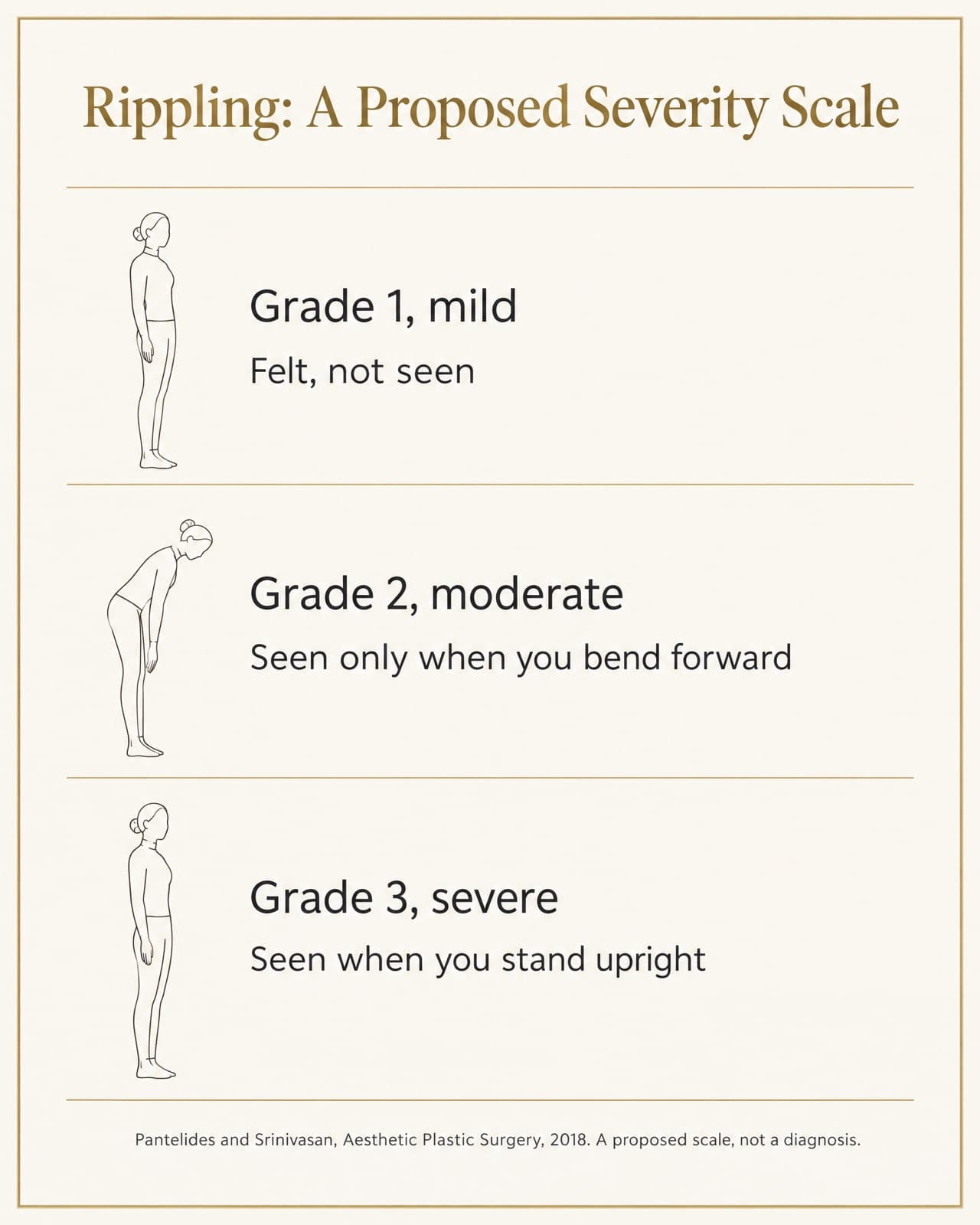
It helps to describe exactly what you notice. A 2018 paper in Aesthetic Plastic Surgery proposes the scale below. It is one group's proposal, rated at evidence level V, the journal's lowest, but it gives you clear words to use with your surgeon.
| Grade | What it means |
|---|---|
| Grade 1, mild | You can feel it but not see it, in the lower outer breast or the upper inner area near the cleavage |
| Grade 2, moderate | You can see it only when you bend forward |
| Grade 3, severe | You can see it when you stand upright |
Breast augmentation at Alluring
Get your breast augmentation price, in writing.
Many of our patients fly in from other states. We confirm your surgery and follow-up dates in writing, and tell you how many nights to stay in Miami.
Alluring patient care
Replies by text within 24 hoursHi! Let’s get your free consultation set up.
What are you thinking about doing?
Private. Only our patient coordinators see it, never a sales team.
How do you fix rippling or bottoming out implants?
Usually with another operation, chosen after an exam, and only if it bothers you enough to be worth one. We found no evidence that massage, exercise or a particular bra corrects either problem.
- Rippling. The 2018 paper says the traditional treatment is replacing the implant, often moving it under the muscle to lower the chance it comes back. It also lists a larger implant, tightening the capsule (the scar tissue around the implant), and newer options such as fat grafting or an acellular dermal matrix, a layer of processed tissue that adds cover. No good study compares them, and a larger implant carries the size trade-offs above.
- Bottoming out. The FDA lists repositioning, "by surgically opening the incision and moving the implant," among the additional surgeries implants can need. The 2006 paper calls bottoming out rare but "in most cases, difficult to correct," and describes lifting the capsule to hold the implant at a new fold.
Another operation has its own risks. In Sientra's study, women having a revision had wrinkling and malposition reported in 4.8% each through 10 years, against 1.9% and 2.7% after a first augmentation. These are different groups, so it isn't a direct comparison, but a second surgery doesn't rule out a repeat.
When should I see my surgeon about it?
See your surgeon about any new fold, shift or change in shape, even if it doesn't hurt. The FDA says abnormal changes in your breasts or implants should be checked promptly. Some change is expected, though: implants are supposed to settle, as our drop and fluff timeline explains.
| Usually expected while healing | Book a visit | Call right away |
|---|---|---|
| Implants sitting high, then settling over about 3 to 6 months | A new ripple or fold you can see or feel | Fever or chills, redness or heat |
| Some unevenness while each breast heals at its own rate | One implant clearly lower than the other | Sudden swelling, or a breast turning firm with pain and pressure |
| Subtle changes through the first 12 months | Practical advice, not from a study: the lower breast looking stretched, or the nipple starting to point up | Severe pain your medicine doesn't help, pus or bad-smelling drainage |
Fever or chills, sudden swelling, severe pain, or pus or bad-smelling drainage can't wait for a visit: call right away.
Settling times come from an article on the ASPS website by Dr. Eric Mariotti and University of Utah Health. Warning signs come from Cleveland Clinic, Sientra's labeling, a UW Medicine patient handout and MedlinePlus, whose page also covers lifts and reductions.
One look-alike: the FDA says a ruptured saline implant deflates, immediately or over several days. That is a different problem, covered in our saline vs silicone guide.
How can you lower the odds before surgery?
You can't remove the risk, but you can ask these questions.
- Do I have enough skin and tissue to cover the implant I want? Sientra's labeling says your surgeon examines this, and that you may be offered several choices if not.
- Does the size I want suit my tissue? Some practices offer bra sizers or 3D simulation, so ask whether yours does, and our size guide explains how to think about them.
- Which fill, surface and placement suit my tissue? Ask how each would change what you can see and feel.
- What is your reoperation rate? The FDA suggests asking this, and it's fair to ask how a correction would work.
Flying in for surgery from another state?
Both problems can show up long after you are home, so leave with your paperwork. The FDA says you get a device card with your implant's style, size and serial or lot number, and The Aesthetic Society says a later surgeon will need the details of your first surgery. You can start with a fly-in consultation. Dr. Victoria Karlinsky, MD, FACS, tells you, in writing, how many nights to stay in Miami before you fly home.
If you want to talk this through, our breast augmentation page sets out the risks that can lead to more surgery and how size fits your tissue. A free consultation with Dr. Karlinsky at Alluring is the place to have your tissue examined and your questions answered.
Frequently asked questions
I can feel my breast implant at the bottom. Is that bottoming out?
Not necessarily. Implants can be felt for several reasons, and Allergan's labeling counts palpability or visibility as its own complication: 12.1% at 5 years for Natrelle saline, moderate or worse only. Bottoming out means the implant has moved below the fold under your breast. Only an exam can tell the difference, so mention it at your next visit.
How much does it cost to fix bottoming out or rippling?
It depends on what the exam finds and which operation you need, so a surgeon can only tell you after seeing you. Our breast augmentation page explains how pricing works. Budget carefully, because the FDA says that even if you have complications, the cost of removing or replacing implants may not be covered by insurance.
Can rippling make an implant rupture?
It isn't known. Sientra's labeling lists "folding or wrinkling of the implant shell" among the reasons an implant may rupture or leak, but it doesn't say whether rippling you can see or feel does this, and no source we read gives a rate. For silicone with no symptoms, the FDA recommends a first ultrasound or MRI 5 to 6 years after surgery, then every 2 to 3 years. Saline has no screening recommendation, because a rupture is detectable without it.
Can bottoming out happen after a breast reduction?
Yes. The term is also used after breast reductions and lifts, where no implant is involved. A 2022 review of 10 studies looked at synthetic mesh as internal support and concluded that meshes "do not effectively prevent recurrent ptosis and bottoming out," although the evidence was low level.
Does wearing a bra prevent bottoming out?
We found no study showing that. University handouts keep you in a surgical bra for 3 to 4 weeks, and UW Medicine says no underwire until your incisions are fully healed, but those are healing instructions rather than proven prevention. Follow your surgeon's plan. Our post on sleeping without a bra covers what is known about timing.
Sources
- FDA: Risks and Complications of Breast Implants
- FDA: Things to Consider Before Getting Breast Implants
- FDA: Breast Implant Surgery
- FDA: What to Know About Breast Implants
- FDA: Certain Labeling Recommendations to Improve Patient Communication
- FDA: Questions and Answers about BIA-ALCL
- Sientra: Silicone Gel Breast Implants, patient labeling
- Allergan: Natrelle Saline-Filled Breast Implants, patient labeling
- ASPS: Types of breast implants
- ASPS website, Dr. Eric Mariotti: What does "drop and fluff" mean?
- ASPS website, Dr. Catherine Huang-Begovic: Exercise after breast augmentation
- The Aesthetic Society: Breast Revision Surgery
- University of Utah Health: Recovering from Breast Augmentation
- Cleveland Clinic: Breast Augmentation
- MedlinePlus: Cosmetic breast surgery, discharge
- UW Medicine: Breast Augmentation patient handout
- Plastic and Reconstructive Surgery: Caplin and colleagues, 2021
- Aesthetic Plastic Surgery: Pantelides and Srinivasan, 2018
- Aesthetic Plastic Surgery: Abramo and colleagues, 2019
- Aesthetic Plastic Surgery: Salgarello and Visconti, 2017
- Aesthetic Plastic Surgery: Araco and colleagues, 2007
- Handchirurgie Mikrochirurgie Plastische Chirurgie: Hoch and Stahlenbrecher, 2006
- Aesthetic Plastic Surgery: Atiyeh and colleagues, 2022
What do real breast augmentation results look like?
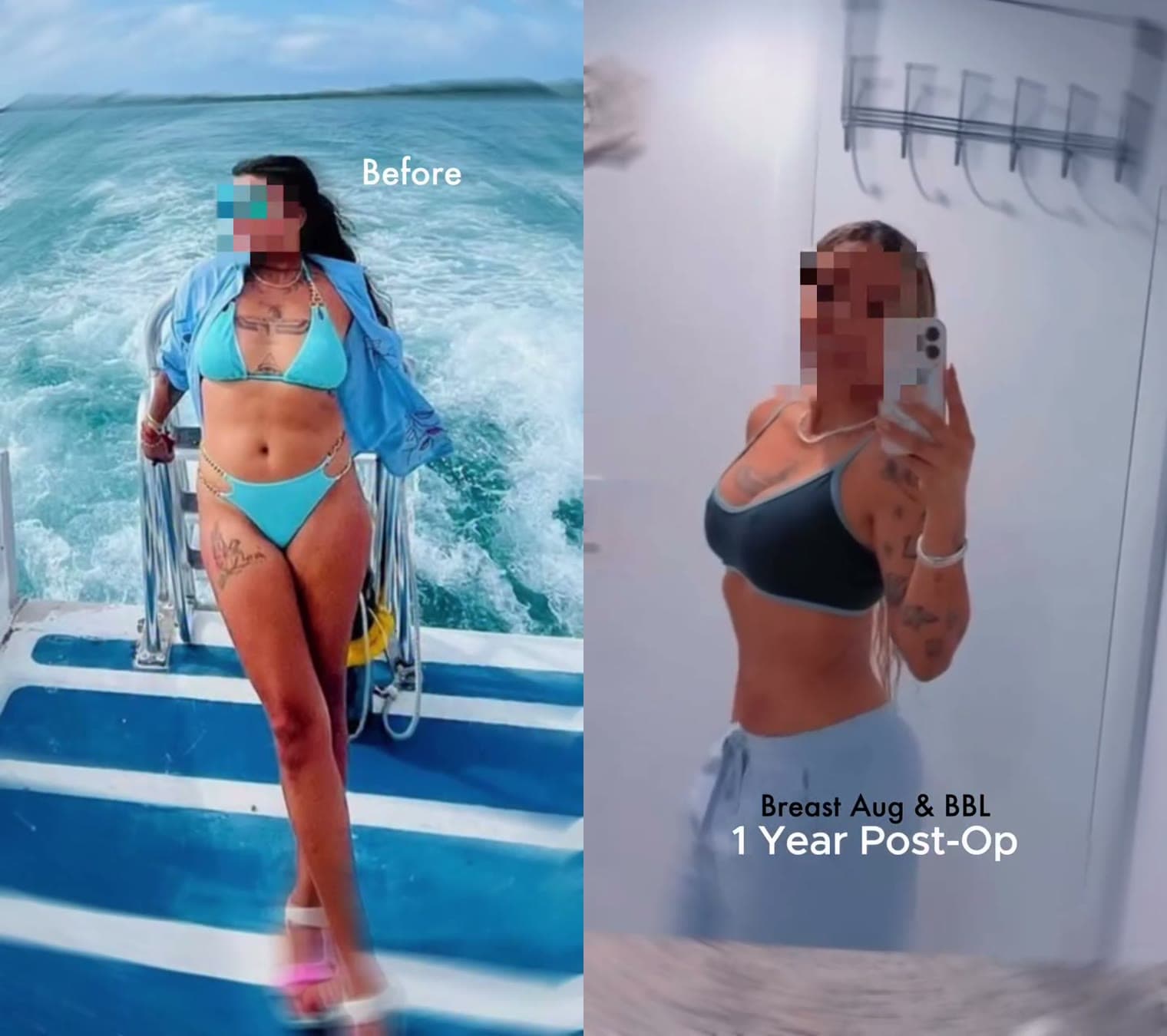
These are photos of real Alluring patients after breast augmentation, shared with their consent. Results differ from person to person, and your surgeon talks you through what is realistic for your body at your free consultation, before you decide anything.
Before and after breast augmentation 
Before and after breast augmentation 
Before and after breast augmentation 
Before and after breast augmentation 
Before and after breast augmentation 
Before and after breast augmentation
Photos in this section are real Alluring patients.
See every breast augmentation photo in the galleryMeet your surgeon

Check her credentials yourself
Each link opens her record on the issuing body's own site.
Licensed as a medical doctor by the Florida Department of Health.
Board certified in general surgery by the American Board of Surgery since 2008.
Fellow of the American College of Surgeons (FACS).
Certified in cosmetic surgery by the American Board of Cosmetic Surgery. The specialty recognition identified herein has been received from a private organization not affiliated with or recognized by the Florida Board of Medicine.
Start here
Personal care. Honest price.
Your price, surgery date and follow-up plan, in writing, before you book a flight.