Breast Augmentation12 min read
Mammograms, Pregnancy and Breastfeeding With Implants
By Alluring Editorial TeamPublished
Can you have a mammogram with breast implants?
Yes. The American Cancer Society says to keep regular screening mammograms, mention your implants when you book, and expect 4 extra pictures called implant displacement views. Rupture from a mammogram is very rare. Many women with implants breastfeed, though a 2023 review of 11 studies found significantly lower odds than without implants.
- 4.7 · 87 Google reviews

Can you have a mammogram with breast implants?
Yes, and please keep having them. The American Cancer Society says women with implants should still get regular screening mammograms as recommended, unless the breast tissue was removed with a bilateral mastectomy before the implants went in. Implants don't change your underlying risk: an FDA review says the risk for breast cancer does not differ in women with implants compared to other women. What changes is how the exam is done and what you say when you book it.
How is a mammogram done with breast implants?
With extra pictures. The American Cancer Society says women with implants have 4 extra pictures, 2 on each breast, as well as the 4 standard ones. The extra ones are called implant displacement (ID) views. The implant is pushed back against the chest wall, the breast is pulled forward over it, and then the breast is compressed, so the doctor gets a better look at the tissue in front.
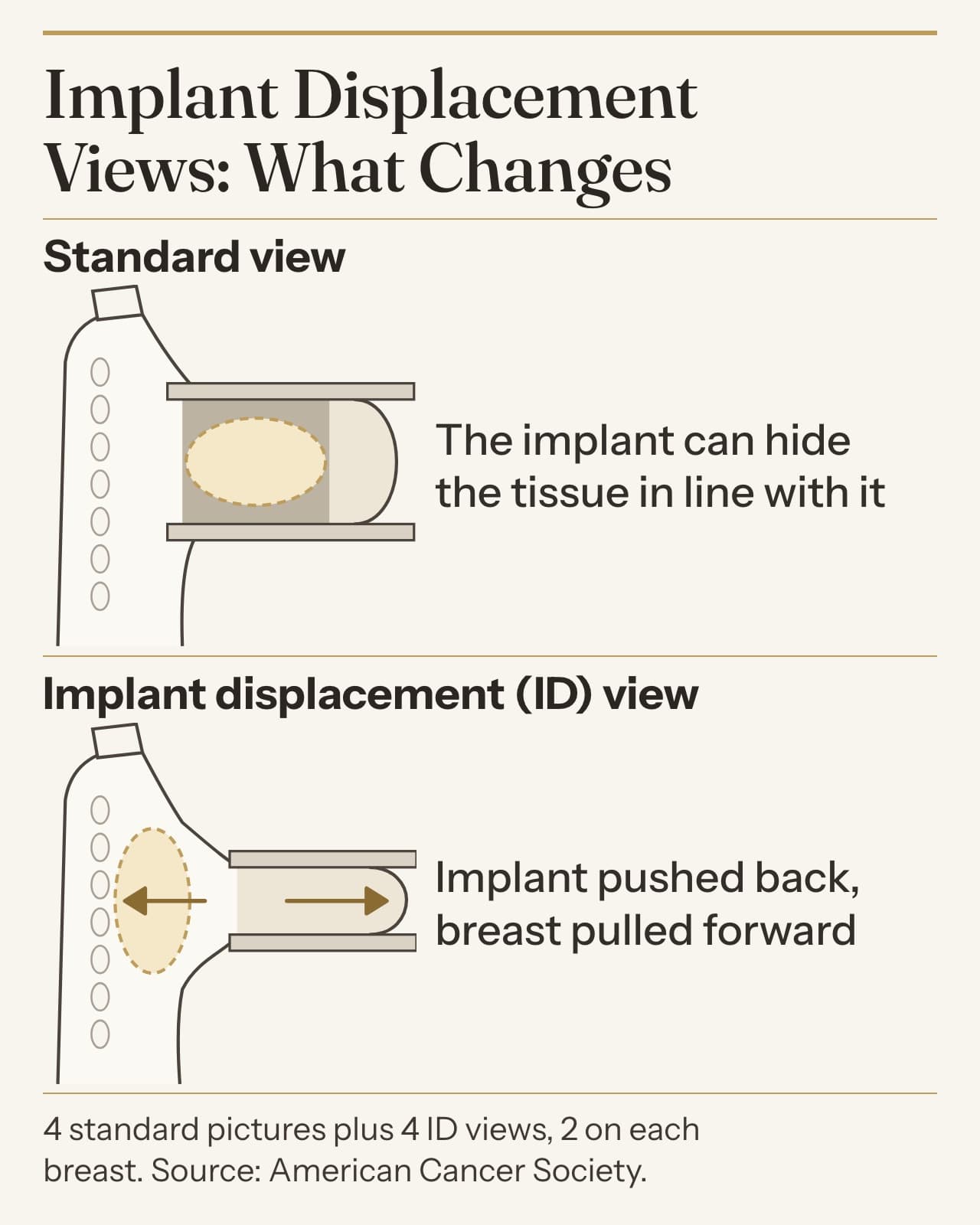
Expect the visit to take a little longer. Sientra's patient labeling says the extra views take more time and mean more radiation than a standard screening mammogram, and that the benefits of mammograms outweigh this risk.
Should I tell the mammogram technologist I have implants?
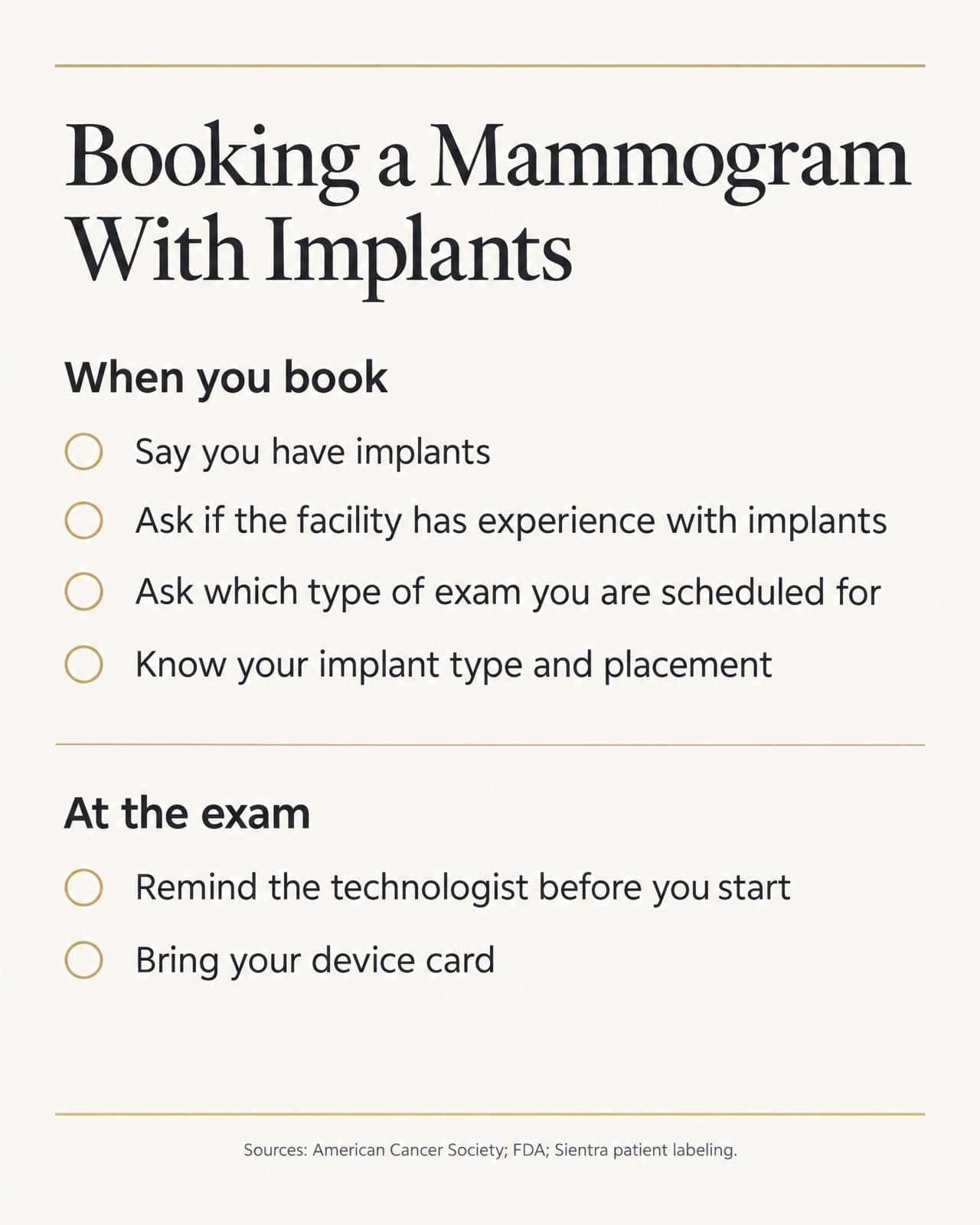
Yes, twice: when you book and again before the exam starts. Both the American Cancer Society and the FDA say so. Booking is your chance to find out whether the facility has experience with implants, and the technologist can then use special techniques to see as much breast tissue as possible.
| When | What to do | Who says so |
|---|---|---|
| Booking | Say you have implants, ask whether the facility has experience with them, and ask what to expect | American Cancer Society, FDA |
| Booking | Ask whether you are scheduled for a screening or a diagnostic mammogram | Sientra's and Allergan's labeling |
| Booking or at the exam | Say what type of implants you have and whether they sit on top of the chest muscle or underneath | Sientra's labeling |
| Before the exam starts | Remind the technologist, and show your device card | American Cancer Society, FDA, Sientra's labeling |
The screening or diagnostic question matters because the sources differ. Allergan's labeling for Natrelle saline implants tells you to request a diagnostic mammogram, because more pictures are taken. Sientra's says your doctor may request one. The American Cancer Society describes ID views alongside a screening mammogram. Ask your doctor which order fits you, then check what the facility has booked.
Do implants make mammograms less accurate?
Yes, for screening in women without symptoms, which is why the extra views exist. The FDA review, which reports older work, found implants hid "between 22% and 83%" of the breast tissue a mammogram can show. A 2004 JAMA study found that augmentation lowered the sensitivity of screening in women without symptoms, without raising false positives.
The same older work is reassuring on what matters most. The FDA review found a delay in detection, "but without increased mortality," and the JAMA study found that implants did not influence the prognostic characteristics of tumors. All of this rests on data from 2004 or earlier, so read it as a direction and not as exact odds. None of it is a reason to skip screening, and any new lump or change between mammograms is worth telling your doctor about.
Is a mammogram easier with implants under the muscle?
Yes. The American Cancer Society says ID views are easier if the implants were placed underneath the chest muscles, and Allergan's labeling lists easier imaging under the muscle and more difficult imaging over it. ID views are also harder and can be uncomfortable if capsular contracture, scar tissue tightening around the implant, has formed.
This is one factor among several. Our guide to over or under the muscle sets out the others, and our breast augmentation page shows how the placement options differ.
Can a mammogram rupture a breast implant?
Very rarely, the American Cancer Society says. A 2022 review of FDA adverse event reports found 41 related to mammography among 20,539 implant-related reports, from 2008 to November 2018. Of those 41, 35 reported a rupture: 19 confirmed by a health care professional, 9 by a deflated saline implant, and 7 unverified reports by patients. The authors concluded this "should neither prevent patients from adhering to breast cancer screening programs nor deter patients from seeking breast implants." These are reports with no count of mammograms behind them, and the FDA says that kind of database can't give a true rate. Sientra's labeling says a technologist who knows about your implants can take steps to lower the chance, which is one more reason to speak up.
The FDA's rupture screening is ultrasound or MRI, not a mammogram. For silicone implants with no symptoms, the FDA recommends a first ultrasound or MRI 5 to 6 years after surgery, then every 2 to 3 years. Saline implants have no screening recommendation, because a rupture is detectable without it. Our saline vs silicone guide explains the difference.
How long after breast augmentation can I get a mammogram?
There is no single agreed date, so ask your surgeon about a baseline after surgery. Sientra's labeling encourages one 6 months to 1 year after surgery, and Allergan's says you may wish to have one in that same window. A UW Medicine patient handout says you will need a second mammogram 9 months after surgery, which becomes your new baseline.
If you are in your 20s or 30s, here is the reassuring part: routine screening doesn't start any earlier just because you have implants. Allergan's labeling says recommendations for screening mammograms are no different for women with implants than for those without, and the FDA says screening recommendations also apply to women with implants. A baseline is a separate question, so ask your surgeon whether you need one at your age.
Can you breastfeed with breast implants?
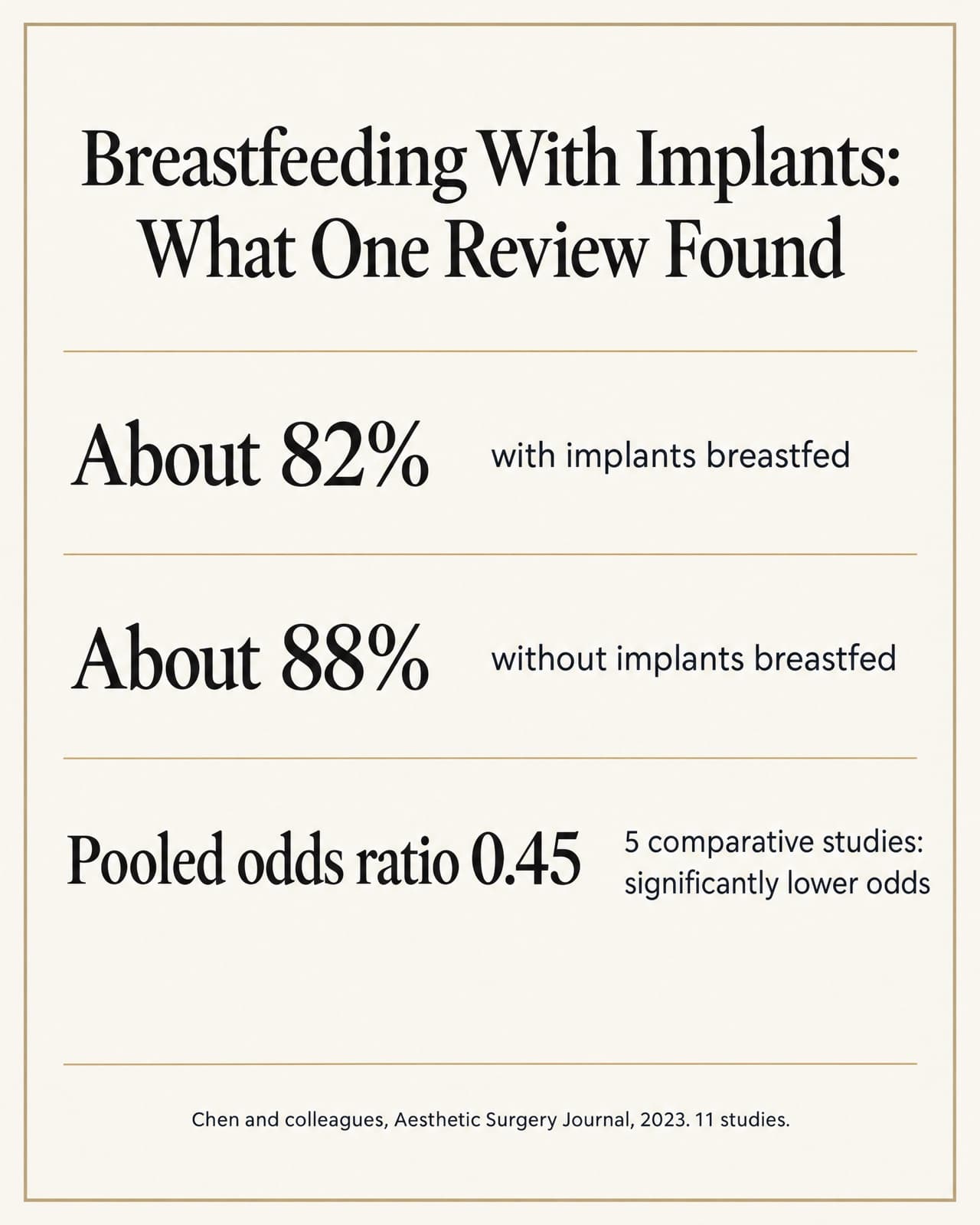
Yes, many women do, although implants may make it harder. A 2023 review of 11 studies found about 82% of women with implants were able to breastfeed, against about 88% of women without them.
Please don't read those two figures as "no real difference." In the 5 studies with a comparison group, the review found significantly lower odds of breastfeeding with implants (pooled odds ratio 0.45), and it concludes there "may be impairment in ability to breastfeed." An odds ratio compares odds and not percentages, and it comes from a smaller set of studies, so the numbers don't convert into each other. These are observational studies.
| Source | What it looked at | What it found |
|---|---|---|
| Chen and colleagues, 2023 | 11 studies, 5 with a comparison group | About 82% with implants, about 88% without; pooled odds ratio 0.45 |
| Cheng and colleagues, 2018 | 5 comparative studies | Less likely to establish breastfeeding, especially exclusive breastfeeding |
| Sientra's 10-year study | 236 women who gave birth after a first augmentation | 85.2% reported no difficulties with lactation |
The FDA says some women can breastfeed and some cannot. Its consumer page says there is insufficient evidence to support an association with trouble breastfeeding, while its example patient checklist says implants may interfere. That is why we say "may make it harder."
If you want to try, you have good company. Sientra's labeling notes that the Institute of Medicine and the American College of Obstetricians and Gynecologists encourage women with implants to try, and it suggests being prepared to use formula in case. Tell your surgeon before surgery if breastfeeding matters to you.
Breast augmentation at Alluring
Get your breast augmentation price, in writing.
Many of our patients fly in from other states. We confirm your surgery and follow-up dates in writing, and tell you how many nights to stay in Miami.
Alluring patient care
Replies by text within 24 hoursHi! Let’s get your free consultation set up.
What are you thinking about doing?
Private. Only our patient coordinators see it, never a sales team.
Do the incision and placement affect breastfeeding?
They may, but the sources disagree about the incision, and all of this evidence is observational.
| Question | Evidence for an effect | Evidence against, or missing |
|---|---|---|
| Incision around the areola | Cleveland Clinic says it is more likely to reduce milk production. Allergan's labeling says it may increase the chance of difficulties. A 1996 study of 42 women from a lactation program, a selected group, found the strongest link with it | The 2018 meta-analysis found no evidence of a reduction in exclusive breastfeeding (pooled relative risk 0.84, confidence interval 0.45 to 1.58) |
| Implant under the muscle | Cleveland Clinic says it usually affects milk production less than above the muscle. The Aesthetic Society says it may interfere less | We found no study that measured this directly |
If breastfeeding matters to you, raise it when you and your surgeon choose your incision and placement. Our guide to scars and incision types explains the options.
Is breast milk safe with implants?
No harm to babies has been shown in the studies the FDA cites, though one question stays open. The FDA says it is not known whether a small amount of silicone may pass from the implant shell into breast milk. It also says there are currently no established methods for accurately detecting silicone levels in breast milk, although a study measuring silicon did not find higher levels in milk from women with silicone implants.
The FDA also says two studies found no increased risk of birth defects, and that a third reported low birth weight, which other factors may explain. Sientra's labeling quotes a 2000 Institute of Medicine conclusion: implants may raise the risk of insufficient lactation, "but no evidence that this poses a hazard to the infant beyond the loss of breast feeding itself."
Can you get pregnant after breast implants?
Implants aren't known to keep you from getting pregnant. The FDA says some patients have reported reproductive problems, and that there is currently insufficient evidence to support an association. That isn't proof of no effect, so bring any fertility questions to your OB-GYN.
The bigger question is timing, and there is no official rule. An article on the ASPS website by Dr. Shahram Salemy, which covers lifts and augmentation together, says it is recommended to wait until you no longer plan to become pregnant, but also that women who may have future children can, in certain cases, still have surgery safely. After a baby, surgeons quoted in articles on the ASPS website range from at least 3 months after weaning to up to 6 months after lactation stops. Our candidate quiz walks through timing, and your surgeon decides at consultation.
Allergan's labeling says implants "will not prevent your breast from sagging after pregnancy." If sagging is your main concern, see augmentation vs a lift, and our guide to how long implants last covers the long term.
Having surgery away from home?
Your mammograms and prenatal care will happen where you live, so leave with your details in hand. The FDA says you get a device card with your implant's style, size and serial or lot number, and it's worth asking your surgeon to note your placement and incision too. You can start with a fly-in consultation. Dr. Victoria Karlinsky, MD, FACS, tells you, in writing, how many nights to stay in Miami before you fly home.
If you are weighing implants against future plans for children, our breast augmentation page covers the safety questions worth asking and who is a good candidate. A free consultation with Dr. Karlinsky at Alluring is a good place to talk through your timing and what matters to you.
Frequently asked questions
Do you need a mammogram before breast augmentation?
The sources differ, so ask your surgeon. Sientra's labeling calls a mammogram before surgery a good idea, because it gives a baseline to compare later pictures against, and Allergan's says you may wish to have one. The UW Medicine handout says you might have one if it has been more than 1 year since your last, regardless of your age.
Do mammograms hurt more with breast implants?
They can feel different. The American Cancer Society says ID views can be uncomfortable if scar tissue has tightened around the implants, and the FDA has received reports of pain during mammography attributed to implants. No source we read gives a rate. Tell the technologist if something hurts, and mention any firmness you have noticed beforehand.
Will pregnancy or breastfeeding change how my implants look?
They can. ASPS says pregnancy, weight loss and menopause may influence the appearance of augmented breasts over your lifetime. The Aesthetic Society lists pregnancy and breastfeeding among the changes that lead some women to consider a revision. No source we read gives a rate, so it is worth discussing with your surgeon if you plan to have children.
Can nipple numbness make it harder to nurse?
It can. Allergan's labeling says feeling in the nipple and breast can increase or decrease after implant surgery, and that while some changes are temporary, they can also be permanent and may affect your ability to nurse a baby. Raise sensation changes with your surgeon before surgery if breastfeeding matters to you, along with your incision.
Can I get implants while I'm still breastfeeding?
No. The FDA's example patient checklist says you are not a candidate for implants while you are pregnant or nursing, and ASPS says good candidates aren't pregnant or breastfeeding. Surgeons quoted on the ASPS website also suggest allowing time after weaning, because the breasts keep changing. The FDA also says to tell your surgeon if you think you may be pregnant.
Sources
- American Cancer Society: Mammograms with Breast Implants
- FDA: Breast Implant Adverse Events during Mammography
- FDA: What to Know About Breast Implants
- FDA: Risks and Complications of Breast Implants
- FDA: Certain Labeling Recommendations to Improve Patient Communication
- FDA: Breast Implant Surgery
- Sientra: Silicone Gel Breast Implants, patient labeling
- Allergan: Natrelle Saline-Filled Breast Implants, patient labeling
- ASPS: Who is a good candidate for breast augmentation?
- ASPS: What are the risks of breast augmentation?
- ASPS website, Dr. Shahram Salemy: Better breasts after pregnancy and breastfeeding
- ASPS website, Alia Willson: Post-pregnancy plastic surgery
- The Aesthetic Society: Breast Augmentation, Detailed Procedure Information
- The Aesthetic Society: Breast Revision Surgery
- Cleveland Clinic: Breast Augmentation
- UW Medicine: Breast Augmentation patient handout
- JAMA: Miglioretti and colleagues, 2004
- Annals of Plastic Surgery: Normandin and colleagues, 2022
- Aesthetic Surgery Journal: Chen and colleagues, 2023
- Journal of Human Lactation: Cheng and colleagues, 2018
- Obstetrics and Gynecology: Hurst, 1996
What do real breast augmentation results look like?
These are photos of real Alluring patients after breast augmentation, shared with their consent. Results differ from person to person, and your surgeon talks you through what is realistic for your body at your free consultation, before you decide anything.
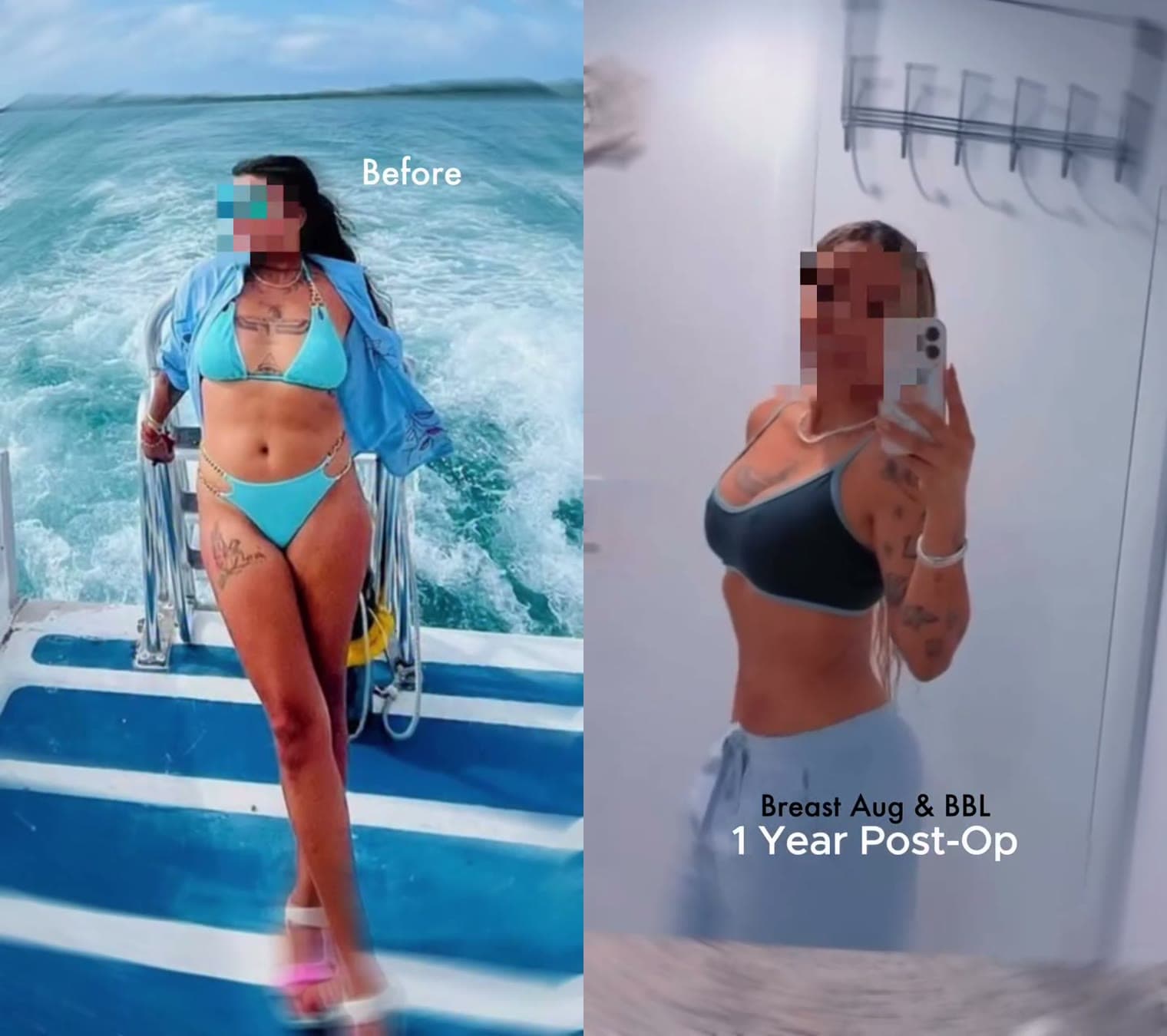
Before and after breast augmentation 
Before and after breast augmentation 
Before and after breast augmentation 
Before and after breast augmentation 
Before and after breast augmentation 
Before and after breast augmentation
Photos in this section are real Alluring patients.
See every breast augmentation photo in the galleryMeet your surgeon

Check her credentials yourself
Each link opens her record on the issuing body's own site.
Licensed as a medical doctor by the Florida Department of Health.
Board certified in general surgery by the American Board of Surgery since 2008.
Fellow of the American College of Surgeons (FACS).
Certified in cosmetic surgery by the American Board of Cosmetic Surgery. The specialty recognition identified herein has been received from a private organization not affiliated with or recognized by the Florida Board of Medicine.
Start here
Personal care. Honest price.
Your price, surgery date and follow-up plan, in writing, before you book a flight.