

What Is J-Plasma Lipo? Renuvion, FDA Status and Cost
J-Plasma lipo is liposuction followed by Renuvion, a helium plasma device that heats the tissue under the skin so it contracts. Here is what the FDA has and hasn't cleared, who it suits, how it compares with a tummy tuck, and what it costs.
Last updated:
What is J-Plasma lipo?
J-Plasma lipo is liposuction followed by Renuvion, a helium plasma device passed under the skin to heat the tissue so it contracts. The FDA cleared this use, coagulating the soft tissue under the skin after liposuction, on April 27, 2023. It suits mild to moderate loose skin, not skin a tummy tuck would remove.
What is J-Plasma lipo?
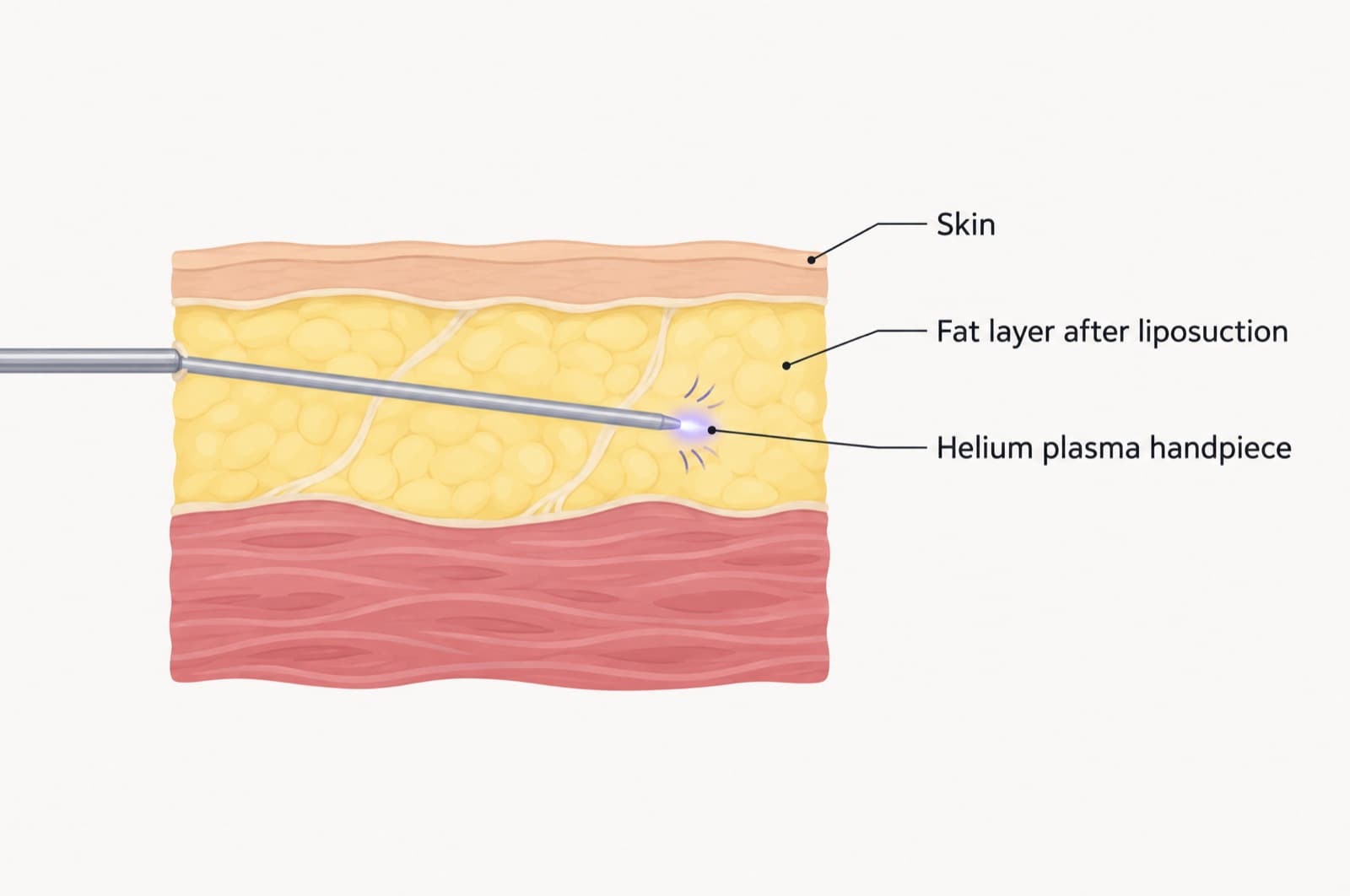
J-Plasma lipo is liposuction followed by a second step: a thin wand is passed under the skin through the liposuction incisions, and it releases helium plasma energy that heats the tissue so it contracts. The aim is to help the skin sit closer to the new, slimmer shape. The device is made by Apyx Medical; J-Plasma is the name of its surgical platform, and Renuvion is the name used for its aesthetic handpieces.
It is not a replacement for liposuction, and it is not a replacement for a tummy tuck. It suits people with a small to moderate amount of loose skin who are already having liposuction.
How does J-Plasma work?
The FDA describes the Renuvion/J-Plasma system as a handpiece and plasma generator that uses radiofrequency (RF) energy and helium to generate plasma, a gas-like substance with high heat. In a J-Plasma lipo procedure, the steps are:
- Liposuction first. The surgeon removes fat through small incisions, as in any liposuction.
- Plasma under the skin. The Renuvion handpiece, a thin tube similar in size to a liposuction cannula, goes in through the same incisions. It releases short bursts of heat into the tissue under the skin, the layer the fat was taken from.
- Contraction. Heat makes the connective tissue in that layer contract, which pulls the skin closer to the muscle beneath it.
- Compression and recovery. The incisions are closed and you wear a compression garment, as after liposuction alone.
Liposuction on its own removes fat without tightening skin, as The Aesthetic Society notes. J-Plasma is meant to address the gap between the two: the fat is gone, and the tissue that holds the skin is tightened in the same operation.
Is J-Plasma FDA approved?
J-Plasma is FDA cleared, not approved, and only for specific uses. A clearance, through what is called a 510(k), means the FDA found the device substantially equivalent to devices already legally on the market for the uses listed. The history matters, because it explains why you may read warnings online:
| Date | What the FDA did |
|---|---|
| March 2022 | Warned against using Renuvion/J-Plasma to tighten skin, alone or with liposuction, or to resurface skin, because no aesthetic skin use had been cleared |
| May 25, 2022 | Cleared the Renuvion Dermal handpiece for moderate to severe wrinkles, limited to Fitzpatrick skin types I, II or III |
| July 15, 2022 | Cleared the Renuvion APR handpiece to improve the appearance of loose skin in the neck and under the chin |
| April 27, 2023 | Cleared the Renuvion APR handpiece for coagulation of the soft tissue under the skin after liposuction, for body contouring |
Sources for the table: the FDA's May 10, 2023 safety communication, the April 2022 MedSun newsletter that carried the March 2022 warning, and the 510(k) clearance letter K230272.
So J-Plasma after liposuction on the body is a cleared use today. The FDA tells providers to "be aware of the current indications" for the handpiece, to "read and carefully follow" its instructions for use and training, to discuss the benefits and risks of all available aesthetic skin procedures with the patient, and to tell the patient which devices they plan to use. That gives you three fair questions for any surgeon: which device and handpiece will you use, is my treatment within its cleared use, and what are my alternatives?
How strong is the evidence?
Limited so far. The 510(k) summary for the April 2023 clearance says it rested on retrospective chart reviews, 1,184 body areas in 483 patients treated after liposuction, compared with published rates for liposuction alone. The same data were published in Aesthetic Surgery Journal Open Forum (online December 2023, in the 2024 volume): a review of six industry-sponsored retrospective studies, funded by Apyx Medical, whose authors list consulting or advisory roles with the company. The authors name the limits themselves: no randomization, no statistical comparison between groups, few before-and-after photos, and no analysis of how well it tightens skin. It found no new safety signal, but it wasn't designed to show how much difference J-Plasma makes to your result.
Who is J-Plasma lipo for?
J-Plasma is an add-on for people already having liposuction whose skin is a little loose. In an ASPS article from 2025, surgeons quoted in a news article from the American Society of Plastic Surgeons (ASPS) describe the patients who do well as those with mild to moderate skin laxity, and say patients with better skin elasticity get better results. One of them says that in general, Renuvion is not a freestanding procedure; it is done alongside something like liposuction.
It may suit you if:
- You are a liposuction candidate. ASPS describes ideal candidates as adults within 30% of their ideal weight, with firm, elastic skin and good muscle tone, who don't smoke or vape.
- Your skin is mildly loose. For example, you worry the skin over your abdomen, arms or bra line may look soft or crepey once the fat underneath is gone.
- You want to avoid a longer scar, and your surgeon agrees your skin is within what tightening can reasonably do.
It is unlikely to be enough if:
- Your skin hangs or folds. An overhanging lower belly, or skin that folds after pregnancy or major weight loss, needs to be removed. ASPS says a tummy tuck removes excess fat and skin and, in most cases, restores weakened or separated muscles.
- Your abdominal muscles are separated. Heat under the skin doesn't repair muscle.
- You are still losing weight. The Aesthetic Society advises waiting until you have lost the weight you plan to lose before liposuction.
Our guide to tummy tuck vs liposuction goes through how to tell which one your skin needs, and the liposuction page covers who is a good candidate for liposuction.
Liposuction alone vs J-Plasma lipo vs a tummy tuck
| Liposuction alone | Liposuction with J-Plasma | Tummy tuck | |
|---|---|---|---|
| What it does | Removes fat | Removes fat, then heats the tissue under the skin so it contracts | Removes loose skin and fat; in most cases tightens the muscles |
| Loose skin | Doesn't tighten skin | Aimed at mild to moderate looseness | Removes it |
| Separated muscles | No | No | Usually repaired |
| Incisions | Small | The same small incisions | A longer incision on the lower abdomen |
| Suits | Firm, elastic skin | Mildly loose skin over the treated area | Hanging or folding skin, and muscle separation |
| Evidence | Long record | Newer; mostly retrospective, industry-funded data | Long record |
What is recovery like after J-Plasma lipo?
Recovery is mostly the recovery from the liposuction itself, and none of the sources we read gives a separate J-Plasma timeline. For liposuction, The Aesthetic Society says swelling peaks around 48 hours, mostly goes down within 2 to 3 weeks and can linger slightly for up to 4 months, and that you wear a compression garment over the treated areas for 4 to 6 weeks. It advises avoiding strenuous exercise for 4 to 6 weeks. Cleveland Clinic says it can take 3 to 6 months for swelling to go away completely before you see the final result.
The Aesthetic Surgery Journal Open Forum review lists the effects the device's instructions for use treat as expected after liposuction with helium plasma. They include:
- Discomfort, swelling, redness and bruising in the treated area.
- Numbness, tingling or touch sensitivity while the nerves recover.
- Itching as the area heals.
- Firmness that moves around under the skin as the tissue settles.
- Crepitus, a crackling feeling under the skin, which is temporary.
- Temporary weight gain from fluid.
For what helps with each stage, see liposuction swelling, week by week and itching after liposuction.
What are the risks of J-Plasma?
The risks include those of liposuction plus those of heat under the skin. When the FDA warned against aesthetic skin uses in March 2022, it said it had received reports of second- and third-degree burns, infection, change in skin color, scars, nerve damage, significant bleeding, and air or gas accumulation under the skin, in body cavities and in blood vessels, with some patients needing intensive care. Those reports came before the aesthetic clearances and from uses the FDA had not cleared, but they show what can go wrong when heat and gas are used under the skin.
In the industry-funded review of 483 patients treated after liposuction, fluid or blood collections under the skin (seroma or hematoma) were recorded in 4.6%, and there was one skin burn or blister. For liposuction itself, a study of an insurance database of cosmetic surgery found major complications, meaning an emergency visit, a hospital stay or another operation within 30 days, after 0.7% of liposuction-only procedures (Kaoutzanis and colleagues, Aesthetic Surgery Journal, 2017). The same study concluded that combining liposuction with other procedures, especially in older patients or patients with obesity, can significantly increase complication rates.
Call your surgeon straight away for a blister, a dark or white patch of skin, a spreading red area, a fever, a swelling that keeps growing, or pain that gets worse instead of better. For shortness of breath or chest pain, call 911. You can read more about liposuction safety on the liposuction page.
How much does J-Plasma cost?
Alluring's price sheet lists J-Plasma as an add-on to another procedure, such as liposuction: $1,000 for the first area and $500 for each additional area. Lipo 360 at Alluring starts at $4,000, so the J-Plasma price comes on top of the liposuction you are having. Ask for your own price at your consultation, and see liposuction and Lipo 360 prices on the liposuction page.
When you compare quotes elsewhere, check that J-Plasma is priced per area, which areas are included, and whether the quote names the device. Ask for every line in writing.
Questions to ask your surgeon about J-Plasma
- Which device and handpiece will you use? The FDA asks providers to tell you.
- Is my treatment within its cleared use? After liposuction on the body, or for loose skin of the neck and under the chin.
- Do I need it at all? Would liposuction alone give me a good result, or would a tummy tuck or arm lift serve me better?
- What result can I realistically expect? Ask to see results in patients with skin like yours.
- What changes in my recovery? Garment, activity limits and follow-up visits.
If you are weighing liposuction with or without skin tightening, a liposuction consultation with Dr. Victoria Karlinsky, MD, FACS, is where your skin is examined and your options, J-Plasma included, are laid out with their prices.
Frequently asked questions
Is J-Plasma the same as Renuvion?
They come from the same company and the same technology. Apyx Medical makes the J-Plasma surgical system, and Renuvion is the name of the handpieces used for aesthetic procedures, including the Renuvion APR handpiece cleared for use after liposuction. The FDA refers to the system as Renuvion/J-Plasma, so many surgeons use the two names for the same procedure.
Can J-Plasma be done without liposuction?
The FDA has cleared the Renuvion APR handpiece on its own for loose skin in the neck and under the chin, and after liposuction for body contouring. On the body, surgeons quoted in an ASPS news article describe it as a procedure done alongside liposuction rather than on its own. Alluring's price sheet lists it as an add-on to another procedure.
Can J-Plasma be used on the neck and chin?
Yes. On July 15, 2022, the FDA cleared the Renuvion APR handpiece to improve the appearance of loose skin in the neck and under the chin. It is sometimes combined with chin liposuction. If you are considering chin liposuction, our guide to chin lipo recovery explains what the weeks after surgery look like.
Does J-Plasma hurt?
It is done under the same anesthesia as the liposuction, so you don't feel it during surgery. Afterward, discomfort, swelling, bruising, numbness and a crackling feeling under the skin are among the expected effects listed in the device's instructions for use. The Aesthetic Society says discomfort after liposuction is generally limited to soreness rather than pain, and your surgeon prescribes pain medicine for the first few days.
When do you see J-Plasma results?
Gradually. The final shape after liposuction takes 3 to 6 months to show, Cleveland Clinic says, as swelling goes away completely, and any tightening is judged at the same time. One surgeon quoted in an ASPS article in 2024 says tissue contraction continues for up to six months, but that is a surgeon's experience rather than a study result.
Is J-Plasma permanent?
The fat removed by liposuction doesn't come back, Cleveland Clinic says. Tightening is different: none of the sources we read gives long-term data on how long the effect lasts, and your skin keeps aging and responds to weight changes. Keeping a stable weight, as ASPS advises for liposuction results, and protecting your skin from the sun both help.
Is J-Plasma the same as a skin tightening treatment at a med spa?
No. J-Plasma after liposuction is done under the skin, during surgery, through the liposuction incisions. Treatments done on the surface of the skin work differently. The FDA's clearance for use on the skin surface is a separate Renuvion Dermal handpiece, for moderate to severe wrinkles in Fitzpatrick skin types I, II or III.
Sources
- FDA: UPDATE: Use of Renuvion/J-Plasma device for certain aesthetic procedures, FDA safety communication (May 10, 2023)
- FDA: MedSun newsletter, April 2022, including "FDA warns against use of Renuvion/J-Plasma device for certain aesthetic procedures"
- FDA: 510(k) K230272, Renuvion APR Handpiece, clearance letter and summary (April 27, 2023)
- Aesthetic Surgery Journal Open Forum: The safety of contraction of subcutaneous tissue following liposuction procedures (Shridharani and colleagues, 2024)
- American Society of Plastic Surgeons: The Renuvion revolution (2025)
- American Society of Plastic Surgeons: Tightening loose skin: An exploration of Renuvion (2024)
- American Society of Plastic Surgeons: Are you a good candidate for liposuction?
- American Society of Plastic Surgeons: Liposuction
- American Society of Plastic Surgeons: Tummy tuck
- The Aesthetic Society: Liposuction
- The Aesthetic Society: Liposuction aftercare and recovery
- Cleveland Clinic: Liposuction
- Aesthetic Surgery Journal: Cosmetic liposuction: preoperative risk factors, major complication rates, and safety of combined procedures (Kaoutzanis and colleagues, 2017)
Not Sure Which Procedure Is Right for You?
Take our free 2-minute quiz to get personalized recommendations based on your goals, lifestyle, and budget.
Take the QuizStart Your Journey Today
Leave your name and phone number. We'll call you within 24 hours to discuss your goals.
Or call us directly
+1 (786) 305-8649Related Articles
Continue reading with these related posts

How to Get Rid of Fibrosis After Lipo, Including at Home
Hard, lumpy areas after liposuction are usually healing tissue that softens with time. Here is what you can safely do at home, how fibrosis differs from a seroma or hematoma, and what the research says about treatment.

Liposuction Swelling Timeline, Week by Week
Liposuction swelling peaks around 48 hours, is mostly down within 2 to 3 weeks and can take 3 to 6 months to clear completely. Here is the week-by-week timeline, how to reduce swelling, what fluid pockets and hard swelling mean, and when to call your surgeon.

How to Fix Uneven Liposuction: When to Wait, What Works
An uneven result after liposuction is upsetting, and it is often too early to judge. Here is how to tell swelling from a lasting irregularity, what causes dents and bulges, and how revision liposuction, fat grafting and other fixes work.

What Is More Painful BBL or Tummy Tuck?
Considering a body contouring procedure but unsure how painful recovery might be? Many patients are surprised to learn that Tummy...
Chin Lipo Recovery Time: How Long Healing Takes
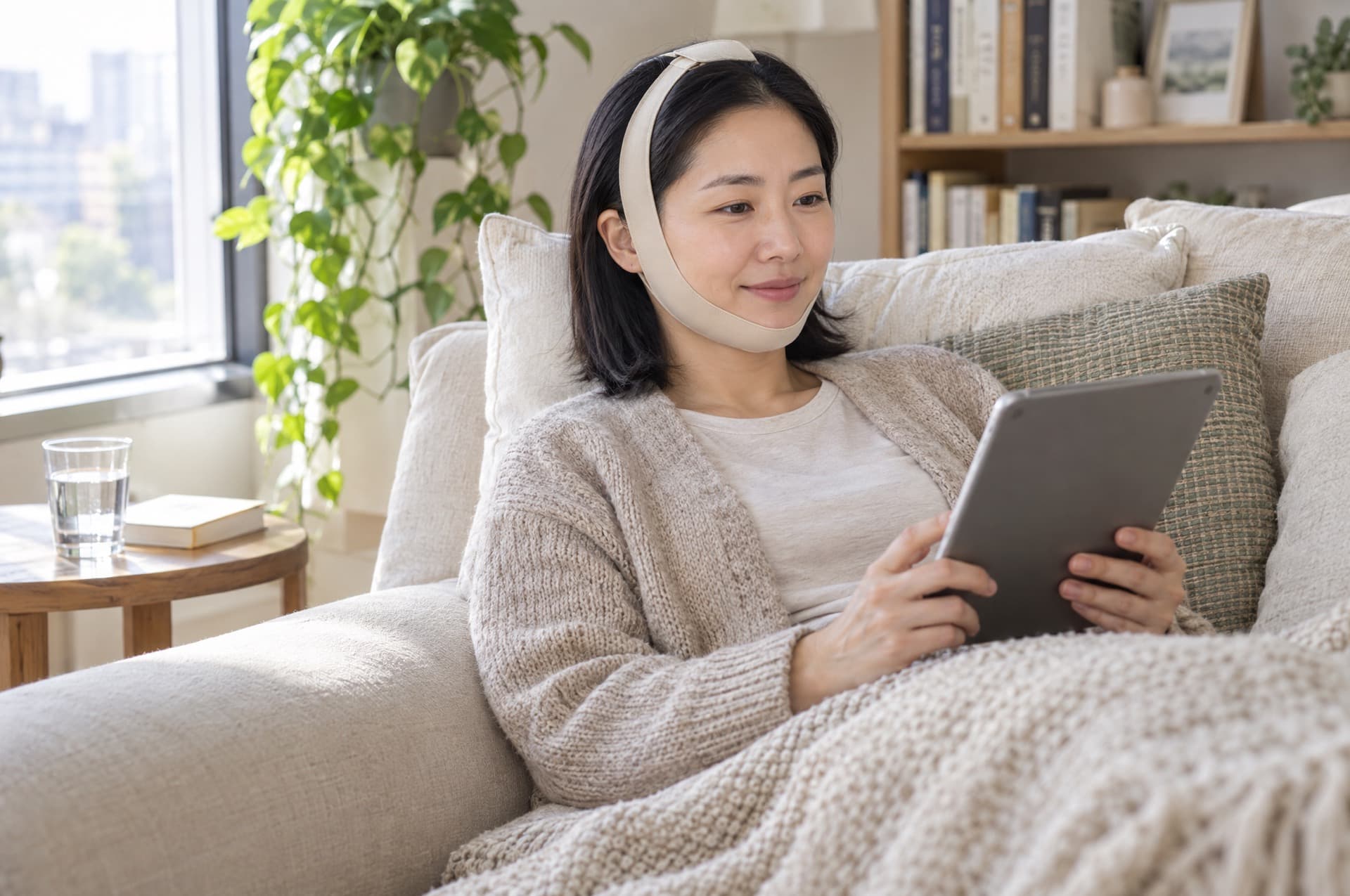
Chin lipo recovery, stage by stage: when swelling peaks and settles, what the chin strap does, how to sleep, numbness, and the signs that mean you should call your surgeon. Plus what chin liposuction costs as an add-on.
How to Fix Dents After BBL?
After undergoing a Brazilian Butt Lift BBL, some patients may notice dents or irregularities in the treatment area—an...
Related Procedures
Explore the procedures discussed in this article

Liposuction Miami
Liposuction in Miami, with Lipo 360 starting at $4,000. Every liposuction at Alluring is performed by Victoria Karlinsky, MD, FACS.

Brazilian Butt Lift (BBL) Miami
BBL in Miami starting at $5,500. Every BBL at Alluring is performed by Victoria Karlinsky, MD, FACS, who places the fat under the skin with ultrasound guidance, as Florida law requires.

Tummy Tuck Miami
Tummy tuck in Miami, from a mini at $3,000 to a full tummy tuck at $4,500. Every tummy tuck at Alluring is performed by Victoria Karlinsky, MD, FACS.
More Liposuction Articles

Liposuction After Ozempic: Are You a Candidate?
Liposuction can remove stubborn fat after GLP-1 weight loss once your weight is stable, but it doesn't tighten loose skin. Here's who is a candidate, when a tummy tuck fits better, and what current anesthesia guidance says about Ozempic, Wegovy and Zepbound.
Do BBLs Stink? What BBL Smell Is and How Long It Lasts
A healed BBL doesn't smell. Odor during recovery usually comes from incision drainage and a sweaty compression garment. Here's what's normal, how long it lasts, how to prevent it and when a smell means infection, checked against ASPS and Cleveland Clinic.
How to Reduce Itching After Lipo?
Itching after liposuction is common as skin and nerves heal. Here is what calms it, how to handle itching under your compression garment, what to ask before using creams or antihistamines, and when an itch or rash means call your surgeon.