

Liposuction Swelling Timeline, Week by Week
Liposuction swelling peaks around 48 hours, is mostly down within 2 to 3 weeks and can take 3 to 6 months to clear completely. Here is the week-by-week timeline, how to reduce swelling, what fluid pockets and hard swelling mean, and when to call your surgeon.
Last updated:
How long does swelling last after liposuction?
Swelling peaks around 48 hours after liposuction and mostly goes down within 2 to 3 weeks, according to The Aesthetic Society, though slight swelling can last up to 4 months. Cleveland Clinic says it can take 3 to 6 months to go away completely and reveal your final result. Your compression garment and daily walks help.
When does liposuction swelling go down?
Liposuction swelling builds over the first two days, peaks around 48 hours, and then eases a little every week. The Aesthetic Society says it mostly goes down within 2 to 3 weeks, with slight swelling for up to 4 months. Cleveland Clinic says it can take 3 to 6 months to go away completely, and that is when your final result shows.
Doctors call this swelling edema. It happens after almost every liposuction, as the tissue reacts to the surgery, so being swollen is not a sign that something went wrong. What matters is the pattern: swelling that slowly gets better is expected, and swelling that suddenly gets worse is a reason to call.
Liposuction swelling timeline, week by week
This is the general pattern. Your surgeon adjusts it to the areas you had treated and how much fat was removed, and their instructions come first.
| When | What's normal | Source |
|---|---|---|
| Days 1–3 | Swelling builds and peaks around 48 hours. Incisions may leak fluid for several days. Walk as soon as you can. | The Aesthetic Society, MedlinePlus |
| Week 1 | You're sore and puffy. Limit your activity, but keep taking short walks. | ASPS |
| Days 7–10 | Bruising typically fades. | The Aesthetic Society |
| Weeks 2–3 | Swelling is mostly down. What's left may feel firm as the fluid is absorbed. | The Aesthetic Society, Dixit and Wagh |
| Weeks 4–6 | You wear the compression garment for 4 to 6 weeks and avoid strenuous exercise for as long. Firm areas start to soften. | The Aesthetic Society, Dixit and Wagh |
| Months 2–4 | Slight swelling can last up to 4 months. | The Aesthetic Society |
| Months 3–6 | Swelling goes away completely and your final result shows. | Cleveland Clinic |
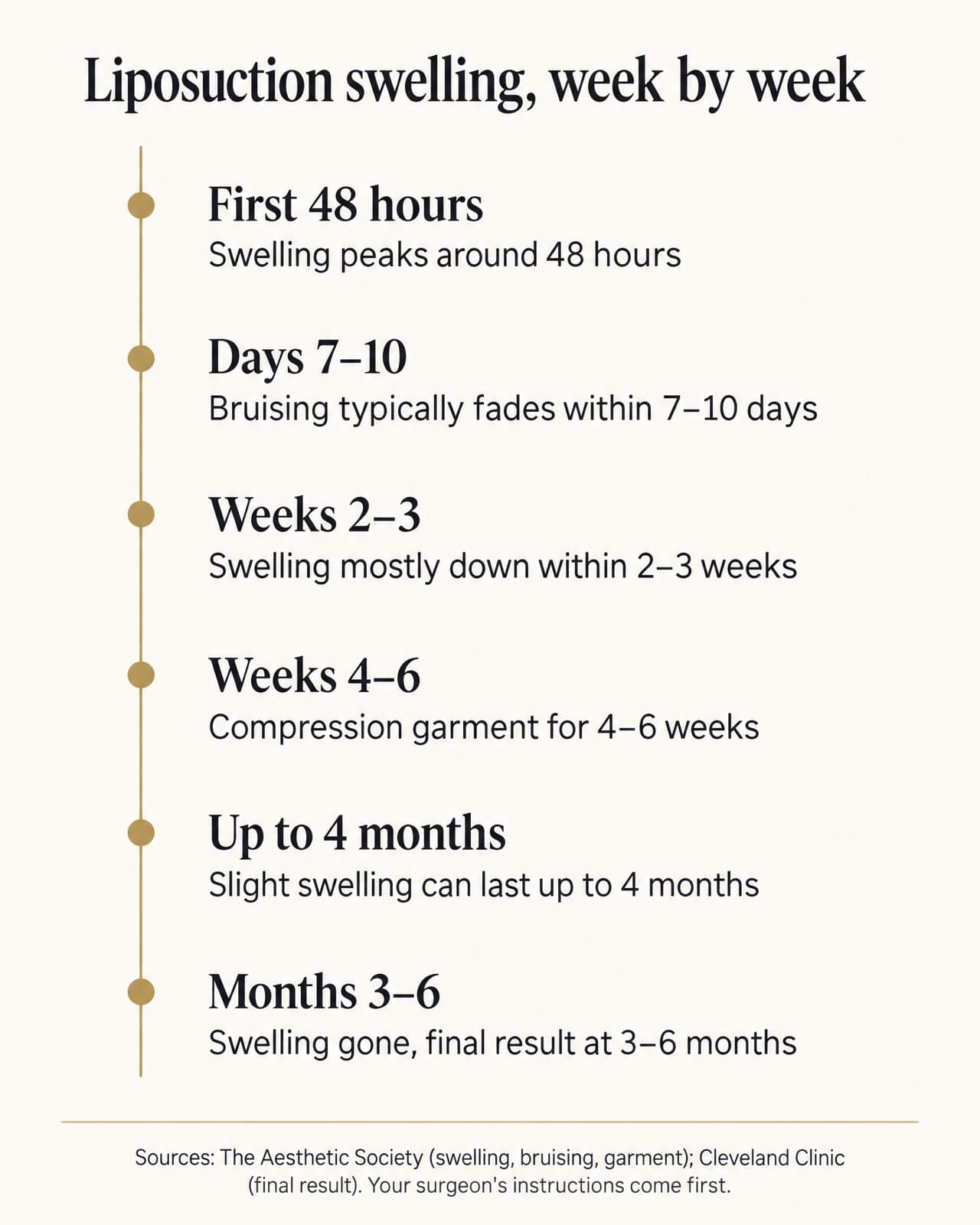
The first week is the hardest. The ASPS recovery timeline says to significantly limit your activity that week, and to expect pain, swelling and bruising. From weeks 2 to 3, most people start to feel much better.
How long is liposuction recovery time?
Most people are back to most of their normal activities within 10 days or less, according to The Aesthetic Society. When you go back to work depends on your job: The Aesthetic Society says most people return within a few days, and ASPS's timeline puts it in weeks 2 to 3. You avoid strenuous exercise for 4 to 6 weeks, and the final result shows at 3 to 6 months (Cleveland Clinic).
So "recovered" means different things at different points. You'll feel like yourself long before your shape has settled. The liposuction recovery section of our procedure page sets out the same milestones, and our guide to when you can work out after liposuction covers exercise week by week.
How to reduce swelling after liposuction
Wear your compression garment as directed, walk every day, and don't rush back into hard workouts. Those three steps have the clearest support. Most other tips are common practice rather than proven, so check them with your surgeon.
- Wear your compression garment. The Aesthetic Society says you wear it over the treated areas for 4 to 6 weeks "to control swelling and promote skin contraction." Keep it on as your surgeon tells you. In a review of liposuction complications in the Indian Journal of Plastic Surgery, the surgeons Dixit and Wagh wrote that a garment that fits poorly, or taking it off and putting it back on again and again, contributes to fluid pockets. Our guide to lipo foam and your compression garment explains the padding some surgeons add underneath.
- Walk early and often. The Aesthetic Society says to walk soon after liposuction "to discourage swelling and prevent blood clots in the legs." MedlinePlus gives the same advice. Short, frequent walks around your home count.
- Hold off on hard workouts. The Aesthetic Society advises avoiding strenuous exercise for 4 to 6 weeks, because it "can trigger unnecessary fluid retention in the treated areas." If swelling comes back after a busy day, take it as a sign to slow down.
- Ask before using ice or heat. MedlinePlus says you may feel numbness or tingling for weeks after liposuction. Numb skin can't warn you when a pack is too cold or too hot, so use them only if your surgeon says so, and wrap them.
- Ask about lymphatic massage. Surgeons commonly recommend it. Dixit and Wagh write that, in their experience, gentle liposuction, a well-fitting garment and early lymphatic drainage massage together help swelling clear faster. That is expert experience, not a trial: no study has compared massage schedules, or massage with no massage, and there is no standard number of sessions or start date. Follow the schedule your surgeon gives you. Our lymphatic massage guide covers what the evidence says.
Why does swelling after liposuction feel hard?
Early swelling is soft and puffy. As your body absorbs the leftover fluid, it often turns firm, even "woody," for a few weeks, then softens again. This is a normal stage, not a sign that the fat came back.
Dixit and Wagh describe the pattern in their patients: the swelling turns firm to woody by the end of 2 to 3 weeks, parts start to soften in patches by the end of 4 weeks, the whole area softens by the end of 6 to 8 weeks, and the tissue usually feels normal again by 3 months, depending on how much was treated.
They also describe a rarer problem: hard, "brawny" swelling with unusual pain that lasts beyond 6 weeks. It takes longer to settle and can lead to scar tissue (fibrosis) and an uneven surface, so tell your surgeon if that sounds like you. Our guide to hard lumps and fibrosis after lipo covers what helps.
| What you feel | What it usually is | What to do |
|---|---|---|
| Soft, even puffiness in the first weeks | Normal swelling | Garment, walking, time |
| Firm or woody areas around weeks 2–3 | Normal firming as fluid is absorbed | Mention it at your follow-up |
| A soft, squishy bump filled with fluid | Possibly a seroma | Call your surgeon |
| Hard, painful swelling beyond 6 weeks | Possibly brawny edema or fibrosis | See your surgeon |
How to get rid of fluid pockets after liposuction
A fluid pocket that stays is usually a seroma, and it isn't something to treat at home. Small ones are often absorbed by your body. A larger or uncomfortable one is drained by your surgeon with a small needle, sometimes more than once.
Cleveland Clinic defines a seroma as "a pocket of fluid that builds up under your skin, most often after surgery." Signs include:
- a soft, squishy bump filled with fluid near the surgery site
- pain or soreness
- trouble moving the area
- a feeling of pulling or strain on your stitches or wound
Cleveland Clinic says symptoms usually appear 7 to 10 days after surgery. Small seromas may shrink in a little over a week, and larger ones may take up to 6 weeks to heal fully.
How common are they after liposuction? It depends on the surgery. Dixit and Wagh saw localized seromas in 3.5% of their cases, most often in the outer and back thighs and the lower abdomen. In a prospective series of 551 patients published in Plastic and Reconstructive Surgery Global Open, there were no seromas after liposuction alone, compared with 5.4% after tummy tucks (Swanson, 2013).
Not every leak is a problem. The Aesthetic Society says incisions may be leaky or drain fluid for several days, and Cleveland Clinic notes that some patients have a temporary drain. If you go home with drains, ASPS says you may be asked to record how much fluid collects. Call your surgeon about a seroma that is getting bigger, causing discomfort, not improving after several weeks, or showing signs of infection such as discoloration, severe pain or fever (Cleveland Clinic).
Swelling after Lipo 360
Lipo 360 usually treats the abdomen, flanks and back, so your waist is shaped from every side (see what areas Lipo 360 covers). So the swelling wraps your whole midsection, and your garment covers all of it.
Fluid also moves downhill. Dixit and Wagh describe fluid that can gravitate to the labia after abdominal, especially pubic, liposuction. It looks more frightening than it is, and in their experience it usually settles over 10 days to 2 weeks. Tell your surgeon if you see it, so they can check it.
Some puffiness in the feet and ankles can happen too, especially after a long car ride or flight home: MedlinePlus notes that long trips and standing for long periods often cause some swelling there. Swelling in only one leg is different: see the table below.
If you had a BBL with your Lipo 360, your sitting rules and timeline differ. Our BBL recovery timeline covers the combined surgery.
If you are recovering in Miami before flying home
If you traveled to Miami for surgery, your surgeon tells you how many nights to stay before you fly home. MedlinePlus lists recent surgery and sitting in one position for too long, such as plane or car travel, as risk factors for blood clots in the legs. Ask your surgeon how to move during the trip, and keep walking once you're home.
When swelling means call your surgeon
Call if swelling suddenly gets worse instead of slowly better, if one leg swells, or if you have a fever or pain that won't settle. Call 911 for shortness of breath or chest pain.
| Usually normal | Call your surgeon |
|---|---|
| Swelling that peaks around 48 hours, then eases | Swelling that suddenly gets worse or keeps growing |
| Some fluid leaking from incisions for several days | Blood, or drainage that is thick, cloudy or smells bad |
| Soreness most people describe as "burning" for a couple of days | Severe or long-lasting pain |
| Firm areas around weeks 2–3 | A fluid-filled bump that grows, or a fever |
| Mild puffiness in both legs | New swelling in only one leg, or a leg that is red or warm |
Cleveland Clinic lists long-lasting or severe pain, swelling, fluid or blood leaking from the surgical site, fever, and shortness of breath or chest pain as reasons to contact your provider after liposuction. MedlinePlus lists pus, a bad smell, redness and warmth as signs of a wound infection, and says new swelling in only one leg, or a leg that is red or warm, needs a prompt call. Shortness of breath or chest pain can mean a blood clot has reached the lungs: MedlinePlus says to call 911.
If you're planning liposuction or Lipo 360 at Alluring, Dr. Victoria Karlinsky, MD, FACS, can talk you through your garment, activity and follow-up plan at your consultation, and your surgery, pre-op and follow-up dates are confirmed in writing. You can read about liposuction and Lipo 360 in Miami or book a free consultation.
Frequently asked questions
Why does swelling happen after liposuction?
Swelling is your body's normal response to the surgery. Dixit and Wagh describe it as expected after almost every liposuction, similar to the inflammation that follows any injury, as the tissue reacts to the cannula. Cleveland Clinic says you'll likely have some swelling and fluid retention after surgery, and that your new shape shows as they decrease. So don't judge your result in the first weeks.
What foods help reduce swelling after liposuction?
No food has been shown to speed up liposuction swelling. MedlinePlus lists a low-salt diet among home steps for leg and ankle swelling, so going easy on salty food is a reasonable choice, but it won't replace your garment and daily walks. Our guide to what to eat after liposuction covers protein, fluids and foods to avoid.
Is water retention after liposuction normal?
Yes, in the first weeks. Cleveland Clinic says you'll likely have some swelling and fluid retention after surgery, and that your new shape shows as they decrease. The Aesthetic Society warns that strenuous exercise in the first 4 to 6 weeks can trigger unnecessary fluid retention in the treated areas, so swelling that returns after a busy day usually means you need to slow down, not that something is wrong.
Can my compression garment be too tight?
It should feel snug, not painful. Dixit and Wagh list excessive pressure from compression garments as one cause of darkened skin after liposuction, and write that an ill-fitting garment can lead to surface irregularities. If your garment digs in, leaves deep marks, or causes new pain or color changes, call your surgeon before changing sizes or loosening it.
Is it normal to still be swollen 6 months after liposuction?
Some people are. The Aesthetic Society says slight swelling can last up to 4 months, and Cleveland Clinic says it can take 3 to 6 months for swelling to go away completely. If you still have noticeable swelling past 6 months, or one area stays hard or lumpy, ask your surgeon to check it at a follow-up visit.
Does lymphatic massage help liposuction swelling?
Surgeons commonly recommend it, but it hasn't been tested head to head. Dixit and Wagh write that, in their experience, gentle liposuction, a well-fitting garment and early massage together help swelling clear faster. No study has compared massage schedules, or massage with none, and there is no standard number of sessions. Follow the schedule your surgeon gives you, and see our lymphatic massage guide for what the evidence says.
Does bruising follow the same timeline as swelling?
Bruising usually clears faster. The Aesthetic Society says it typically fades within 7 to 10 days, while swelling takes 2 to 3 weeks to mostly go down. A bruise with a lump or painful swelling under it is a different matter. Our guide to bruising after liposuction explains how to tell a bruise from a hematoma.
Sources
- The Aesthetic Society: Liposuction aftercare and recovery
- Cleveland Clinic: Liposuction
- Cleveland Clinic: Seroma
- American Society of Plastic Surgeons: What should I expect during my liposuction recovery?
- MedlinePlus: Liposuction
- MedlinePlus: Foot, leg, and ankle swelling
- MedlinePlus: Deep vein thrombosis
- MedlinePlus: Pulmonary embolus
- MedlinePlus: Surgical wound infection, treatment
- Indian Journal of Plastic Surgery: Unfavourable outcomes of liposuction and their management (Dixit and Wagh, 2013)
- Plastic and Reconstructive Surgery Global Open: Prospective clinical study of 551 cases of liposuction and abdominoplasty (Swanson, 2013)
Not Sure Which Procedure Is Right for You?
Take our free 2-minute quiz to get personalized recommendations based on your goals, lifestyle, and budget.
Take the QuizStart Your Journey Today
Leave your name and phone number. We'll call you within 24 hours to discuss your goals.
Or call us directly
+1 (786) 305-8649Related Articles
Continue reading with these related posts

How to Get Rid of Fibrosis After Lipo, Including at Home
Hard, lumpy areas after liposuction are usually healing tissue that softens with time. Here is what you can safely do at home, how fibrosis differs from a seroma or hematoma, and what the research says about treatment.

How to Fix Uneven Liposuction: When to Wait, What Works
An uneven result after liposuction is upsetting, and it is often too early to judge. Here is how to tell swelling from a lasting irregularity, what causes dents and bulges, and how revision liposuction, fat grafting and other fixes work.
How to Fix Dents After BBL?
After undergoing a Brazilian Butt Lift BBL, some patients may notice dents or irregularities in the treatment area—an...

What Is J-Plasma Lipo? Renuvion, FDA Status and Cost
J-Plasma lipo is liposuction followed by Renuvion, a helium plasma device that heats the tissue under the skin so it contracts. Here is what the FDA has and hasn't cleared, who it suits, how it compares with a tummy tuck, and what it costs.
How to Regain Sensation After Breast Reduction?
Feeling concerned about sensation changes after your procedure is completely normal. We'll guide you through proven methods to restore sensation after Breast...
What Is More Painful BBL or Tummy Tuck?
Considering a body contouring procedure but unsure how painful recovery might be? Many patients are surprised to learn that Tummy...
Related Procedures
Explore the procedures discussed in this article

Liposuction Miami
Liposuction in Miami, with Lipo 360 starting at $4,000. Every liposuction at Alluring is performed by Victoria Karlinsky, MD, FACS.

Brazilian Butt Lift (BBL) Miami
BBL in Miami starting at $5,500. Every BBL at Alluring is performed by Victoria Karlinsky, MD, FACS, who places the fat under the skin with ultrasound guidance, as Florida law requires.
Tummy Tuck Miami
Tummy tuck in Miami, from a mini at $3,000 to a full tummy tuck at $4,500. Every tummy tuck at Alluring is performed by Victoria Karlinsky, MD, FACS.
More Liposuction Articles

Liposuction After Ozempic: Are You a Candidate?
Liposuction can remove stubborn fat after GLP-1 weight loss once your weight is stable, but it doesn't tighten loose skin. Here's who is a candidate, when a tummy tuck fits better, and what current anesthesia guidance says about Ozempic, Wegovy and Zepbound.
Do BBLs Stink? What BBL Smell Is and How Long It Lasts
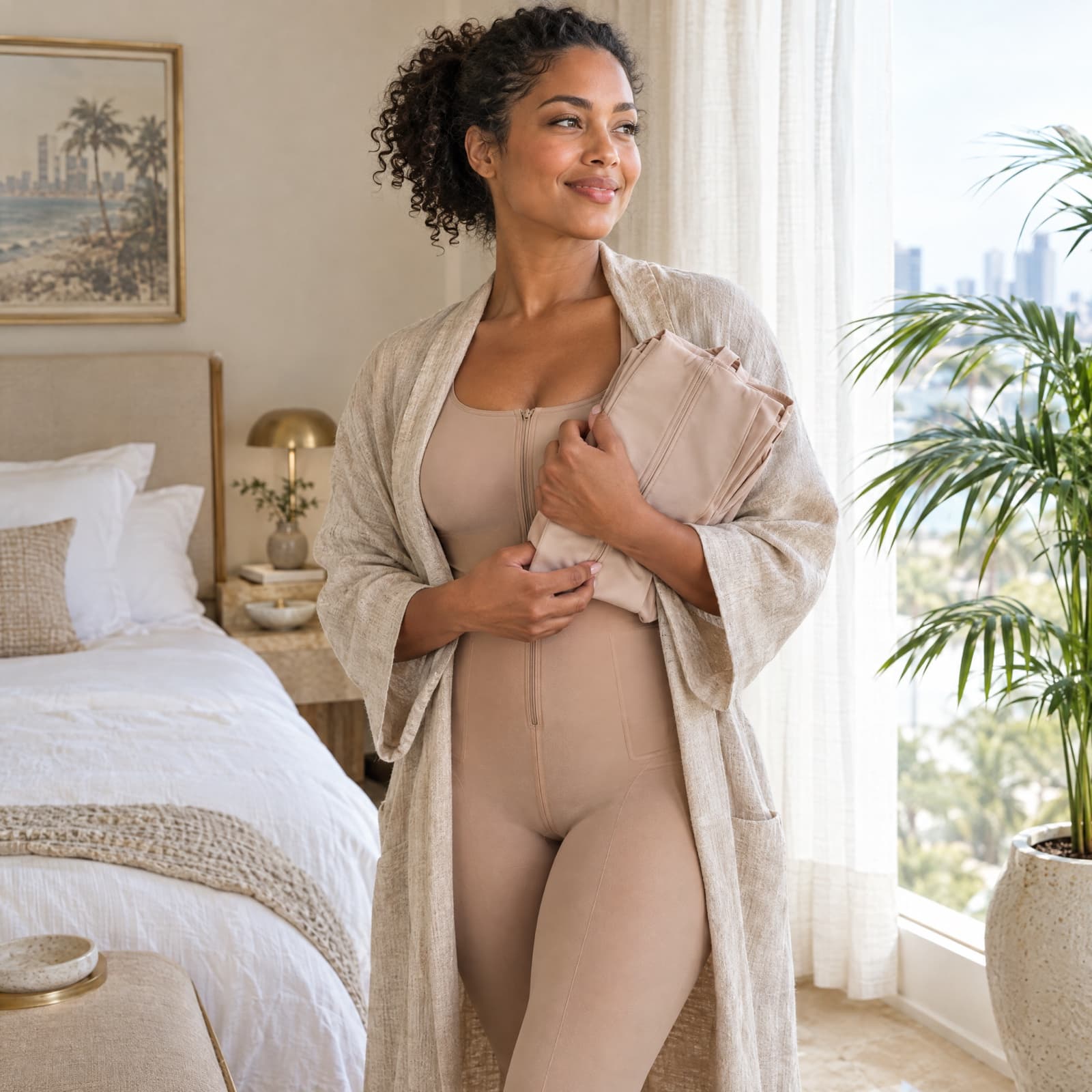
A healed BBL doesn't smell. Odor during recovery usually comes from incision drainage and a sweaty compression garment. Here's what's normal, how long it lasts, how to prevent it and when a smell means infection, checked against ASPS and Cleveland Clinic.
How to Reduce Itching After Lipo?
Itching after liposuction is common as skin and nerves heal. Here is what calms it, how to handle itching under your compression garment, what to ask before using creams or antihistamines, and when an itch or rash means call your surgeon.